


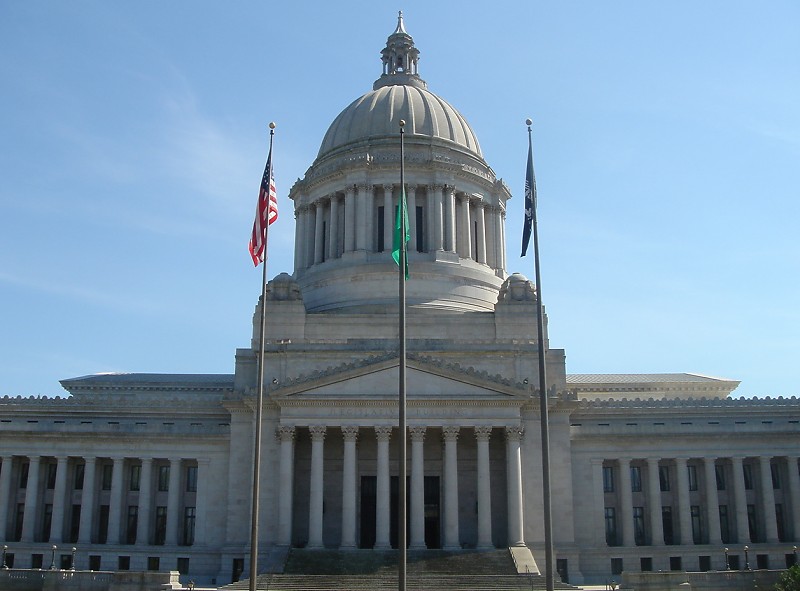
Washington Gov. Bob Ferguson (D) signed Senate Bill 6346 (SB 6346) on March 30, 2026, which imposes a 9.9% tax on household income above $1 million beginning in 2028.
The legislation follows decades of ballot measures regarding personal income taxes in Washington. Voters have decided on eight ballot measures related to a personal income tax, approving one and rejecting seven.
In 2024, the legislature approved an indirect initiated state statute, Initiative 2111, which prohibited the state and local governments from enacting a personal income tax. SB 6346 amended this language to provide an exception for the tax on household income above $1 million. Let's Go Washington sponsored the initiative.
Opponents of SB 6346 cannot file a veto referendum against the bill. In Washington, legislation enacted for the “support of the state government and its existing public institutions” is exempt from the referendum power. The bill includes language stating, “The tax imposed in this act is necessary for the support of the state government and its existing public institutions.”
However, a citizen-initiated state statue could be filed, with signatures due on July 2. Regarding an initiative, Brian Heywood, founder of Let’s Go Washington, said, "It’s crazy to wait." Jim Walsh, chair of the state Republican Party, said, "... the issue is on people’s minds now. We should strike while the iron is hot." An indirect initiative could also be filed for 2027. Sandeep Kaushik, a partner at Sound View Strategies who worked on the opposition campaign to Let’s Go Washington’s 2024 initiatives, said, "If I was them, I wouldn’t be running an initiative," citing his expectation that the political environment will favor Democrats in 2026.
History of income tax ballot measures in Washington
The one income tax ballot measure that was approved, Initiative 69 of 1932, an initiated state statute establishing a graduated income tax ranging from 1.0% to 7.0%. Initiative 69 received 70% of the vote. On September 8, 1933, the Washington Supreme Court, in Culliton v. Chase, ruled that Initiative 69 violated the state constitution's clause that "all taxes shall be uniform upon the same class of property..." The court held that income is property under the state constitution, and because the constitution requires taxes on the same class of property to be uniform, an income tax could not have graduated rates.
The legislature proposed several constitutional amendments to address the court's ruling. In 1936, voters rejected SJR 7, which would have amended the uniform taxation clause to allow for a graduated income tax. In 1938, voters rejected SJR 5, which would also have allowed a graduated income tax. In 1942, voters rejected HJR 4. After HJR 4, the legislature did not propose amending the constitution to allow for an income tax until 1970, when voters rejected HJR 42. HJR 42 would have reduced the maximum property tax rate to 1% and allowed for a single-rate income tax, also known as a flat income tax. The legislature last proposed a change in 1973, when voters rejected HJR 37, which would have placed limits on school district taxes and authorized a graduated income tax.
Voters have also rejected two initiated state statutes after Initiative 69 of 1932. In 1944, 70% of voters rejected an initiative to establish a flat 3% income tax to fund monthly payments to the elderly, blind, disabled, and widowed. In 2010, 64% of voters rejected Initiative 1098, which would have established a tax on adjusted gross income above $200,000 for individuals and $400,000 for married couples.
Opponents of SB 6346 have cited the court's ruling against Initiative 69. Former Attorney General Rob McKenna (R) said, "Washington’s constitution is clear, and the courts have been equally clear for nearly a century — income is property, and progressive income taxes are unconstitutional under existing law."
Supporting SB 6346, state House Majority Leader Joe Fitzgibbon (D-34), stated that "[Culliton] was a single Supreme Court case from before anybody in this room was alive, on a five-to-four decision that said income was property," and that "no other state in the union, nor the federal government" has shared that opinion.
Recent ballot measures to tax income of $1 million or more
Voters have decided on three ballot measures to enact a tax on income above $1 million since 2000.
- In 2004, voters in California approved Proposition 63, with 54% of the vote. Proposition 63 enacted a 1% tax on income above $1 million and dedicated the tax revenue to mental health services and programs.
- In 2022, voters in California rejected Proposition 30, with 58% voting against the initiative. Proposition 30 would have enacted a 1.75% tax on income above $2 million and dedicated tax revenue to zero-emission vehicle subsidies, zero-emission vehicle infrastructure, such as electric vehicle charging stations, and wildfire suppression and prevention programs.
- In 2022, voters in Massachusetts approved Question 1, with 52% of the vote. Question 1 levied a 4% tax on income above $1 million and dedicated revenue to education and transportation purposes.
Additional reading: