


Welcome to the March 30 edition of Robe & Gavel, Ballotpedia’s newsletter about the Supreme Court of the United States (SCOTUS) and other judicial happenings around the U.S.
"All sorts of things can happen when you're open to new ideas and playing around with things."
- Stephanie Kwolek
Inventor of Kevlar®, a high-strength, heat-resistant fiber used in items such as bullet-resistant vests, tires, and aircraft parts
Did you miss us, dear reader? Half a fortnight has passed since you’ve seen us last. It’s been too long. In the world of federal courts, a lot can happen in a week. And indeed, much has transpired. So without further ado, let’s gavel in!
Follow Ballotpedia on X and Bluesky or subscribe to the Daily Brew for the latest news and analysis.
We #SCOTUS and you can, too!
Grants
SCOTUS has accepted one new case to its merits docket since our March 23 issue. To date, the Court has agreed to hear 59 cases for argument for the 2025-2026 term and five cases for the 2026-2027 term.
Click the link below to learn more about this case:
- Younge v. Fulton Judicial Circuit District Attorney’s Office, Georgia originated from the U.S. Court of Appeals for the Eleventh Circuit and concerns affirmative defense.
Arguments
The Supreme Court will hear four arguments this week. Click here to read more about SCOTUS' current term.
Click the links below to learn more about these cases:
March 30
- Abouammo v. United States concerns whether federal prosecutors can try a defendant in the judicial district where the crime’s contemplated effects are felt.
- The question presented: “Whether venue is proper in a district where no offense conduct took place, so long as the statute's intent element ‘contemplates’ effects that could occur there.”
- Jules v. Andre Balazs Properties concerns arbitration awards.
- The question presented: “Whether a federal court that initially exercises jurisdiction and stays a case pending arbitration maintains jurisdiction over a post-arbitration Section 9 or 10 application where jurisdiction would otherwise be lacking.”
March 31
- Pitchford v. Cain concerns the Antiterrorism and Effective Death Penalty Act of 1996 and 28 U.S.C. § 2254(d).
- The question presented: “Whether, under the standards set forth in AEDPA, 28 U. S. C. §2254(d), the Mississippi Supreme Court unreasonably determined that petitioner waived his right to rebut the prosecutor's asserted race-neutral reasons for exercising peremptory strikes against four black jurors.”
April 1
- Trump v. Barbara concerns birthright citizenship in the U.S.
- The question presented: “...whether the Executive Order complies on its face with the Citizenship Clause and with 8 U.S.C. 1401(a), which codifies that Clause.”
In its October 2024 term, SCOTUS heard arguments in 65 cases. Click here to read more about SCOTUS's previous term.
Opinions
SCOTUS has ruled on two cases since our March 23 edition. The court has issued rulings in 23 cases so far this term. At this point in the 2024-2025 term, SCOTUS had issued rulings in 21 cases.
Click the links below to read more about the specific cases SCOTUS ruled on since March 23:
March 25
Rico v. United States was argued before the court on Nov. 3, 2025.
The case concerns 18 U.S. Code § 3583(i).
The outcome: In an 8-1 opinion, SCOTUS reversed and remanded the decision of the U.S. Court of Appeals for the Ninth Circuit. The Court held that the Sentencing Reform Act does not authorize a rule that automatically extends a defendant’s term of supervised release when the defendant does not report to their probation officer.
Cox Communications, Inc. v. Sony Music Entertainment was argued before the court on Dec. 1, 2025.
The case concerns a business's liability for copyright infringement.
The outcome: In a unanimous opinion, the Court reversed and remanded the decision of the U.S. Court of Appeals for the Fourth Circuit. The Court held that because Cox neither prompted its users to perform copyright infringement nor provided a service tailored to infringement, Cox is not contributorily liable for the infringement of Sony’s copyrights.
Federal court action
Nominations
President Donald Trump (R) has not announced any new Article III nominees since our March 23 edition.
Committee action
The Senate Judiciary Committee has not reported any new nominees out of committee since our March 23 edition.
Confirmations
The Senate has not confirmed any nominees since our March 23 issue.
Vacancies
The federal judiciary currently has 36 vacancies, 35 of which are for lifetime Article III judgeships. As of publication, there were 11 pending nominations.
According to the Administrative Office of U.S. Courts, there were 10 upcoming vacancies in the federal judiciary, where judges have announced their intention to leave active judicial status.
For more information on judicial vacancies during President Trump’s term, click here.
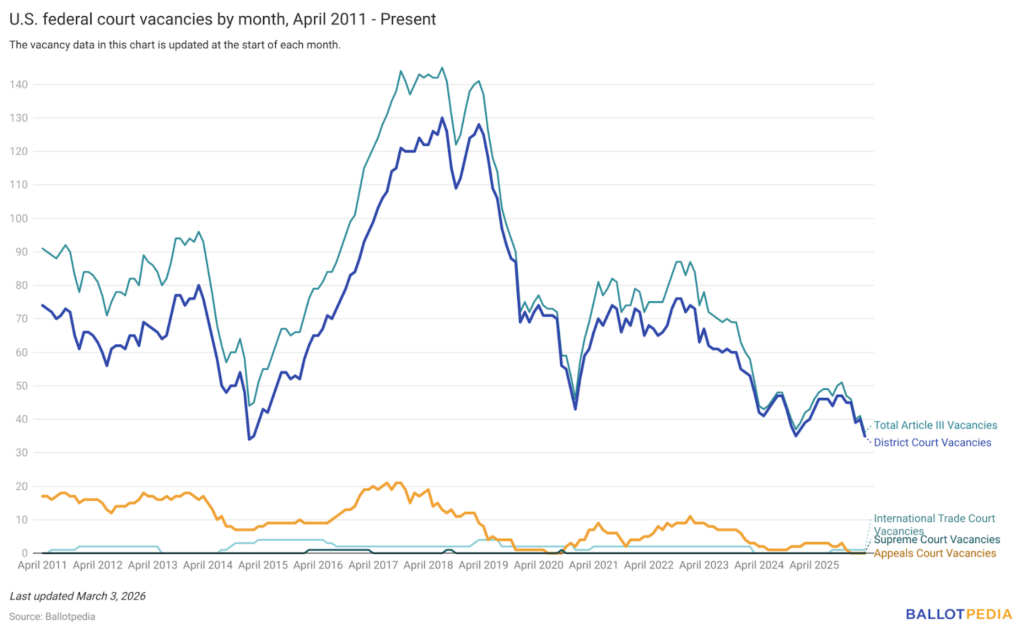
Do you love judicial nomination, confirmation, and vacancy information? We figured you might. Our monthly Federal Vacancy Count monitors all the faces and places moving in, moving out, and moving on in the federal judiciary. Click here for our most current count.
Need a daily fix of judicial nomination, confirmation, and vacancy information? Click here for continuing updates on the status of all federal judicial nominees.
Or, keep an eye on our list for updates on federal judicial nominations.
Looking ahead
We’ll be back on April 13 with a new edition of Robe & Gavel. Until then, gaveling out!
Contributions
Myj Saintyl compiled and edited this newsletter, with contributions from Sam Post and Ellie Mikus.