


This year’s filing deadline for candidates running for the U.S. House of Representatives in Nevada was March 13, 2026.
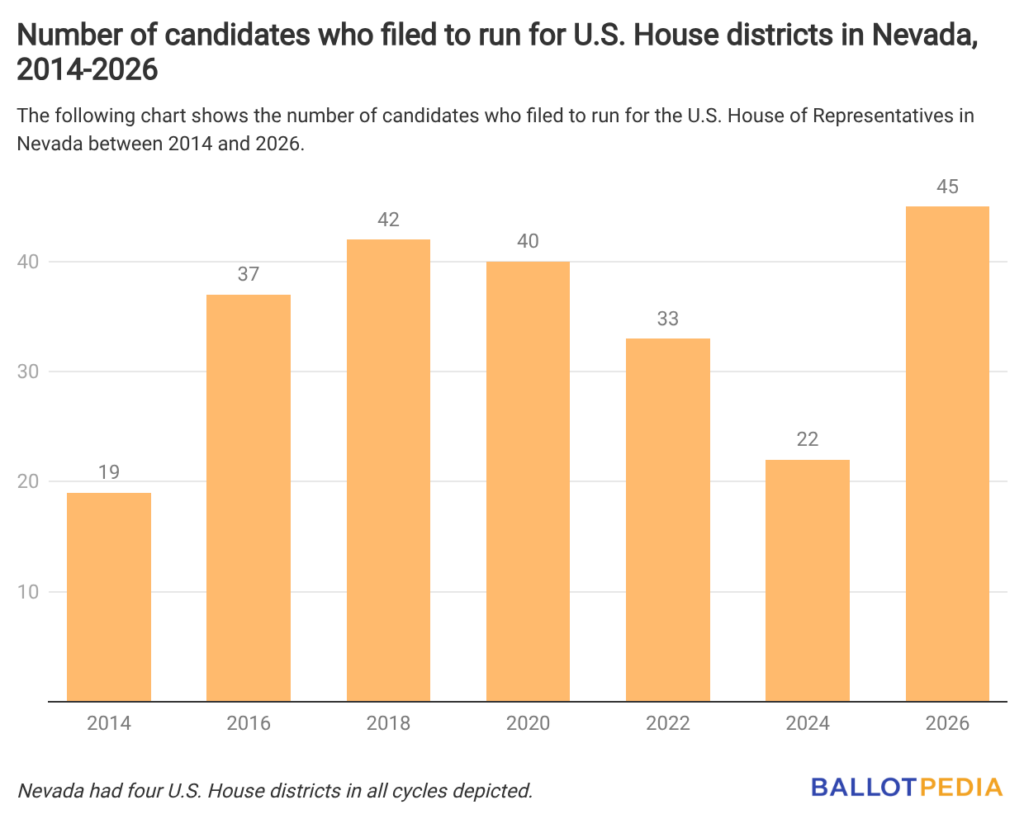
Forty-five candidates — 20 Democrats and 25 Republicans — are running for Nevada’s four U.S. House districts. That’s the highest total number of candidates to run for the U.S. House since 2014. Twenty-two candidates ran in 2024, 33 ran in 2022, 40 ran in 2020, 42 ran in 2018, 37 ran in 2016, and 19 ran in 2014.
This year, there are 11.3 candidates per district. There were 5.5 candidates in 2024, 8.3 in 2022, 10 in 2020, 10.5 in 2018, 9.3 in 2016, and 4.8 in 2014.
Here are some other highlights from this year’s filings:
- Nevada’s 2nd Congressional District is the only open district this year. The district’s incumbent, Rep. Mark Amodei (R), is retiring from public office. Two districts were open in 2018, and one was in 2016 — those were the only other election cycles since 2014 in which districts were open.
- Twenty-four candidates — 11 Democrats and 13 Republicans — are running for Nevada’s 2nd Congressional District. That’s the most candidates running for a district this year.
- Seven primaries — three Democratic and four Republican — are contested this year. There were six contested primaries in 2024, seven in 2022, eight in 2020, eight in 2018, seven in 2016, and six in 2014.
- Two incumbents — Rep. Dina Titus (D) in Nevada’s 1st Congressional District and Rep. Susie Lee (D) in Nevada’s 3rd Congressional District — are facing primary challengers this year. Three incumbents faced primary challengers in 2024, three in 2022, four in 2020, two in 2018, two in 2016, and two in 2014.
- Candidates filed to run in the Republican and Democratic primaries in all four districts, meaning no districts are guaranteed to either party.
Nevada and three other states — Maine, North Dakota, and South Carolina — are holding U.S. House primaries on June 9, 2026.
In Nevada, the winner of the primary election is the candidate who receives the greatest number of votes, even if they do not win more than 50% of the vote.