


Welcome to the Wednesday, April 15, Brew.
By: Briana Ryan
Here’s what’s in store for you as you start your day:
- Alabama voters to decide two constitutional amendments related to the pledge of allegiance and school prayer
- A roundup of recent election administration legislative activity
- Mikie Sherrill to become first New Jersey governor in 20 years to live in the state's official governor's residence
Alabama voters to decide two constitutional amendments related to the pledge of allegiance and school prayer
Alabama voters will decide on two constitutional amendments related to the pledge of allegiance and student-led school prayer on Nov. 3.
In Alabama, constitutional amendments require a 60% majority vote in both chambers. Currently, Republicans have a Republican trifecta, in which the party controls the governorship and both legislative chambers.
The first amendment, House Bill 511 (HB 511), would require each local board of education to adopt a policy for every public K-12 school to conduct the pledge of allegiance to the United States flag. State Rep. Reed Ingram (R-75) introduced HB 511 on Feb. 25. It is an updated version of House Bill 43 which Ingram also introduced. HB 511 passed the House 94-3 on March 10, and passed the Senate 30-0 on April 8. Three Democrats voted against it in the amendment.
HB 511 would also require each local board of education to allow for student-led prayer. According to the amendment, a student must initiate and lead the prayer, and no student would be required to participate. The amendment also says that any policies local boards of education adopt should allow students to opt out of the pledge of allegiance or prayer.
Current Alabama law requires public K-12 schools to conduct the pledge of allegiance at the start of each school day, while allowing students to opt-out. Alabama law also includes a provision allowing teachers or students to lead a prayer specified in the statute (§ 16-1-20.2) at the beginning of any homeroom or any class. However, this was struck down in the U.S. Supreme Court case Wallace v. Jaffree in 1985, the Court ruling that the law violated the First Amendment's Establishment Clause.
Current Alabama law requires public K-12 schools to conduct the pledge of allegiance at the start of each school day, while allowing students to opt-out.
Alabama law (Section 16-1-20.2) addressed teacher-led prayer and was struck down by the U.S. Supreme Court in Wallace v. Jaffree (1985) as a violation of the First Amendment. A separate provision, Section 16-1-20.3, addresses student religious expression and allows student-initiated prayer. This provision has not been struck down and remains in effect.
The amendment differs from current law in that it would explicitly require school boards to adopt policies allowing student-led prayer at the beginning of the school day, whereas existing statute generally provides that students may engage in voluntary prayer at school.
The second amendment, Senate Bill 5 (SB 5), would require all public schools to broadcast or arrange for the performance of the first stanza of the Star-Spangled Banner at least once per week. State Sen. Gerald Allen (R-21) introduced SB 5 was introduced on Feb. 5. It passed the Senate 23-5 on March 3, 2026 — 23 Republicans voted for the amendment, while five Democrats opposed it. The amendment then passed the House 75-27 on April 9, with 74 Republicans and one Democrat voting in favor while 27 Democrats opposed.
In 2022, following the release of the U.S. Census, Alabama had 743,012 students enrolled in a total of 1,479 schools in 138 school districts.
Both measures join three other constitutional amendments on the Nov. 3 Alabama ballot. Alabama voters will also decide on two constitutional amendments on May 19.
Click here for more information about all the constitutional amendments that Alabama voters will decide this year.
A roundup of recent election administration legislative activity
State legislators have introduced 4,357 bills on election policy and administration this year, more than the 4,234 at this point last year. With 30 state legislatures currently in session, lawmakers enacted 26 bills in the past week, 29 bills passed both chambers of a state legislature, and governors vetoed six bills.
So far, 61% (99) of all enacted bills have been in states with Republican trifectas, while 30% (49) have been in states with Democratic trifectas and 9% (14) have been in states with divided governments.
In the past week, there was more legislative action in Democratic trifectas. Of the bills acted on last week, 50% (144) were in states with Democratic trifectas, 40% (115) were in states with Republican trifectas, and 10% (30) were in states with divided governments.
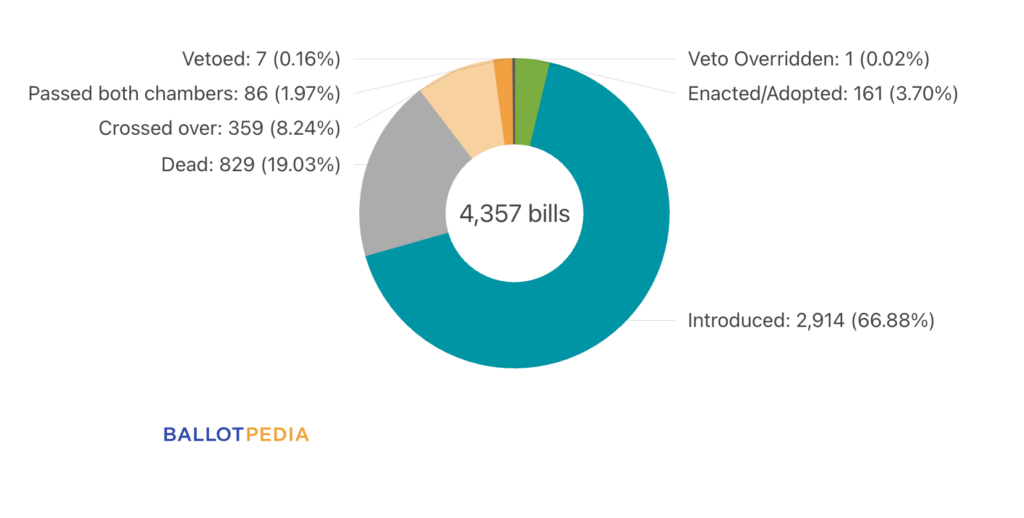
One noteworthy bill enacted last week was Kansas HB 2437. On April 9, the Kansas House and Senate overturned Gov. Laura Kelly’s (D) veto of HB 2437. The House voted 84-39 to overturn the bill and the Senate voted 28-11. Kelly vetoed the bill on April 9. HB 2437, titled the SAVE Kansas Act, requires scheduled checks of the state voter list against the federal Systematic Alien Verification for Entitlements (SAVE) database maintained by the Department of Homeland Security. It also requires county election officers to remove voters with driver’s licenses issued by another jurisdiction from the rolls if no confirmation of Kansas residency is confirmed within 45 days of receiving a confirmation notice.
Three states ended their legislative sessions in the past 40 days.
Utah: Before adjourning on March 6, lawmakers sent 14 election-related bills to Gov. Spencer Cox (R), who signed all of them. Utah has a Republican trifecta in which the party controls the governorship and both legislative chambers. Utah enacted 30 election-related bills in 2025, 14 in 2024, and 16 in 2023.
Among this year’s bills was HB 209, which requires individuals to provide documentary proof of citizenship to register to vote in state and local elections. The law allows voters who do not provide proof of citizenship to cast a ballot in federal elections only.
Washington: Before adjourning on March 12, lawmakers sent 10 election-related bills to Gov. Bob Ferguson (D), who signed all of them. Washington has a Democratic trifecta in which the party controls the governorship and both legislative chambers. Washington enacted 11 election-related bills in 2025, four in 2024, and 11 in 2023.
Two of the 10 bills amended the state’s Voting Rights Act. HB 1750 prohibits political subdivisions from adopting election policies or practices that burden protected classes of voters. The bill also establishes legal guidelines for courts that are reviewing claims from voters, groups, or tribes alleging violations of this prohibition.
HB 1710 requires certain local governments that are proposing election-related changes — like altering voting methods, redistricting, or relocating polling places — to obtain approval from the state attorney general before implementation.
Washington is one of five states to advance legislation creating or amending a state-level voting rights act in 2026. Washington, Maryland, New Jersey, and Virginia have Democratic trifectas. Vermont has a divided government.
Wisconsin: Before adjourning on March 19, lawmakers sent three election-related bills to Gov. Tony Evers (D), who signed two of them and vetoed one. Wisconsin had a divided government in which the governor is a Democrat and Republicans control both legislative chambers. Wisconsin enacted four election-related bills in 2025, two in 2024, and eight in 2023.
On April 8, Evers vetoed AB 595, which would have required the Wisconsin Elections Commission to remove ineligible voters from the voter rolls. Currently, officials designate those voters as ineligible but do not actually remove them from the voter registration list.
Click here to sign up for The Ballot Bulletin — our weekly email that follows developments in election policy around the country. You can also click here to see a full list of the bills we're following in 2026.
Mikie Sherrill to become first New Jersey governor in 20 years to live in the state's official governor's residence
On April 3, Gov. Mikie Sherrill (D-N.J.) announced she would be moving into Drumthwacket, the official residence of the governor of New Jersey. Sherrill will be only the third governor to live in the mansion since it was designated the official governor's residence in 1981. Only Governors James Florio (D-N.J.), who left office in 1994, and Jim McGreevey (D-N.J.), who left office in 2004, have lived in the mansion.
Sherrill’s decision to move into the governor’s mansion makes her one of 38 state governors living in their state’s governor's mansion. Five other states have governors who lived outside the mansion, and Ballotpedia was unable to determine whether the governor lived in the mansion in two states. This number does not include summer homes or any other supplementary residences. Additionally, five states do not provide the governor a specific residence.
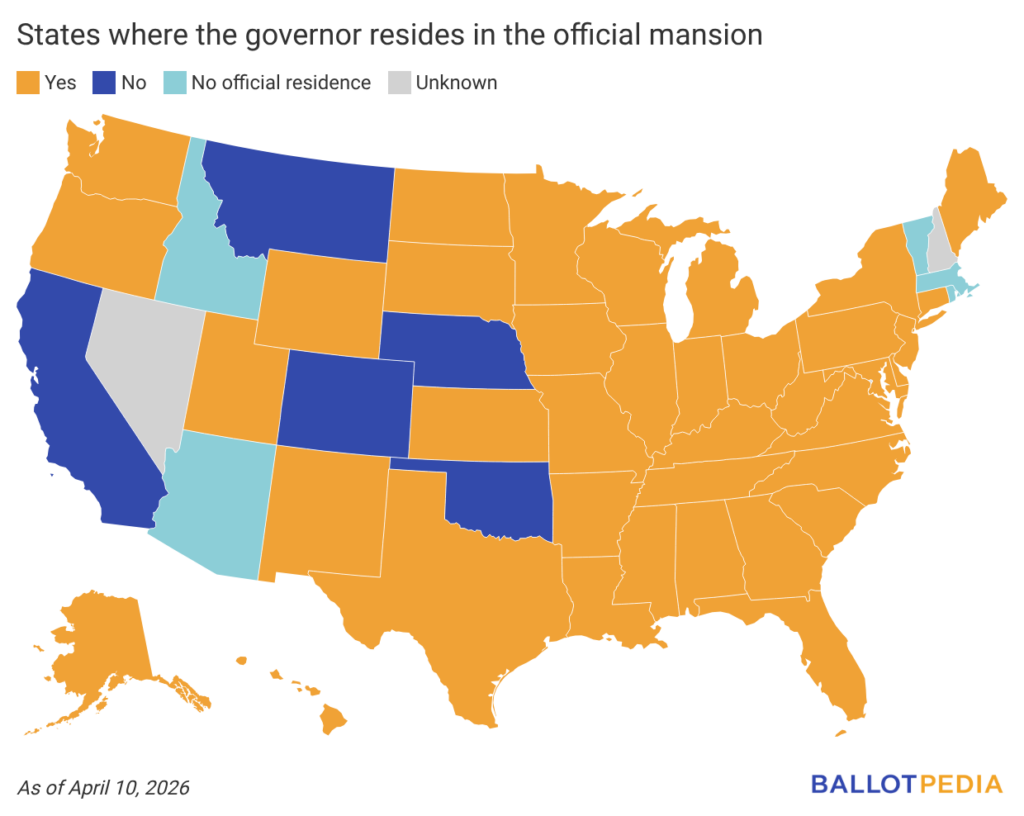
The five states where the governor does not reside in the mansion are California, Colorado, Montana, Nebraska, and Oklahoma. In Oklahoma, a new mansion is being built, with an expected completion date of 2026, meaning the winner of this year’s gubernatorial election will be the first person to reside in the new governor’s mansion.
In 2024, Montana Gov. Greg Gianforte (R-Mont.) bought the historic Hauser House with the intention of donating it to the state upon completing his term in 2029. The Montana Department of Administration reportedly plans to take over the Hauser mansion for future governors to reside in.
The official Montana governor’s residence is currently unoccupied and in disrepair. Repairs to the mansion have been delayed, as according to a statement on the official website for the governor of Montana, “Due to inflation, supply chain shortages and delays, and the low availability of skilled labor, the Montana Department of Administration paused repairs on the Montana Governor’s Residence.” The state has sought public input on the future of the residence through an official survey, the results of which have not yet been publicly discussed.
Click here to read more about the official governor’s residence in each state.
Editor’s notes:
This post was corrected to clarify that the residence was designated as the official governor’s residence in 1981.
This post was updated to replace a general description of how policies could be elevated to constitutional status with specific details about current Alabama law on the pledge of allegiance and classroom prayer, including relevant statutory references and the impact of the Wallace v. Jaffree decision.