


On April 15, 2026, Sen. Mark Kelly (D-Ariz.), introduced S. 4297 to repeal the provisions in the One Big Beautiful Bill Act (OBBBA) that established the federal education tax credit scholarship program, also known as the Education Freedom Tax Credit. The bill, titled the Keep Public Funds in Public Schools Act, has 29 Democratic and two Independent cosponsors. The measure was referred to the Senate Committee on Finance.
The federal education tax credit scholarship program requires states to opt in. Five Democratic governors have vetoed bills to opt into the program, with two legislatures — in Kansas and Kentucky — overriding the vetoes to require the state to participate. One Democratic governor, Colorado's Jared Polis, opted into the program.
At least 29 states have officially opted into the program, 23 of which have a Republican trifecta. Four states with divided governments — Alaska, Kansas, Kentucky, and Nevada — have opted in, and two states with Democratic trifectas — Colorado and Virginia — opted in. Former Virginia Gov. Glenn Youngkin (R) opted into the program in Jan. 2026, shortly before Gov. Abigail Spanberger (D) took office.
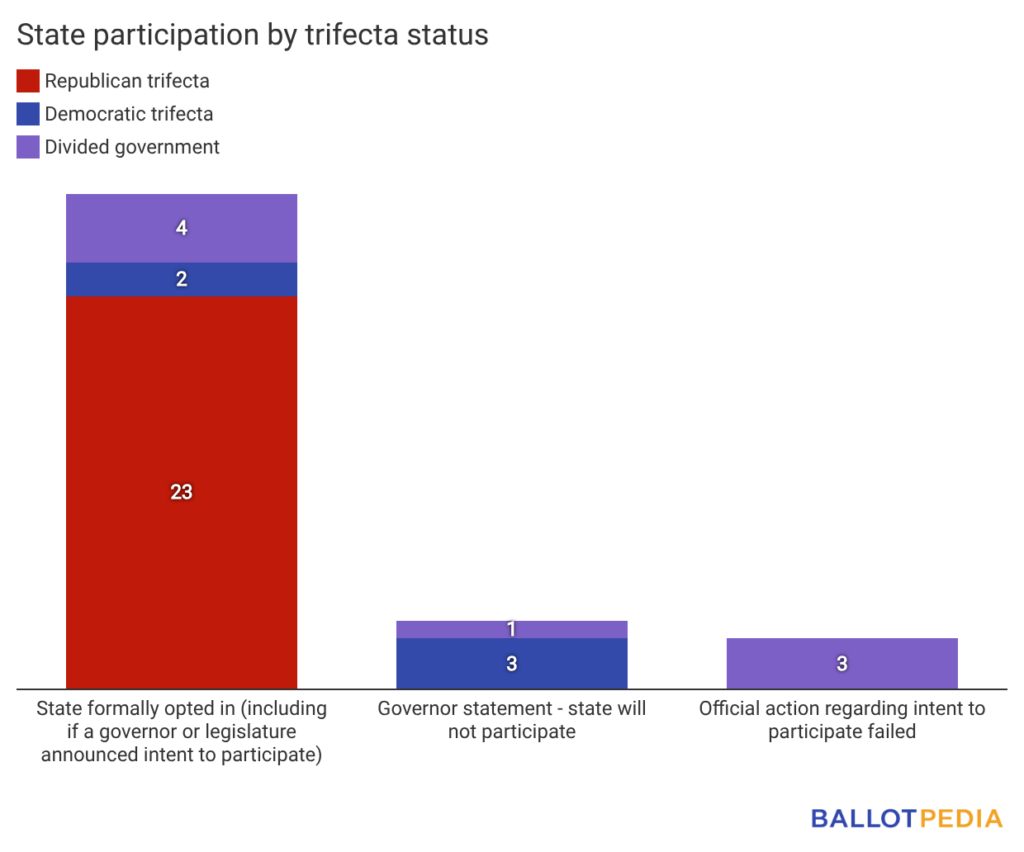
Click to learn more about which states have taken action on the program.
About the program
The U.S. school choice tax credit scholarship is a nonrefundable tax credit, allowing individuals to receive federal tax credits for donations up to $1,700 to authorized scholarship-granting organizations (SGOs). It is a dollar-for-dollar nonrefundable tax credit, meaning individuals can lower their federal tax liability by $1 for every $1 donated to accredited SGOs. If a taxpayer donates more than $1,700, they will not receive a tax refund for the amount over $1,700. The total amount of credits the program can offer is not capped.
SGOs distribute the donated scholarship funds to eligible families, which can be used on a variety of private or public educational expenses, including private school tuition, tutoring services, textbooks, and more. In order to qualify for scholarships, students had to live in households earning no more than 300% of the area's median gross income and be eligible to enroll in K-12 schools. The program will take effect on January 1, 2027.
States that elect to participate must submit a list of SGOs that taxpayers can donate to in order to receive the federal tax credit. Students in states that do not opt in cannot receive scholarships funded under the program, but donors in those states can still receive a federal tax credit by donating to SGOs in participating states. As enacted, the program will not affect state budgets.
Sen. Bill Cassidy (R-La.), who authored portions of the legislative text establishing the program, said when it passed, "Parents should decide where their kids go to school. This bill helps them do that. I am grateful to see President Trump sign the first federal school choice bill into law as a part of the One, Big, Beautiful Bill.”
Democratic responses to the program
While Democrats tend to oppose participation in the program, some in the party say that it present an opportunity for public or private school students to receive additional educational funds. Debates among Democrats about the tax credit generally concern the program's nature, whether states should participate, and how the U.S. Treasury should craft regulations implementing it.
Opponents of the program, including Public Funds for Public Schools, say that the program is poorly designed, it could take money away from public schools, and that opting in would be irresponsible. Some Democrats want to add nondiscrimination requirements for schools receiving funds under the program.
Democratic supporters of the program say that, though it benefits private school students, donations accrued under the program can increase funding for students enrolled in public education as well. CEO of Democrats for Education Reform Jorge Elorza said, "For too long, the political Left has allowed the debate over school choice to be defined and dominated by conservatives. In doing so, we’ve neglected the most dynamic lever for equity and innovation in American education while alienating the Black, Latino, and working-class families we claim to represent. It’s time for progressives to come to the school choice table—not to dismantle public education, but to reinvent it for a new era."
Chad Aldeman, education policy writer and founder ofRead Not Guess, said that too many Democrats are focused on repealing the program. He said "[a] more productive approach would be to utilize the policy and improve it so it better targets need, protects students, and expands access to high-quality learning opportunities."
Democratic opponents of the program say that while many people believe the program is free for states, they believe it could harm other programs that depend on federal tax revenue that the federal school choice program would eliminate. Kevin Welner with the National Coalition for Public Education said, "[F]or every dollar contributed to an SGO, the federal budget loses a dollar that would otherwise be paid in taxes. ... The loss of federal funds under Title I and other programs, with funding instead diverted to this tax credit program, will place very real pressures on state budgets."
U.S. Sen. Mazie Hirono (D-Hawaii) said, "As the Trump administration continues its all-out, coordinated attack on public education, its newly-created national school voucher program will harm our public schools by diverting critical resources that could otherwise be used to support students."
Read Ballotpedia's full taxonomy of arguments and policy proposals for the program here.
To read more about the program, click here.