


Welcome to the Wednesday, April 29, 2026, Brew.
By: Briana Ryan
Here’s what’s in store for you as you start your day:
- Virginia’s new Democratic trifecta has enacted more election-related bills than any other state so far this year
- Twelve legislatures are set to adjourn in May as lawmakers consider at least 60 potential legislative ballot measures
- Four candidates are running in the June 23 Democratic primary for Utah's 1st Congressional District
Virginia’s new Democratic trifecta has enacted more election-related bills than any other state so far this year
Virginia has enacted more election-related bills than any other state so far this year, including several notable pieces of legislation.
The 2026 session was the first time in five years that Virginia had a Democratic trifecta — with Democrats controlling both chambers of the General Assembly and the governor’s office — following Gov. Abigail Spanberger's (D) election in November 2025.
Spanberger signed 31 election-related bills in March and April and returned an additional 22 bills to legislators with suggested amendments. The General Assembly approved her amendments to 17 of those bills on April 22. As of April 27, lawmakers had not considered five bills.
The 48 election-related bills enacted in Virginia so far this session exceed the total number of bills enacted in all other Democratic trifecta states combined.
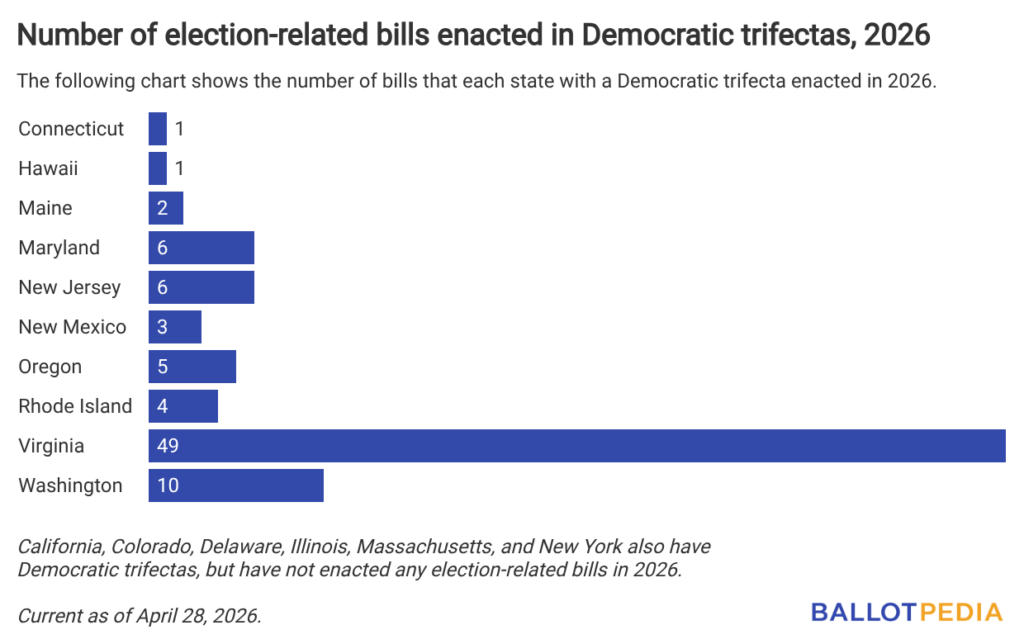
Some of the bills enacted in Virginia are similar to those advanced in other Democratic trifecta states this year.
Virginia lawmakers sent a constitutional amendment to voters that would allow mid-decade redistricting, with new congressional maps taking effect ahead of the 2026 elections. Voters approved the amendment in an April 21 special election, though a Tazewell County judge enjoined officials from certifying the election results in an April 22 ruling, which is being appealed. Virginia was one of two Democratic trifecta states, along with Maryland, to advance mid-decade redistricting legislation.
Virginia is also one of four Democratic trifecta states, along with California, Colorado, and Maryland, to advance legislation related to voting rights for individuals convicted of a felony.
Currently, Virginia has no mechanism for automatically restoring voting rights for individuals convicted of a felony. Instead, people must apply for restoration to the governor's office upon completion of their sentence, including any prison time, parole, or probation. Some governors have historically used their authority to automatically restore voting rights to thousands of people with felony convictions upon completion of their sentences.
Legislators referred HJR 2, a constitutional amendment that would automatically restore voting rights for individuals convicted of a felony upon completion of their sentence. Two other bills, HB 964 and SB 164, would implement the policy if the constitutional amendment is approved.
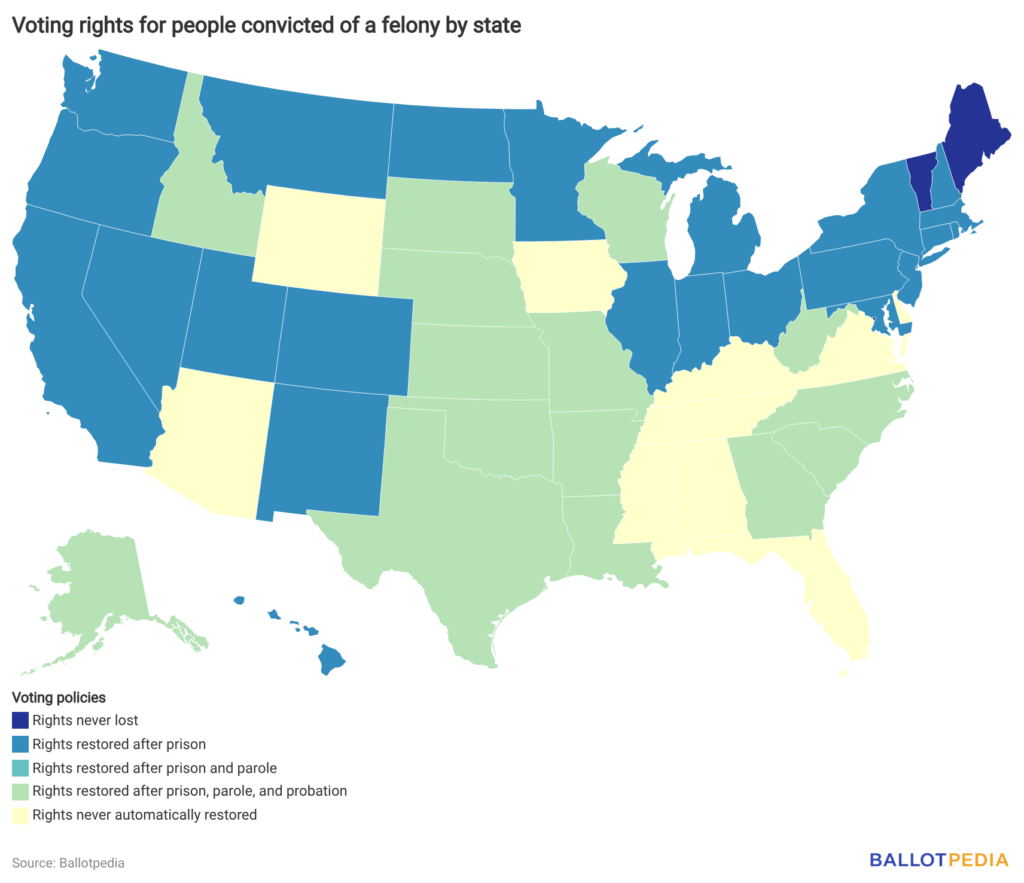
Virginia lawmakers also enacted legislation that was unique among Democratic trifecta states this year.
On April 13, Spanberger signed HB 965 and SB 322, which require Virginia to join the National Popular Vote Interstate Compact, an initiative in which member states agree to award their Electoral College votes to the presidential ticket that receives the most votes nationwide. Virginia was the only Democratic trifecta state that had not previously joined the NPVIC.
Virginia was also one of three Democratic trifecta states that were not members of the Electronic Registration Information Center (ERIC). ERIC is a nonprofit organization of member states that shares information to assist in voter list maintenance. Virginia was formerly a member of ERIC but withdrew in 2023, under former Gov. Glenn Youngkin (R).
Under SB 57 and HB 215, Virginia will be required to rejoin ERIC and ensure its membership remains in good standing. HB 215 also sets out future requirements for joining or terminating a data-sharing agreement with a third-party organization. Spanberger signed SB 57 on April 13 and approved HB 215 on April 22.
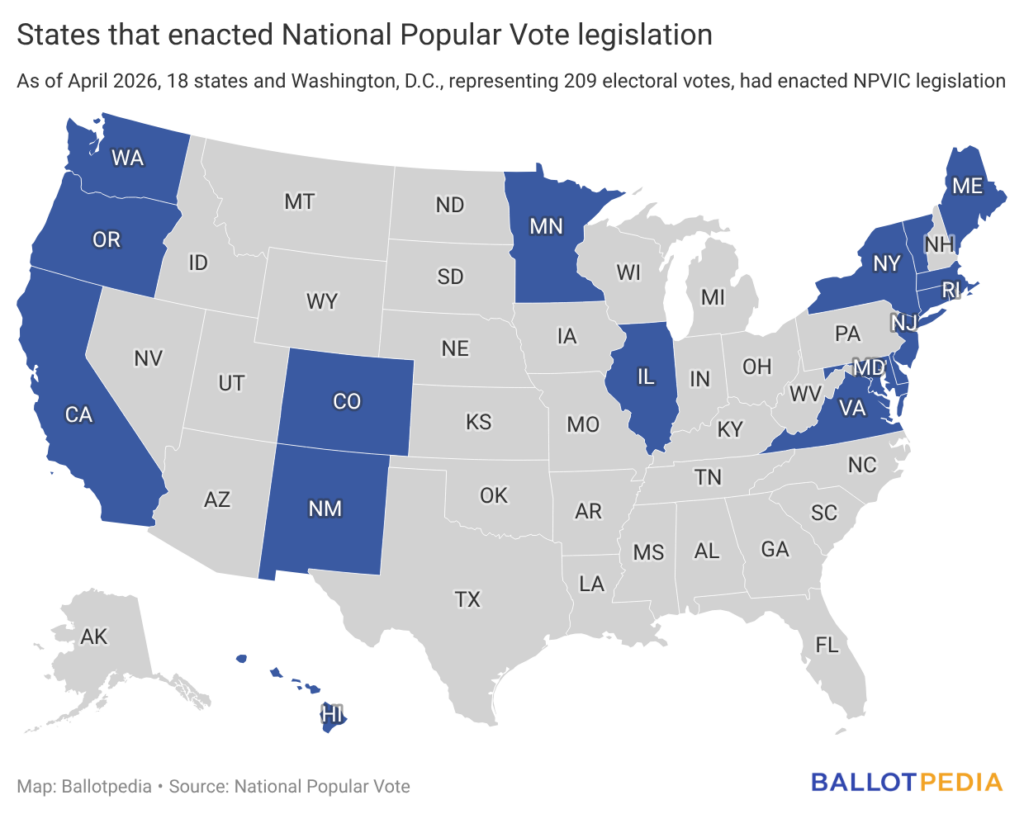
In 2025, the Democratic-controlled General Assembly sent 16 election-related bills to Youngkin, which he vetoed. Spanberger vetoed one election-related bill in 2026, SB 661, which would have legalized skill games in Virginia and allowed municipalities to hold referendums on prohibiting skill games locally.
In 2025, when the state had a divided government, lawmakers enacted 11 election-related bills.
Click here for more information on election policy in Virginia.
Twelve legislatures are set to adjourn in May as lawmakers consider at least 60 potential legislative ballot measures
Twelve legislatures are set to adjourn in May. In the coming weeks, lawmakers in these states will decide whether to advance measures to the statewide ballot. Across these states, at least 60 potential measures have already completed at least half of the process required to qualify for the ballot.
Alaska
The Alaska Legislature will adjourn on May 20, and is currently considering two referrals — both of which are constitutional amendments:
- Senate Joint Resolution 2: The amendment would require a two-thirds (66.67%) vote to overturn a governor's veto of a bill that raises revenue or appropriates funds. Currently, a three-fourths (75%) vote is required to overturn the veto of any bill.
- Senate Joint Resolution 29: The amendment would create a separate fund in the state treasury dedicated to public education.
Arizona
The Arizona Legislature will adjourn on May 22, and is currently considering 30 referrals — 19 of which are constitutional amendments, and 11 of which are state statutes. Here are three noteworthy or interesting referrals:
- Senate Concurrent Resolution 1040: The amendment would increase the mandatory retirement age for justices and judges from 70 to 75.
- Senate Concurrent Resolution 1013: The statute would prohibit a government entity from using donations of any kind from a foreign national to administer an election. It would also prohibit campaigns supporting or opposing ballot measures from accepting funding from foreign nationals or from organizations that have received more than $100,000 in funding from a foreign national in the past four years.
- House Concurrent Resolution 2048: The amendment would withhold the salaries of the governor, lieutenant governor, and state legislators if the budget for the next fiscal year has not been signed by April 30 of each year. Any salaries that are withheld after April 30 would not be paid retroactively after the budget bill is signed.
Arkansas
The Arkansas General Assembly will adjourn on May 7, but no referrals have been passed in either chamber this session. However, there are four referrals — three constitutional amendments and one state statute — that have already made this year's statewide ballot.
Hawaii
The Hawaii Legislature will adjourn on May 8, and is currently considering seven referrals — all of which are constitutional amendments. Here are three noteworthy or interesting referrals:
- Senate Bill 350: The amendment would provide in the state constitution that "no law shall be enacted, nor any state action taken, that denies or interferes with a person's right to obtain contraceptives or voluntarily engage in contraception."
- Senate Bill 2152: The amendment would increase the mandatory retirement age for justices and judges from 70 to 75.
- Senate Bill 2315: The amendment would remove the requirement that constitutional amendments in Hawaii must be approved by a majority of voters casting a vote in an election.
Illinois
The Illinois General Assembly will adjourn on May 31, and is currently considering one referral — House Joint Resolution Constitutional Amendment 28. The amendment would establish a ranked criteria for legislative redistricting, including the creation of racial coalition districts.
Missouri
The Missouri General Assembly will adjourn on May 15, and is currently considering six referrals — all of which are constitutional amendments. Here are three noteworthy or interesting referrals:
- House Joint Resolution 115: The amendment would provide for a homestead property tax exemption or 100% disabled veterans and surviving spouses.
- House Joint Resolution 154: The amendment would establish work requirements for adults ages 19-64 to qualify for Medicaid coverage.
- Senate Joint Resolution 87: The amendment would require the election of county sheriffs and establish that the county sheriff is the chief law enforcement officer in most counties.
Oklahoma
The Oklahoma Legislature will adjourn on May 29, and is currently considering 13 referrals — 12 of which are constitutional amendments, and one is a constitutional convention question. Here are three noteworthy or interesting referrals:
- House Joint Resolution 1067: The amendment would allow the state legislature to decide not to cover the additional costs to the state if the federal funding participation for Medicaid is less than 90%.
- House Joint Resolution 1089: The constitutional convention question would call a state constitutional convention, beginning in January 2027, to amend or rewrite the state constitution and propose changes to voters for approval or rejection.
- Senate Bill 1114: The amendment would provide for a property tax credit for individual heads of household at least 65 years old who qualify for the fair cash value freeze.
Vermont
The Vermont Legislature will adjourn on May 8, and is currently considering one referral — Proposal 4. The amendment would prohibit the denial of rights to an individual based on their race, ethnicity, sex, religion, disability, sexual orientation, gender identity, gender expression, or national origin.
Other states
No referrals have passed either chamber of the following legislatures that will adjourn in May: the Connecticut General Assembly, the South Carolina Legislature, the Colorado General Assembly, and the Minnesota Legislature.
Click here for a full list of measures that may be on the ballot this year.
Four candidates are running in the June 23 Democratic primary for Utah's 1st Congressional District
Four candidates are running in the June 23 Democratic primary for Utah's 1st Congressional District. Nate Blouin (D) and Ben McAdams (D) lead in fundraising and media attention.
The race is taking place in the context of redistricting ahead of the 2026 elections. On Nov. 10, 2025, Judge Dianna Gibson ordered the adoption of a new U.S. House map after she ruled the process used to adopt the previous map was unconstitutional.
Inside Elections' Nathaniel Rakich wrote, "[u]nder the new map, Utah's 1st District is now a Democratic-leaning seat that covers most of Salt Lake County. Former Vice President Kamala Harris would have carried it by 24 percentage points in the 2024 presidential election." In the 2024 presidential election, President Donald Trump (R) won the district by 20 percentage points.
The Salt Lake Tribune's Robert Gehrke wrote that the race is "revealing the divisions within the Democratic Party, between the largely older, moderate pragmatists and the rising generation of progressive idealists inspired by the likes of Vermont Sen. Bernie Sanders and New York City Mayor Zohran Mamdani." Gehrke described McAdams as a moderate, and stated that the Congressional Progressive Caucus has endorsed Blouin.
Blouin was elected to the Utah Senate in 2022. Blouin previously worked as a renewable energy advocate.
McAdams is an attorney and represented Utah's 4th Congressional District from 2019 to 2021. The district lines of the 4th Congressional District during McAdams' term overlapped with the lines of the new 1st Congressional District.
Michael Farrell (D) and Liban Mohamed (D) are also running in the primary.
Click here to read more about the Democratic primary for Utah's 1st Congressional District. Also, if you're a Utah voter, check out our Sample Ballot Lookup here to prepare for Election Day.