


Welcome to the Thursday, April 30, 2026, Brew.
By: Lara Bonatesta
Here’s what’s in store for you as you start your day:
- California will be the second state with a Democratic trifecta to vote on a voter ID ballot initiative
- Ohio to decide local measures on May 5, including Columbus crisis response system and Richland County energy ban referendum
- Jay Edwards and Kristina Daley Roegner running in May 5 Republican primary for Ohio Treasurer
California will be the second state with a Democratic trifecta to vote on a voter ID ballot initiative
California voters will decide on a citizen-initiated constitutional amendment that would require voter identification and establish new requirements for voter registration lists and citizenship verification, making it the second state with a Democratic trifecta to decide on a ballot measure to require voter ID.
State Assemblymember Carl DeMaio (R) and State Sen. Tony Strickland (R), along with business owner Donald DiCostanzo, filed the initiative. The campaign, named Californians for Voter ID, filed 1.37 million signatures on March 2. At least 874,641 needed to be valid. On April 24, the state Elections Division announced that a random sample projected that 80.2% of the signatures were valid, or about 1.1 million valid signatures.
The Californians for Voter ID and Reform California PACs raised $12.4 million through Dec. 31 in support of the initiative. The largest donors were Richard Uihlein, CEO of Uline Corporation, who donated $4 million, and Steven Bray, CEO of Power Plus, who donated $2.5 million.
Opponents formed Californians for Voting Rights on April 7, after the last campaign finance deadline on Feb. 2. The next campaign finance update is April 30.
Since 2004, voters in 11 states decided on 12 ballot measures to require or expand voter identification requirements. Voters approved nine of these measures and rejected three.
Of the 12 measures, three were decided in states with Republican trifectas at the time of the vote, eight were in states with divided governments, and one — Maine in 2025 — was in a state with a Democratic trifecta. Based on the 2024 presidential election results, California will be the most Democratic-leaning state to vote on a voter ID ballot initiative.
Thirty-six states require some form of voter identification for in-person voting, including 24 that require identification containing a photograph.
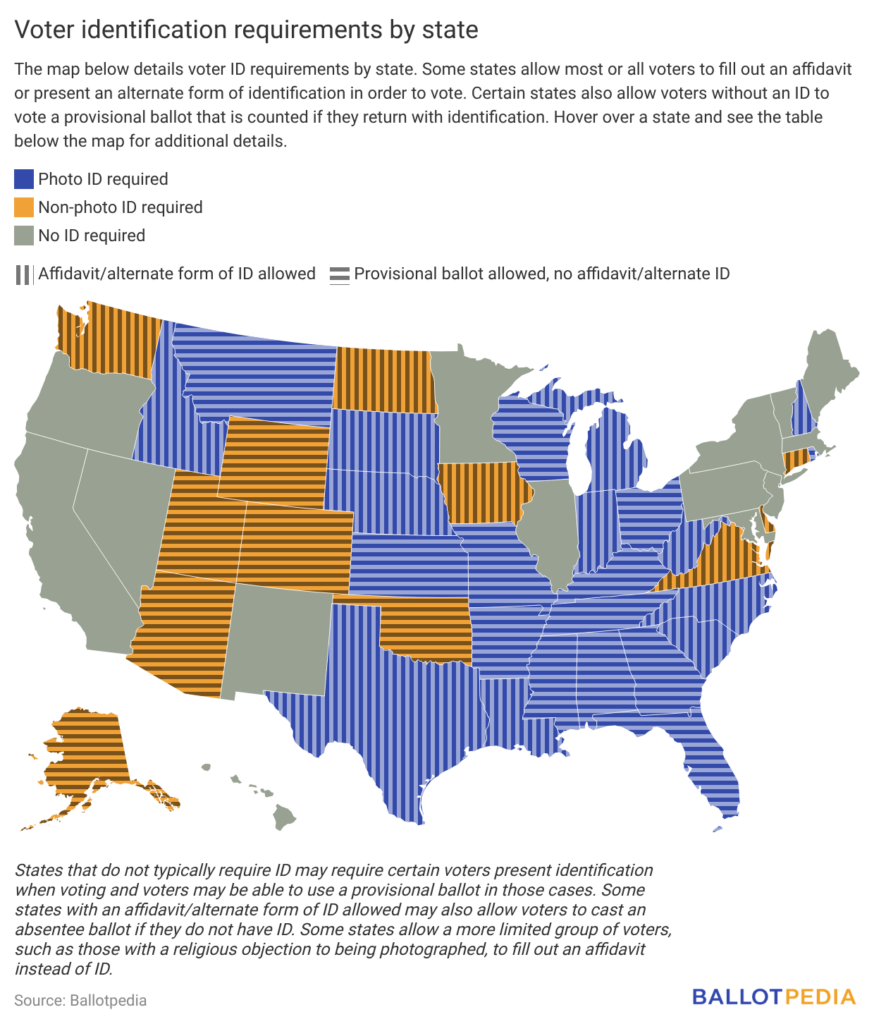
The initiative would require voters to present a government-issued ID for in-person voting or provide the last four digits of a government-issued ID designated during voter registration for mail-in voting. The state would be required to provide a voter with a voter ID card at no cost upon request. The amendment also says, "Officials shall only count a regular or provisional ballot after verifying the identity of the person... and verifying that the person has cast only one ballot in the election."
The initiative would also require election officials to "maintain accurate voter registration lists [and]... use best efforts to verify citizenship attestations using government data” and to report each year the percentage of each county’s voter rolls that have been citizenship-verified. The State Auditor would be required to audit government compliance with these requirements during odd-numbered years and report findings to the public.
Citizens would be permitted to seek judicial review for state or local non-compliance with the initiative.
Currently in California, voters must attest to their citizenship under penalty of perjury when registering to vote. State law does not require documentary proof of citizenship, and election officials are not required to verify citizenship using government data.
California will be one of at least four states to decide on a voter ID ballot measure in 2026. This includes Nevada’s Question 7, which will be on the ballot for the second time. In Nevada, initiated constitutional amendments need to be approved in two even-numbered election years. In 2024, voters approved Question 7 73.2% to 27%.
North Carolina and Oklahoma will decide on measures the legislatures have placed on the ballot. Both states have voter identification requirements in state law. In North Carolina, the state constitution requires photo ID for in-person voting. The proposal would expand the constitutional requirement to voting in general, including mail-in voting. Oklahoma has a state law, but not a constitutional requirement.
Click here to learn more about the amendment in California.
Ohio to decide local measures on May 5, including Columbus crisis response system and Richland County energy ban referendum
Ballotpedia is covering seven local measures on Ohio ballots on May 5. This is part of our coverage for local measures in the 100 most populous cities and state capitals, as well as other notable local measures.
Two notable measures include a charter amendment proposing a community crisis response system in Columbus, Ohio, and a Richland County referendum on a resolution prohibiting certain solar power facilities and wind power farms.
Columbus crisis response system
The Columbus measure, Proposed Charter Amendment No. 2, would establish a community crisis response system for certain 911 calls, providing crisis services such as de-escalation, stabilization, and transportation. It would prioritize sending non-police responders, such as clinicians and case managers, as first responders in appropriate situations. According to the amendment, this would include ”situations that do not involve substantial risk of death or bodily harm to persons, including but not limited to, crisis involving behavioral health and/or homelessness.”
The measure is an amended version of a successful citizen initiative effort. The Columbus Safety Collective submitted enough signatures to qualify their initiative for the ballot. The Columbus City Council wrote the new version in collaboration with the Columbus Safety Collective. The City Council voted 9-0 to refer the measure to the ballot in March. Supporters of the measure include Mayor Andrew Ginther, the ACLU of Ohio, and the Planned Parenthood Advocates of Ohio.
The measure would require the city council to establish a department to run the crisis response system, require the system to coordinate and integrate with the 911 emergency response system, and create a community crisis response advisory board to oversee the system.
Richland County energy ban referendum
In Richland County, voters will decide on a referendum on a county resolution prohibiting certain solar power facilities and wind power farms in 11 of the county’s 18 townships: Blooming Grove, Franklin, Jackson, Jefferson, Mifflin, Monroe, Perry, Plymouth, Sharon, Troy, and Weller.
The Richland County Board of Commissioners passed the resolution in July 2025. Counties are authorized to adopt such restrictions under Ohio House Bill 52 (HB 52), enacted in 2021. HB 52 said that boards of commissioners can prohibit, within unincorporated areas, wind projects capable of generating five megawatts or more and solar projects capable of generating 50 megawatts or more. HB 52 also said that resolution opponents could file a veto referendum.
A “yes” vote on the referendum would uphold this resolution, while a “no” vote would repeal it. The Richland County Citizens for Property Rights & Job Development (also known as No Ban on Property Rights), supports the “no” vote. The group submitted enough valid signatures to put the referendum on the ballot. The Richland County Republican Party supports a “yes” vote, while the Richland County Democratic Party supports a “no” vote.
Click here to learn more about the May 5 local ballot measures in Ohio.
Jay Edwards and Kristina Daley Roegner running in May 5 Republican primary for Ohio Treasurer
In an edition of the Brew from earlier this week, we wrote about the 49 state financial offices (SFOs) up for election this year. We also wrote about a few notable contests, including the Republican primary for Ohio Treasurer. Today, we’re expanding on that race.
Jay Edwards (R) and Kristina Daley Roegner (R) are running in the primary on May 5.
Incumbent Robert Sprague (R) is running for secretary of state. Vice President J.D. Vance (R) endorsed Edwards. Gubernatorial candidate Vivek Ramaswamy (R), who ran for president in 2024, endorsed Roegner. Politico's Jacob Wendler said, "The otherwise sleepy battle… is one of many divides bubbling up in the Republican Party that is tentatively charting a post-Trump future, with both Ramaswamy and Vance jockeying to put their stamp on the GOP."
Edwards is a realtor and small business owner. He was a member of the Ohio House from 2017 to 2024. Edwards is running on his legislative experience. His campaign website says he "served as the House Finance Committee Chair where he sponsored and passed a $3.2 billion dollar tax cut, and universal school choice." Edwards is running on his experience as House Finance Chair. In an interview with The Statehouse News Bureau’s Jo Ingles, Edwards said, “I know the budget really well, I know the mechanics of state funding and state spending.” Edwards has said his priorities would include lowering property taxes and electricity bills.
Roegner is a member of the Ohio Senate, elected in 2018. Roegner was a member of the Ohio House from 2011 to 2018 and a member of the Hudson City Council from 2005 to 2010. Before running for public office, Roegner was an engineer and management consultant. In an interview with Ingles, Roegner highlighted her position in the legislature and said, “The treasurer doesn't operate in a vacuum. They need to be able to interact and work well with the leadership in the House, the Senate, and the governor's office.” In addition to her legislative experience, Roegner said her work in the private sector, and educational background led her to run for treasurer, and that her top priority would be to “safeguard the taxpayers' money and to invest it wisely."
In 2022, Sprague defeated Scott Schertzer (D) 58.6% to 41.4%. The last Democrat to win a statewide election in Ohio was Jennifer Brunner (D), who was elected to the Ohio Supreme Court in 2020.
Click here to learn more about the Republican primary for Ohio Treasurer. Also, if you're an Ohio voter, check out our Sample Ballot Lookup here to prepare for Election Day.