


Welcome to the Wednesday, June 3, 2026, Brew.
By: Lara Bonatesta
Here’s what’s in store for you as you start your day:
- Federal judge strikes down part of New Hampshire's documentary proof of citizenship law
- Utah's Senate President and House Speaker issue dueling endorsements in 2nd District Republican primary
- Elections Ballotpedia is covering in June 2026
Federal judge strikes down part of New Hampshire's documentary proof of citizenship law
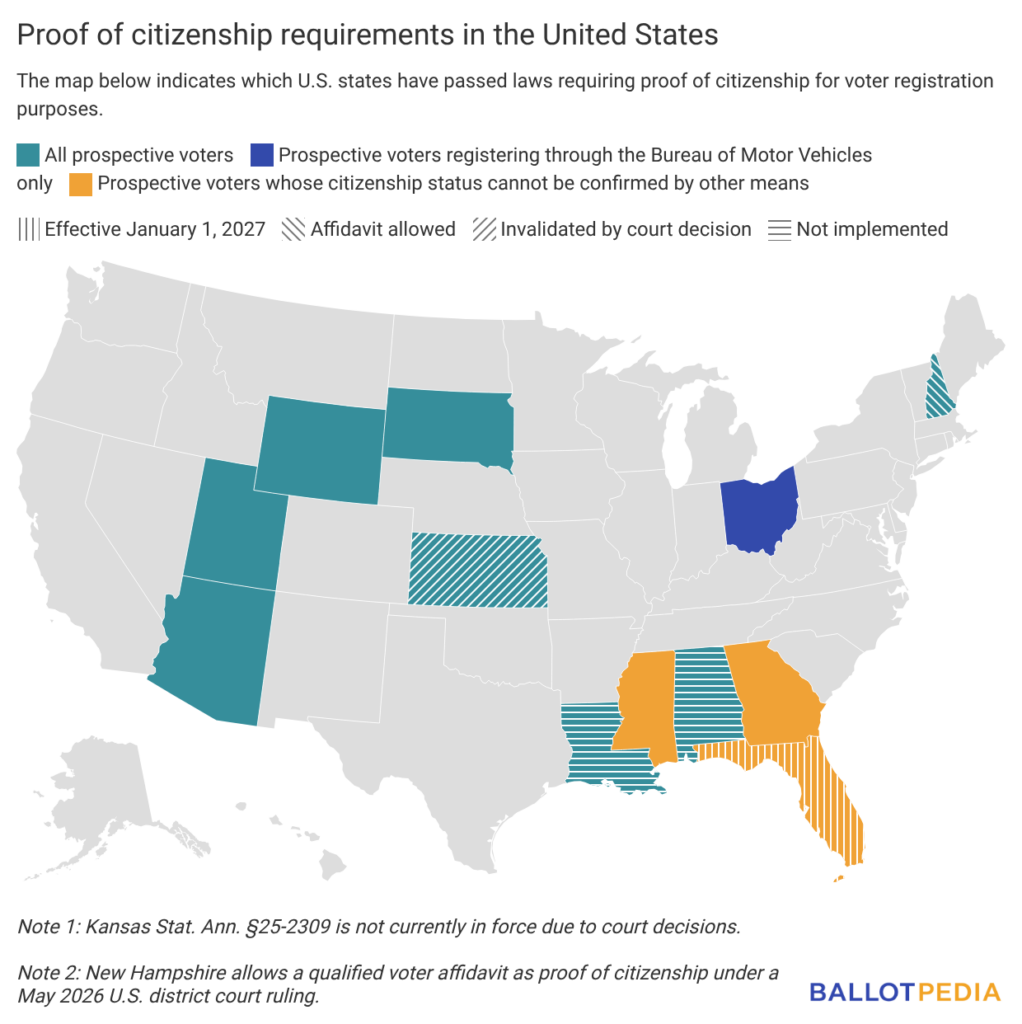
All 49 states with voter registration systems (North Dakota is the exception) require prospective voters to attest to their U.S. citizenship. In 12 states, voters must also provide documentary evidence of their citizenship, such as a birth certificate, passport, or naturalization papers. One of those states, New Hampshire, must now again allow voters to register to vote if they sign a sworn affidavit attesting to their citizenship under penalty of perjury.
The policy change is the result of a May 28 U.S. District Court ruling, which said parts of the New Hampshire law requiring individuals to provide documentary proof of citizenship to register to vote were unconstitutional.
Beyond the eight states that have laws requiring documentary proof of citizenship for voter registration in all cases, Florida, Georgia, and Mississippi require proof of citizenship at the time of registration if a person's citizenship status cannot be confirmed by other means. Ohio requires proof of citizenship only when registering to vote at a Bureau of Motor Vehicles facility.
As of June 1, Alabama and Louisiana have not implemented their proof-of-citizenship laws. A federal court blocked Kansas' proof-of-citizenship law in 2018.
Background on the U.S. District Court case in New Hampshire
In September 2024, Gov. Chris Sununu (R) signed HB 1569, eliminating the option for prospective voters to sign a qualified voter affidavit as proof of citizenship. It also removed voters' ability to sign a separate affidavit in response to having their eligibility to vote challenged on Election Day.
That same month, the New Hampshire Youth Movement and the Coalition for Open Democracy, the League of Women Voters, the Forward Foundation, and multiple prospective voters filed two lawsuits, stating that eliminating the two affidavits unduly burdened the right to vote and violated the U.S. Constitution. The lawsuits were later consolidated into one case.
The New Hampshire Attorney General's office argued that the new requirements were necessary to reduce the risk of voter fraud and increase voter confidence in elections. It also argued that changes to the law in 2025, including allowing election officials to use an online database to help verify a person’s citizenship, mitigated the burden on voters.
In her ruling, U.S. District Court judge Samantha Elliott, who President Joe Biden (D) appointed in 2021, held that removing the affidavit option led to eligible voters being turned away from polling places when trying to register on Election Day. She said that the 2024 law did not adequately further the state’s interests.
“It may be tempting for some to describe the Qualified Voter Affidavit as an exception to the proof-of-citizenship requirement, but it is not,” Elliott wrote. “A sworn affidavit capable of exposing an affiant to criminal prosecution is a method of proving citizenship and not an exception to that requirement. Moreover, the evidence shows that it is the only method of proof available to a significant number of New Hampshire voters.”
The ruling prevents the state from enforcing the prohibition on using the two affidavits, reinstating their use ahead of New Hampshire’s Sept. 8 primary election.
In a statement, League of Women Voters chief of activation and justice Marcia Johnson said, "This decision sends a clear message that constitutional rights do not end when voting begins. Eligible voters should not be denied access to voting because of burdensome and unnecessary requirements."
A spokesperson for the New Hampshire Attorney General's office said they would appeal the decision.
“We are disappointed with the court’s decision and are carefully reviewing the order at this time,” spokesperson Michael Garrity said. “HB 1569 represents a common-sense approach to voter registration and election administration designed to protect the integrity of our elections.”
HB 365, which Gov. Kelly Ayotte (R) signed into law on May 18, will also be in effect for the primary election. The law requires clerks to confirm the citizenship status of individuals without documentary proof of citizenship through the New Hampshire Secretary of State's office. If a check of "relevant and available in-state, out-of-state, and federal databases" confirms that a person is a U.S. citizen, the proof of citizenship requirement is considered satisfied.
Florida, Mississippi, South Dakota, and Utah enacted or expanded documentary proof-of-citizenship laws this year. Twenty-three states have introduced 49 bills related to proof of citizenship. Twenty-three of these bills are in states with Republican trifectas, 12 are in states with Democratic trifectas, and 14 are in states with divided government. Thirty-nine bills have Republican sponsors, six have Democratic sponsors, two have bipartisan sponsors, and two have sponsors with other partisan affiliations.
For more information on documentary proof-of-citizenship laws, click here.
Utah's Senate President and House Speaker issue dueling endorsements in 2nd District Republican primary
Incumbent Blake Moore (R) and Karianne Lisonbee (R) are running in the June 23 Republican primary for Utah's 2nd Congressional District.
Utah’s primaries will be the first to take place since the Utah Third District Court Judge Dianna Gibson struck down the state’s Legislature-drawn congressional map in 2025 and ordered the state to implement a map adding one Democratic-leaning district.
Gibson ruled the Legislature violated voters' constitutional rights in 2020 when it overturned Proposition 4, a ballot measure voters approved 50.3%–49.7% in 2018 that created an independent redistricting commission. Click here to learn more about Gibson’s decision and redistricting in Utah ahead of the 2026 elections.
Incumbent Celeste Maloy (R) is running for re-election in the 3rd District. Moore is the incumbent in the 1st District, which Utah News Dispatch's Alixel Cabrera said "[is] on a likely path to turn blue ... It’s a major shakeup for Republicans, who have occupied all federal offices in recent years. Utah Senate President Stuart Adams (R) endorsed Moore, and Utah House Speaker Mike Schultz (R) endorsed Lisonbee.
In 2018, Moore was a co-chair of Better Boundaries, the campaign supporting Proposition 4. Moore’s role in that campaign has become an issue in the 2026 race. Politico's Samuel Benson said Moore's support of the independent redistricting commission "is fueling a primary challenge and could potentially hinder his future hopes at statewide office ... Lisonbee and other political foes have nicknamed Moore 'Salt Lake Blake,' suggesting he run in the blue district they blame him for creating." Lisonbee defeated Moore 61.5%–33.7% at the nominating convention. Moore was also defeated in the 2024 and 2020 Republican conventions in Utah’s 1st District. He was one of two candidates who advanced from the Republican convention in 2020.
Moore was elected to the U.S. House in 2020. He was elected vice chairman of the House Republican Conference in 2023. Moore's campaign website says he is "the first Utahn ever elected to leadership in the House or the Senate" and says he "has built one of the most effective records of any member of Congress in his class ... His work has earned national recognition, including being named the 2025 Best of Constituent Service winner."
Lisonbee was elected to the Utah House of Representatives in 2016 and served on the Syracuse City Council from 2011 to 2017. Lisonbee's campaign website says she has "never wavered on her principles — not once. ... She is not a transplant looking for a seat. She is home. Utah's newly drawn 2nd Congressional District deserves a representative who matches its convictions."
Major election forecasters have rated the general election Solid/Safe Republican.
Click here to learn more about the GOP primary in Utah’s 2nd Congressional District. Also, if you're a Utah voter, check out our Sample Ballot Lookup here to prepare for Election Day.
Elections Ballotpedia is covering in June 2026
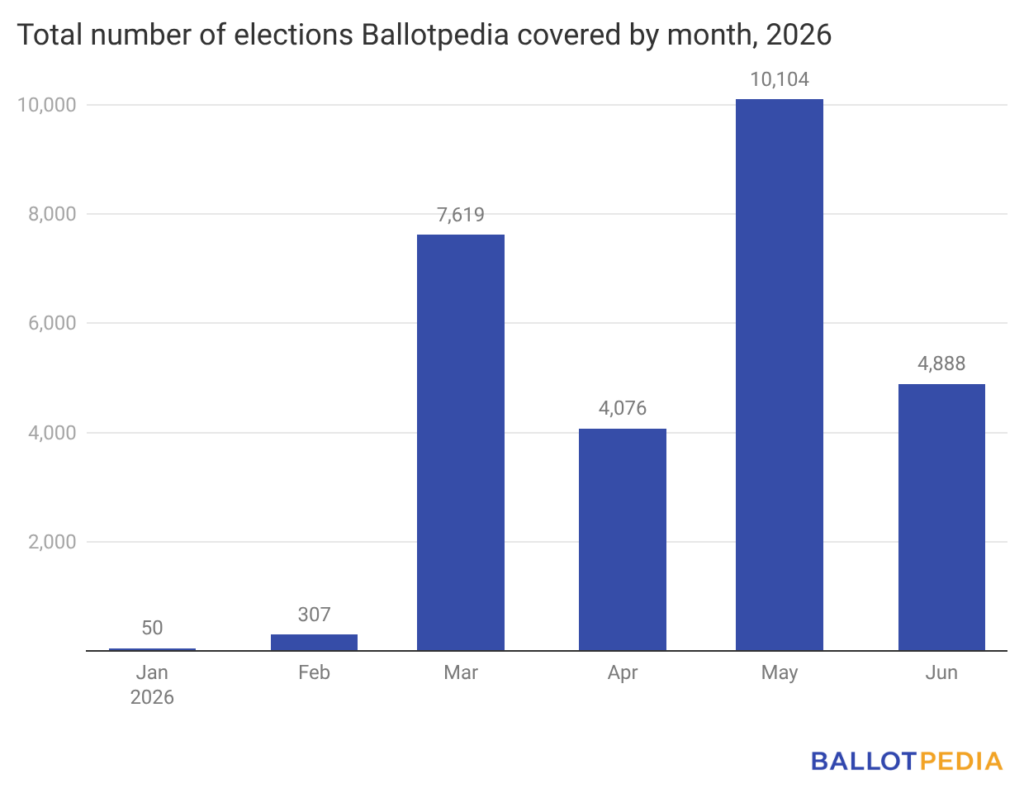
There are 4,888 elections happening across 28 states in June. These include 18 statewide elections, 94 special elections held to fill vacancies in 19 states, and two recall elections in two states.
In May 2026, Ballotpedia tracked 10,104 elections across 29 states. This included 13 statewide elections, 181 special elections, and nine recall elections.
Upcoming elections
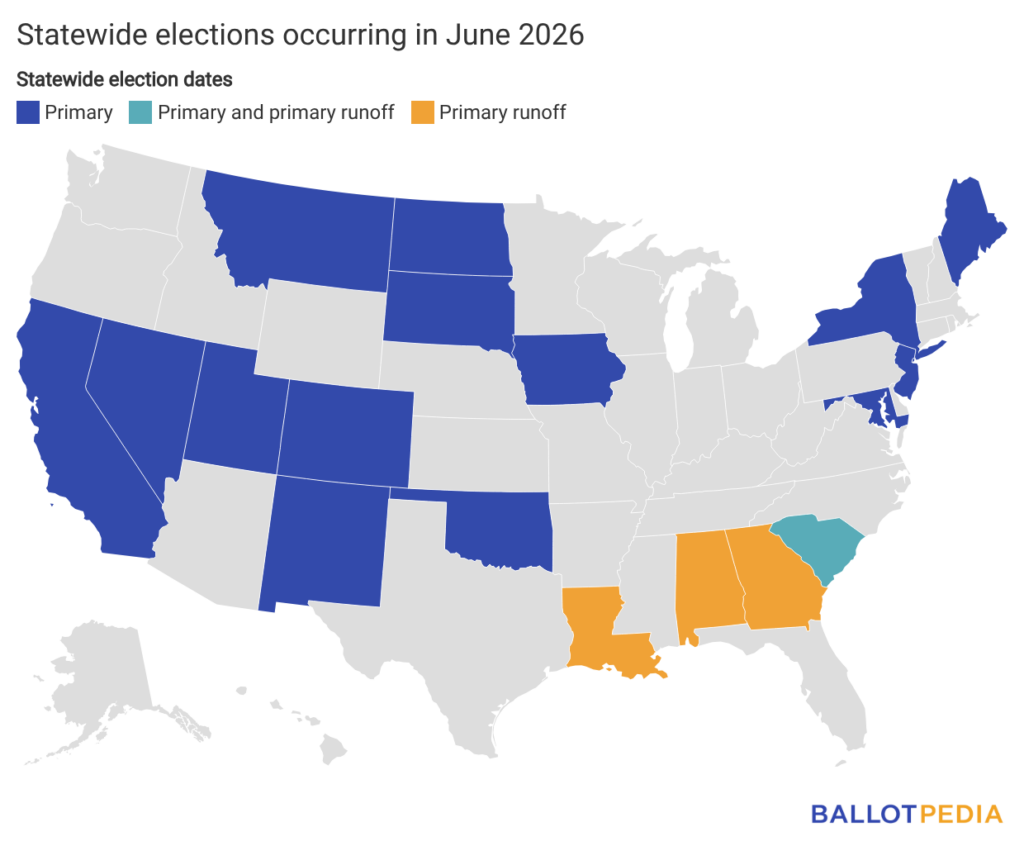
In June, the following states have regularly scheduled statewide elections:
- June 2: California statewide primary, Iowa statewide primary, Montana statewide primary, New Jersey statewide primary, New Mexico statewide primary, South Dakota statewide primary
- June 9: Maine statewide primary, North Dakota statewide primary, Nevada statewide primary, South Carolina statewide primary
- June 16: Alabama statewide primary runoff, Georgia statewide primary runoff, Oklahoma statewide primary
- June 23: Maryland statewide primary, New York statewide primary, South Carolina statewide primary runoff, Utah statewide primary
- June 27: Louisiana statewide party primary runoff
- June 30: Colorado statewide primary
The following federal and state-level special elections are taking place:
- June 2: California U.S. House District 1 special nonpartisan primary, Arkansas House District 44 special Republican primary, New Mexico Senate District 33 special primaries, and New Mexico Court of Appeals special Democratic primary
- June 9: Nevada Board of Regents District 8 special nonpartisan primary, North Dakota Public Service Commission special primaries, North Dakota Superintendent of Public Instruction special nonpartisan primary, Georgia House District 177 special general runoff, Maine House District 29 special general, North Dakota House Districts 26 and 42 special primaries, and North Dakota Supreme Court special nonpartisan primary
- June 16: California U.S. House District 14 special nonpartisan primary, Oklahoma Senate District 17 special Republican primary, and Oklahoma House District 92 special Democratic primary
- June 23: Utah State Board of Education District 7 special general
- June 30: Colorado State Senate Districts 17, 21, 29, and 31 special primaries
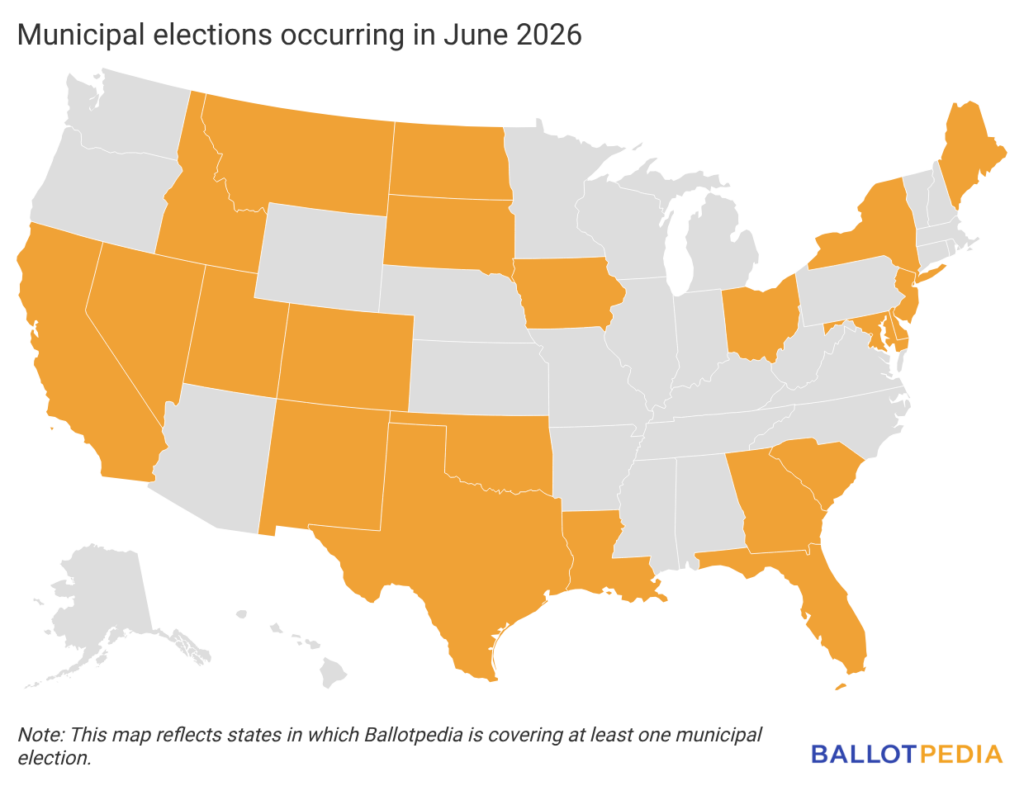
Ballotpedia is also tracking 2,980 municipal elections in 22 states. This includes 67 special municipal elections. Below is a list of local special elections that overlap state capitals, the 100 largest cities by population, or the 200 largest school districts by enrollment:
- June 2: Alameda County (California) District Attorney special nonpartisan primary, New Mexico District Court special Democratic primaries, San Francisco (California) Board of Supervisors Districts 2 and 4 special generals, San Francisco Unified School District (California) special general
- June 9: North Las Vegas (Nevada) Municipal Court special nonpartisan primary, Las Vegas (Nevada) Municipal Court special nonpartisan primaries, Charleston County School District (South Carolina) special general
- June 16: Washington, D.C. City Council special general
- June 23: New York City (New York) Civil Court special primaries (Kings, New York, and Queens counties), and New York City Council special Democratic and Working Families Party primaries
- June 27: Lubbock (Texas) City Council District 4 special general, and Orleans Parish (Louisiana) district courts special primaries
The following recall elections have been called:
- June 2: County Supervisor Ignacio Velazquez in San Benito County, California.
- June 23: Mayor Michael Bivens and at-large city council members Amy Harcar and Lori Elmore in Whitehall, Ohio.
Click here to see a list of upcoming elections that we are covering.