



The California Secretary of State announced that a ballot initiative to make permanent the state’s top marginal tax rates on higher incomes, which are set to expire in 2031, has qualified for the November ballot. This will be the third ballot initiative related to this income tax, which was enacted in 2012 with the approval of Proposition 30 by 63% of voters and renewed in 2016 with the approval of Proposition 55 by 55% of voters.
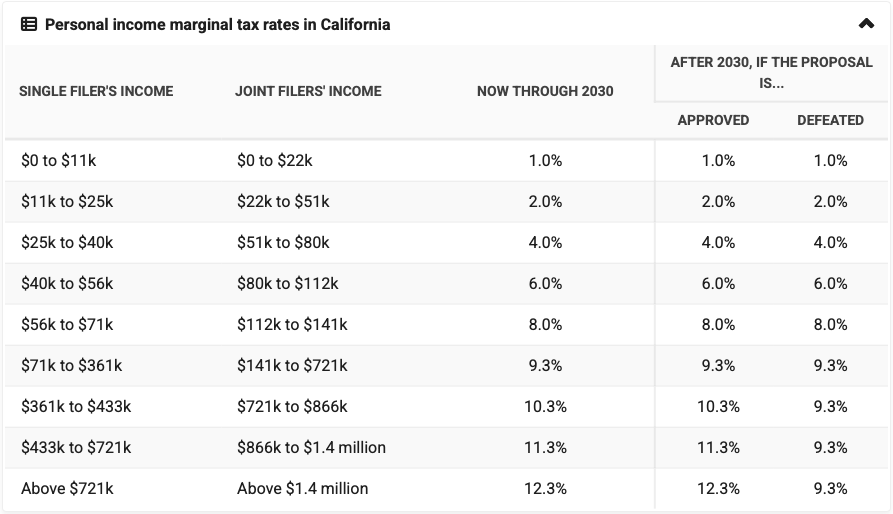
The initiative would continue the higher marginal income tax rates on income above $361,000 for single filers and $721,000 for joint filers. The initial tax rate in 2012 applied to incomes above $250,000 for single filers and $500,000 for joint filers, and Proposition 55 extended the rate for these brackets until 2031. Propositions 30 and 55 did not contain mechanisms to adjust the bracket threshold in response to inflation increases. The proposed initiative increases the threshold and ties it to inflation.
In California, the income tax bracket applies to a filer's portion of income within that bracket. The chart below shows the current rates through 2030 and the tax rates if it is approved or rejected.
The initiative would maintain that the revenue generated from the increased marginal tax would be divided with 89% to K-12 schools and 11% to state community colleges and deposited into the Education Protection Account (EPA). This division of revenue and account were adopted in 2012 with the approval of the tax. If there are funds in excess of the Proposition 98 education-funding requirement and education workload budget in the EPA, then 50% of the excess (not to exceed $2 billion per fiscal year) is required to be allocated to the state Department of Health Care Services. These funds must be used for critical, emergency, acute, and preventive health care for children and their families, primarily through Medi-Cal programs.
Californians for Protecting Public Education, Health Care and Budget Stability is leading the campaign in support of the initiative. It has reported over $10.25 million in contributions. It has received endorsements from California Teachers Association, AFSCME California, California Federation of Teachers, California Professional Firefighters, California School Employees Association, and SEIU California.
California Teachers Association President David Goldberg said, “It’s clear from the widespread support that the Prop. 55 extension received in the signature gathering process that our communities are committed to fighting for fully funded public schools. California is the 4th largest economy in the world, with egregious wealth disparity. We either vote to extend Prop. 55 now, or our state’s wealthiest get a tax break in 2030 while 1-in-6 educators lose their jobs. Seems like a common-sense choice.”
Wayne Winegarden, senior fellow at the Pacific Research Institute, opposes the extension. He said, “Extending these income tax rates, it’s hitting that same pressure points and it’s causing the same incentives to leave. And if you look at the latest IRS migration data, you can see it. People with greater means are leaving the state.”
The required number of signatures in California for an initiated constitutional amendment is 874,641, which equals 8% of the vote cast in the prior gubernatorial election.The campaign submitted 1,648,745 signatures, of which the secretary of state estimated that 72.49% were valid (about 1,195,175 signatures).
Signatures were submitted for a separate ballot initiative on April 27 that would levy a one-time 5% wealth tax on billionaires in the state to fund state healthcare programs, food assistance, and public education. The initiative is sponsored by SEIU-UHW.
Six other initiatives and three legislative referrals have qualified for the ballot. The measures address healthcare executive compensation, housing, health clinic spending, vote requirements on tax measures, voter ID, public financing of election campaigns, conducting recall elections, healthcare union political spending, and vote thresholds for ballot measures.
Signatures are pending for seven other California ballot initiatives. To see the list of measures, click here.
The deadline to qualify for the ballot is June 25 (131 days prior to the election).
Additional reading: