


Since 1821, New York voters have decided on 430 statewide ballot measures. Of those, 316 (73%) were approved, and 114 (27%) were defeated.
In New York, the state legislature can refer measures to the ballot. Citizens of New York do not have the power to initiate statewide ballot measures.
Ballot measures can also take the form of an automatic constitutional convention question, which appears on the ballot every 20 years under the New York Constitution. Alternatively, the state legislature can refer a constitutional convention question to the ballot. If a state constitutional convention is held, any amendments approved by delegates would be placed on the ballot for voters to decide.
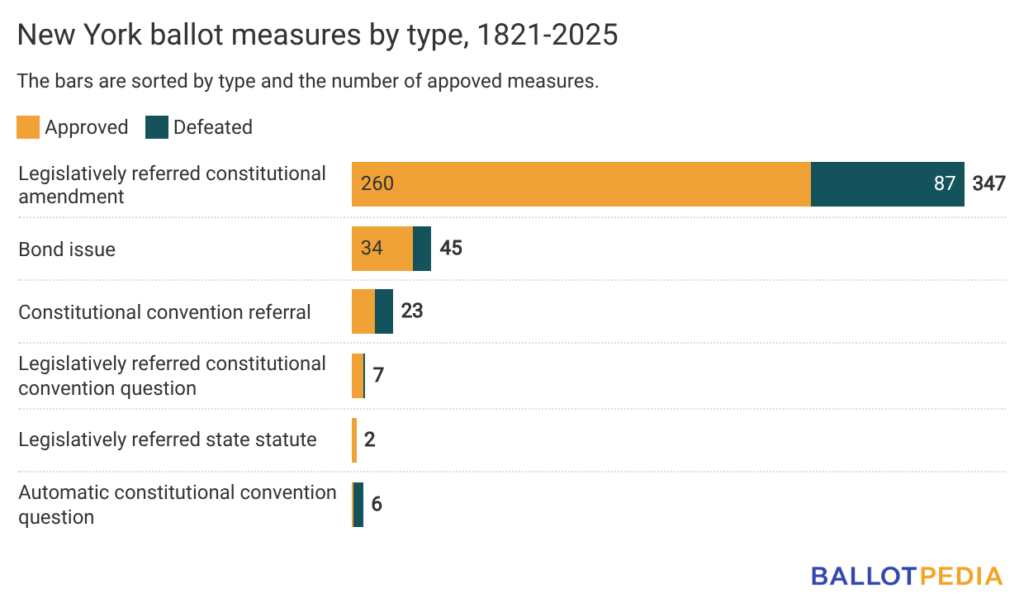
While the majority of ballot measures have been legislatively referred constitutional amendments — with a total of 347 (81%) measures — New York residents have also voted on 45 bond issues; 23 constitutional convention referrals; 13 constitutional convention questions; and two referred state statutes.
Throughout New York's history, 266 (75%) of the legislatively referred constitutional amendments and constitutional convention questions referred to the ballot by the state legislature were approved. Of the 23 constitutional convention referrals, 13 (57%) were approved. Of the six automatic constitutional convention questions, one (17%) was approved.
New York ballot measures have addressed 108 unique topics, ranging from state judicial authority to housing development funding. The most common topics that appeared on the ballot have been bond issues (56 measures), parks, land, and natural area conservation (35 measures), and debt limits (33 measures).
Below is a selection of notable ballot measures throughout New York's history. For a more comprehensive list, see here.
- In 1822, voters approved a measure to ratify the first state constitution submitted to them. The state's first constitution was from 1777, but the 1821 constitution was the first to be approved by voters.
- Voters initially rejected an amendment in 1915 that would have granted women the right to vote, but approved one in 1917 — three years before the ratification of the Nineteenth Amendment to the U.S. Constitution. Additionally, New Yorkers decided on three measures related to suffrage for African American men, rejecting two amendments in 1846 and 1860 that would have repealed a property tax requirement for them to vote, and approving an amendment in 1869 that upheld the requirement.
- In 1938, voters defeated Amendment 7, which would have prohibited proportional representation electoral systems in New York. This followed New York City voters' adoption of proportional representation for city council elections in 1936, which remained in effect until 1947.
- Voters have amended the Forever Wild clause, which said that state-owned land in the Adirondack and Catskill State Parks "shall be forever kept as wild forest lands," and prohibited their lease, sale, or exchange. New York residents amended this clause three times — in 1941, 1947, and 1987 — to permit the construction of ski trails and infrastructure while maintaining the protection of forest preserve lands.
- In 1975, voters approved an Equal Rights Amendment to the state constitution prohibiting discrimination based on sex. Voters expanded the Equal Rights Amendment in 2024 when they approved Proposal 1, which provided that people cannot be denied rights based on their "ethnicity, national origin, age, and disability" or "sex, including sexual orientation, gender identity, gender expression, pregnancy, pregnancy outcomes, and reproductive healthcare and autonomy."
- Voters approved an amendment — Proposal 1 — that created a redistricting commission and altered the state's redistricting process in 2014. In 2021, New Yorkers defeated an amendment that would have repealed the higher vote threshold for adopting redistricting plans when the legislature is controlled by a single party.
Of the 430 statewide ballot measures in New York, 13 were decided by less than one percentage point of the vote. The measure with the closest margin — Amendment 1 — would have elected two additional Associate Judges of the Court of Appeals, terminated the provision for the designation of Justices of the Supreme Court to serve as Associate Judges of the Court of Appeals, and increased the salaries of judges. Amendment 1 was defeated in 1910, with 332,300 (49.98%) voting 'Yes' and 332,592 (50.02%) voting 'No', leaving a margin of 0.04%.
The measure with the widest margin, at 99.16%, was decided in 1839. The amendment, which allowed the state legislature to provide for the annual election of city mayors by eligible male voters, rather than requiring mayors to be appointed annually by city councils, received 90,473 (99.58%) 'Yes' votes and 382 (0.42%) 'No' votes.
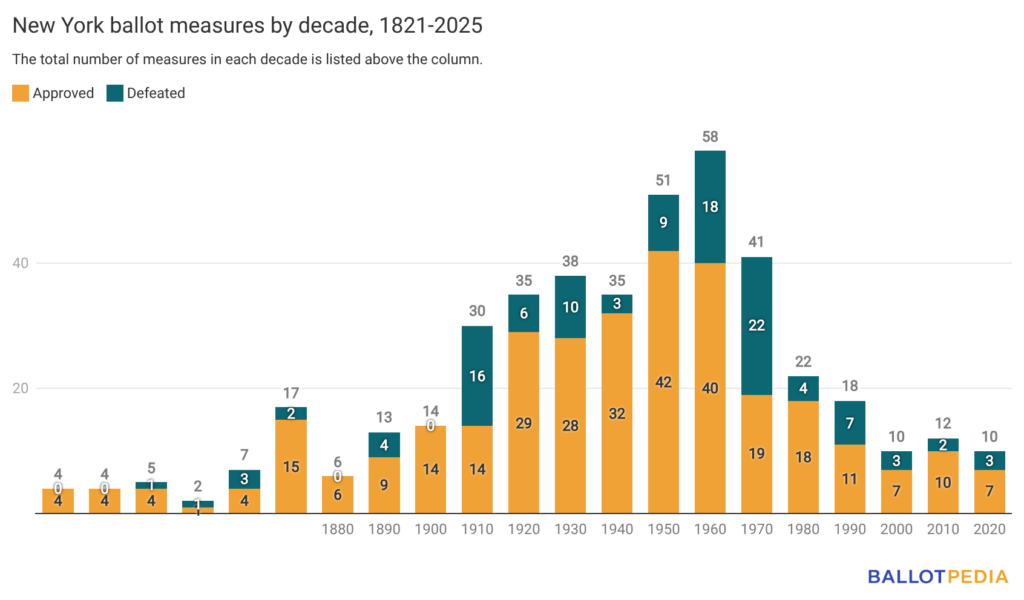
On average, New York voters have decided on 20 ballot measures per decade. The 1960s had the most ballot measures within a single decade, at 58. Of these, 40 (69%) were approved, and 18 (31%) were defeated. The decades with the highest approval rate — all at 100% — were the 1820s, 1830s, 1880s, and 1900s. The decade with the lowest approval rate was the 1970s. In the 1970s, there were 41 ballot measures. Of these, 19 (46%) were approved, and 22 (54%) were defeated.
The inventory of New York statewide ballot measures is part of Ballotpedia's Historical Ballot Measure Factbooks, which document nearly 200 years of direct democracy in the United States. This ongoing research effort will provide an unparalleled resource for researchers, reporters, and voters on how ballot measures have evolved, the issues they've covered, and the role they have played in our civic life.
Additional reading: