


Welcome to the Wednesday, June 17, 2026, Brew.
By: Lara Bonatesta
Here’s what’s in store for you as you start your day:
- Kansas could become the first state to change how its Supreme Court justices are selected since 2021
- Sixty-nine members of the U.S. Congress have announced they will not seek re-election in 2026, the most since 2018
- A comprehensive look at 204 years of ballot measures in New York
Kansas could become the first state to change how its Supreme Court justices are selected since 2021
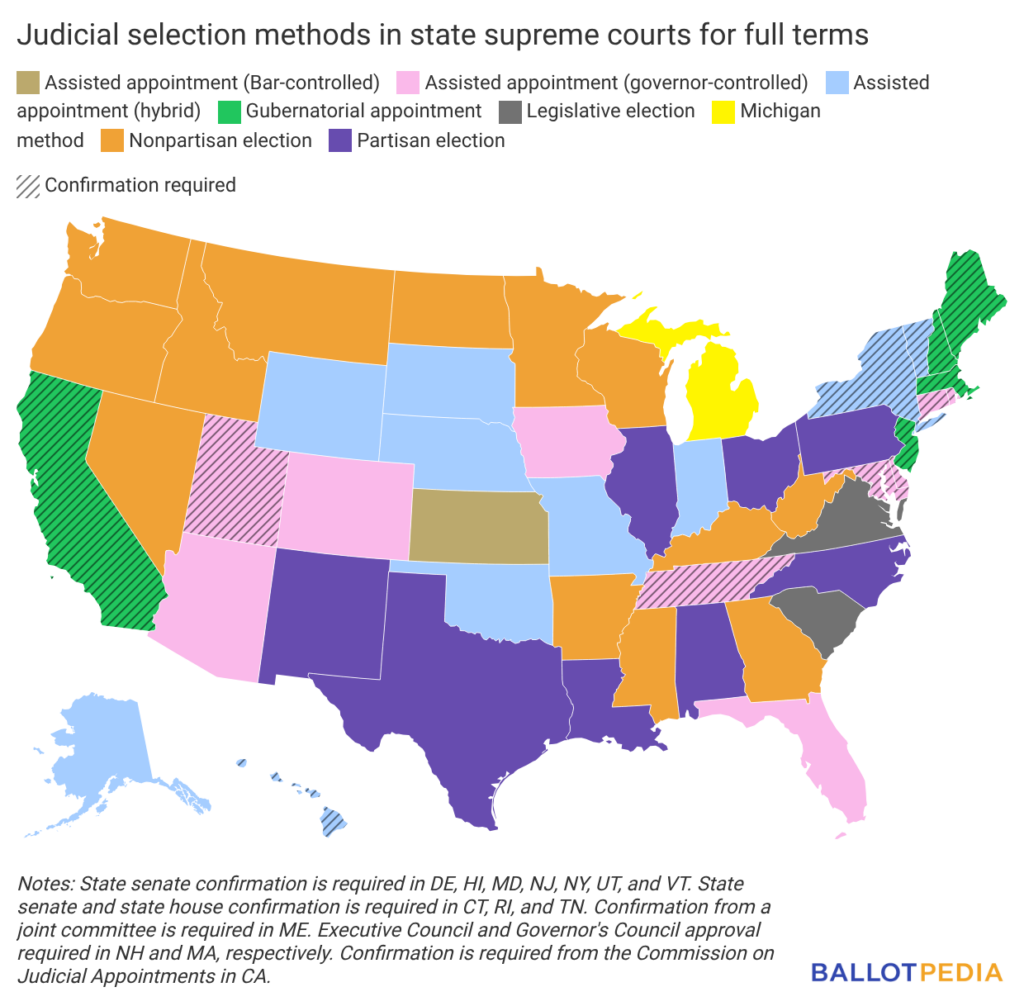
On Aug. 4, concurrent with its statewide primaries, Kansans will vote on a constitutional amendment to change the method for appointing state supreme court justices. If the measure passes, it will be the first time since 2021, when Ohio changed its supreme court elections, that a state has changed how it selects members of its supreme court. Ohio changed from using partisan primaries and nonpartisan general elections (known as the Michigan method) to using partisan primaries and partisan general elections.
The measure would change Kansas' judicial selection method from assisted appointment to direct election, and abolish the Kansas Supreme Court Nominating Commission.
The Kansas Legislature put the measure on the ballot when legislators passed Senate Concurrent Resolution 1611 (SCR 1611). On March 6, the state Senate approved it 27-13. Twenty-seven Republicans voted in favor of the amendment, while four Republicans and nine Democrats voted against it. On March 19, the state House approved the amendment 84-40. Eighty-four Republicans voted in favor, while four Republicans and 36 Democrats voted against it.
Supporters of the measure say that adopting elections would improve transparency. State Senate President Ty Masterson (R) said: “Critics of elections warn of politics but every system is political … Direct elections make the political dynamic explicit, not hidden in backrooms by bar members who think they’re better than the rest of us.”
Opponents of the measure said it resulted from the court issuing decisions that the Legislature disagreed with. ACLU of Kansas director Micah Kubic said: “This is a blatant attack by the legislators on our justices, and it’s part of a decades-long pattern of politicians attempting to punish the judicial branch for issuing decisions on education and reproductive freedom that they disagree with.”
Kansas is one of 21 states that uses the assisted appointment method, in which a nominating commission sends a list of applicants to the governor, who selects from that list. It is the only state in which the state Bar Association is responsible for appointing a majority of members of the nominating commission, while in other states the governor is responsible for appointing a majority of members, or neither the governor nor the state bar association are responsible for a majority of appointments.
After their initial appointment, Kansas Supreme Court justices must currently stand for a retention election, in which voters vote yes or no to retain them in office. In Ballotpedia’s analysis going back to 1990, no Kansas justice has lost a retention election, and no justice has received less than 52% of the vote in favor of retention. The average yes vote that justices received in retention elections in Kansas was 68.14.
The ballot measure would authorize the direct partisan election of justices and authorize the Kansas Legislature to develop rules for the elections. Twenty-one states directly elect state supreme court justices. Thirteen of them hold nonpartisan elections, and eight hold partisan elections.
Montana voters could also decide on a measure on their state supreme court selection method this year. Proponents recently filed signatures for a citizen-initiated constitutional amendment that would appear on the November ballot to add a section to the Montana Constitution stating that “Judicial elections shall remain nonpartisan.”
Montana has used nonpartisan judicial elections since 1936, but the requirement is in statute. If the amendment is approved, making judicial elections partisan would require another voter-approved constitutional amendment.
Click here to learn more about the measure in Kansas and here to learn more about the proposed measure in Montana. To read more about state supreme court selection methods, click here.
Sixty-nine members of the U.S. Congress have announced they will not seek re-election in 2026, the most since 2018
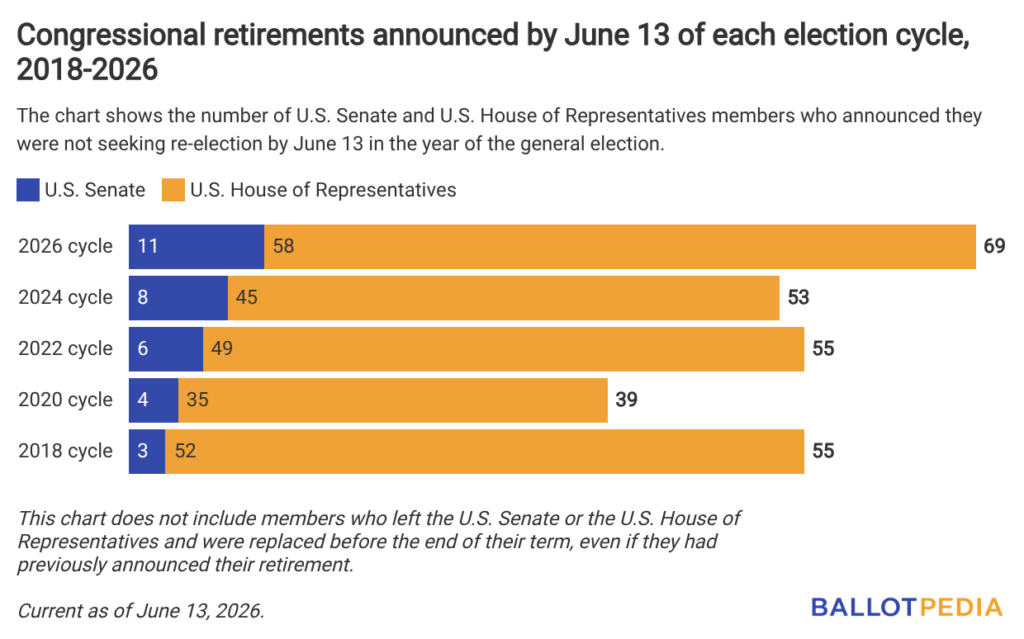
Sixty-nine members of the U.S. Congress — 58 U.S. representatives and 11 U.S. senators — have announced they will not seek re-election in 2026. This is the largest number of retirements as of this point since 2018. Retirements are up in both chambers.
Since our May 19 update, one member — Rep. Frederica Wilson (D-Fla.) — announced on May 29 that she is retiring from public office. Election forecasters have rated the 2026 general election for Florida's 24th Congressional District, which she currently represents, as either Solid or Safe Democratic.
U.S. House of Representatives
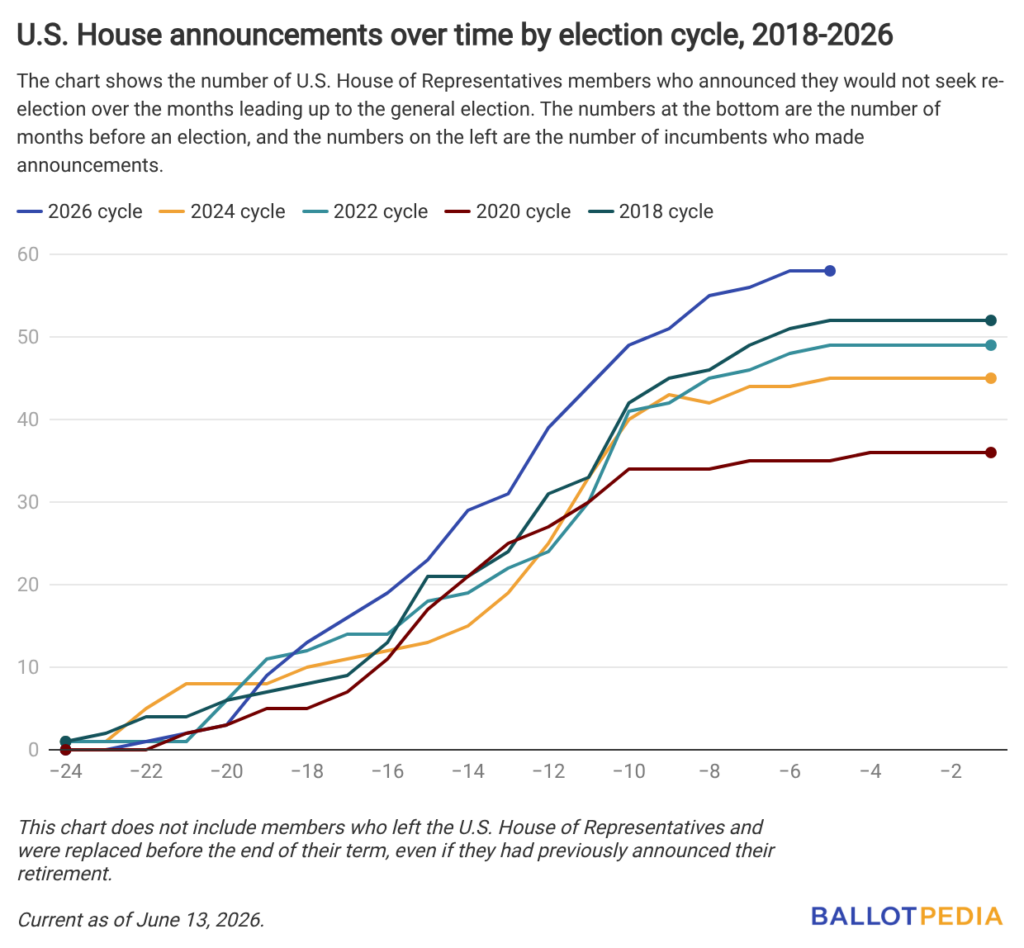
Fifty-eight U.S. representatives — 21 Democrats and 36 Republicans — will not seek re-election in 2026. Of the 58 members not seeking re-election:
- Thirty-one — 15 Democrats and 16 Republicans — are retiring from public office
- Sixteen — seven Democrats and nine Republicans — are running or ran for the U.S. Senate. So far, two candidates have won their primaries, two have advanced to primary runoffs, and four have lost their primaries.
- Ten — all Republicans — are running or ran for governor. One candidate has advanced to a primary runoff, three have lost their primaries.
- One Republican ran for state attorney general and lost in the primary runoff.
This is more retirements than there were at this point in the last four election cycles. There were 45 retirement announcements in 2024, 49 in 2022, 35 in 2020, and 52 in 2018.
Seven of the 58 retiring U.S. representatives — two Democrats and five Republicans — won by 10 percentage points or fewer in 2024. Three U.S. representatives — Jared Golden (D-Maine), Don Bacon (R-Neb.), and David Schweikert (R-Ariz.) — won by fewer than five percentage points.
U.S. Senate
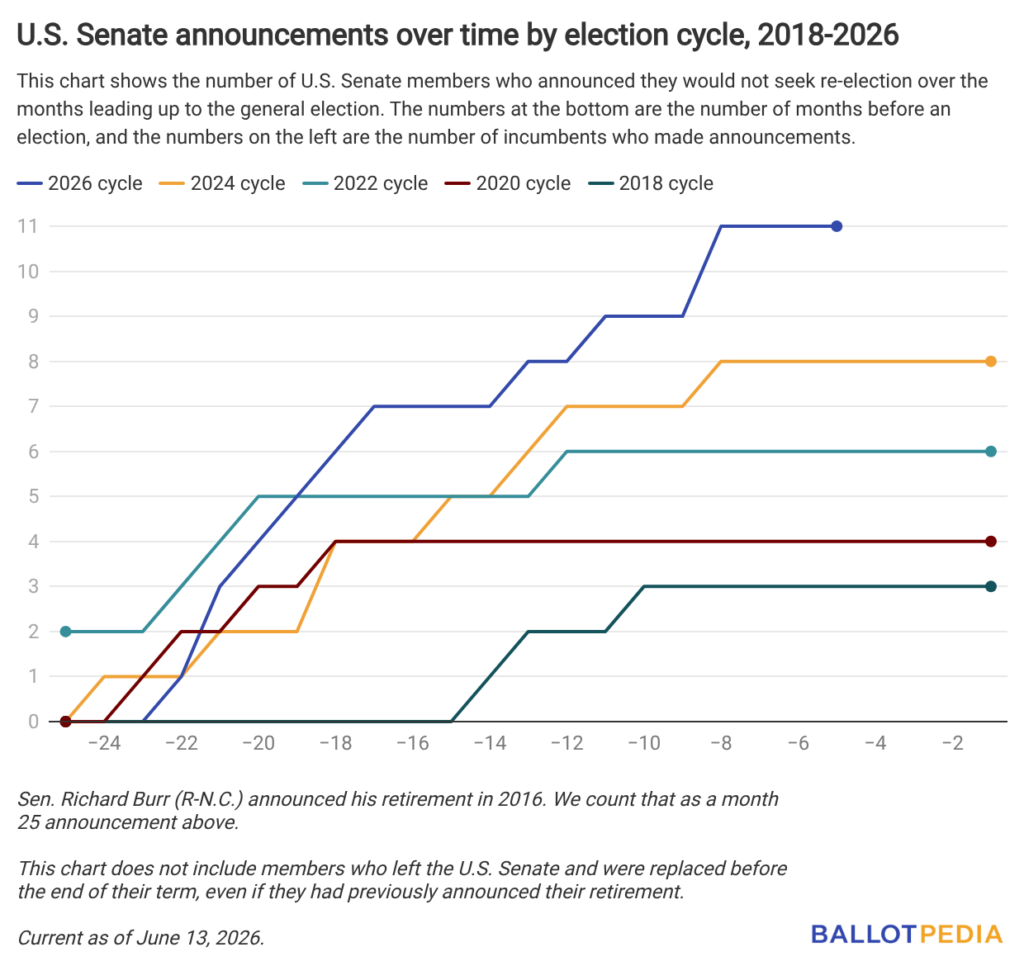
Eleven senators — four Democrats and seven Republicans — announced they will not seek re-election in 2026. Senators Alan Armstrong (R-Okla.), Steve Daines (R-Mont.), Cynthia Lummis (R-Wyo.), Joni Ernst (R-Iowa), Thom Tillis (R-N.C.), Dick Durbin (D-Ill.), Jeanne Shaheen (D-N.H.), Mitch McConnell (R-Ky.), Tina Smith (D-Minn.), and Gary Peters (D-Mich.) are retiring from public office. Sen. Tommy Tuberville (R-Ala.) is running for governor of Alabama.
This is more retirements than there were at this point in the last four election cycles. There were eight retirement announcements in 2024, six in 2022, four in 2020, and three in 2018.
Looking at the last time those 10 U.S. senators ran in 2020, five of them — two Democrats and three Republicans — won by 10 percentage points or less. Tillis and Peters won by less than five percentage points. Armstrong — who was appointed to the U.S. Senate in 2026 — was not on the ballot in 2020.
Between January 2011 and June 2026, 416 U.S. Senate and House incumbents announced they would not seek re-election. The 74 retirement announcements in January are the most of any month. June had the fewest at 16.
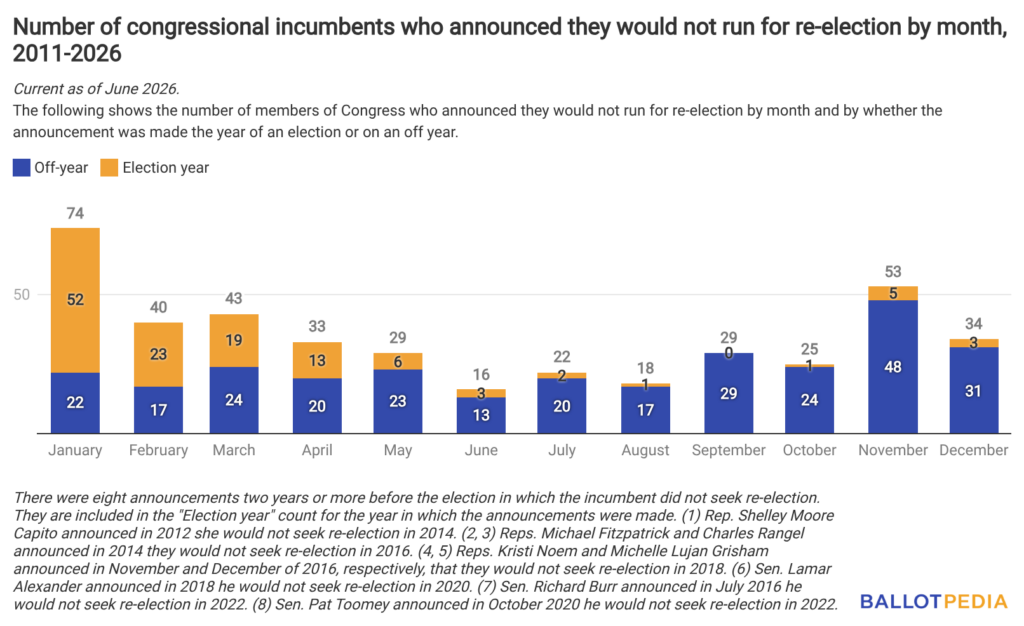
Click here to read more about congressional retirements this year.
A comprehensive look at 204 years of ballot measures in New York
Since 1821, New York voters have decided on 431 statewide ballot measures. Of those, 316 (73%) were approved, and 114 (27%) were defeated.
In New York, the Legislature can refer measures to the ballot. New York does not have a citizen initiative process.
Ballot measures can also be an automatic constitutional convention question, which is constitutionally required to appear on the ballot every 20 years. The Legislature can also refer a constitutional convention question to the ballot. Any amendments that convention delegates approve would be placed on the ballot for voters to decide.
Voters approved 266 (75%) of the legislatively referred constitutional amendments and referred constitutional convention questions. Of the 23 constitutional convention referrals, 13 (57%) were approved. Of the six automatic constitutional convention questions, one (17%) was approved.
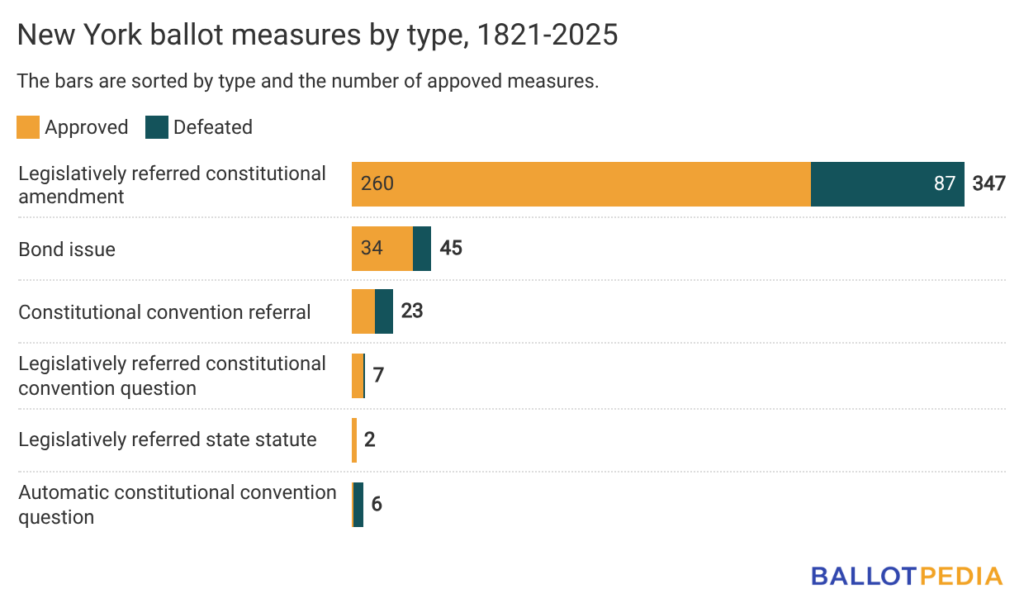
New York ballot measures have addressed 108 unique topics, ranging from state judicial authority to housing development funding. The most common topics have been bond issues (56 measures), parks, land, and natural area conservation (35 measures), and debt limits (33 measures).
Below is a selection of notable ballot measures throughout New York's history. For a more comprehensive list, see here.
- In 1822, voters approved a measure to ratify the first state constitution submitted to them. The state's first constitution was from 1777, but the 1821 constitution was the first that voters approved.
- Voters have amended the Forever Wild clause, which said that state-owned land in the Adirondack and Catskill State Parks "shall be forever kept as wild forest lands," and prohibited their lease, sale, or exchange. New York residents amended this clause three times — in 1941, 1947, and 1987 — to permit the construction of ski trails and infrastructure while maintaining the protection of forest preserve lands.
- In 1975, voters approved an Equal Rights Amendment to the state constitution prohibiting discrimination based on sex. Voters expanded the Equal Rights Amendment in 2024 when they approved Proposal 1, which provided that people cannot be denied rights based on their "ethnicity, national origin, age, and disability" or "sex, including sexual orientation, gender identity, gender expression, pregnancy, pregnancy outcomes, and reproductive healthcare and autonomy."
- In 2014, voters approved another amendment — called Proposal 1 — that created a redistricting commission and altered the state's redistricting process. In 2021, New Yorkers defeated an amendment that would have repealed the higher vote threshold for adopting redistricting plans when a single party controls the Legislature.
Thirteen of New York’s ballot measures were decided by less than one percentage point of the vote. The measure with the closest margin — Amendment 1 (1910) — would have elected two additional Associate Judges of the Court of Appeals, terminated the provision for the designation of Justices of the Supreme Court to serve as Associate Judges of the Court of Appeals, and increased the salaries of judges. It was defeated with 332,300 (49.98%) voting 'Yes' and 332,592 (50.02%) voting 'No', a margin of 0.04%.
The measure with the largest margin, at 99.16%, was decided in 1839. The amendment allowed the Legislature to provide for eligible male voters to elect city mayors annually, rather than requiring city council members to appoint mayors annually. It received 90,473 (99.58%) 'Yes' votes and 382 (0.42%) 'No' votes.
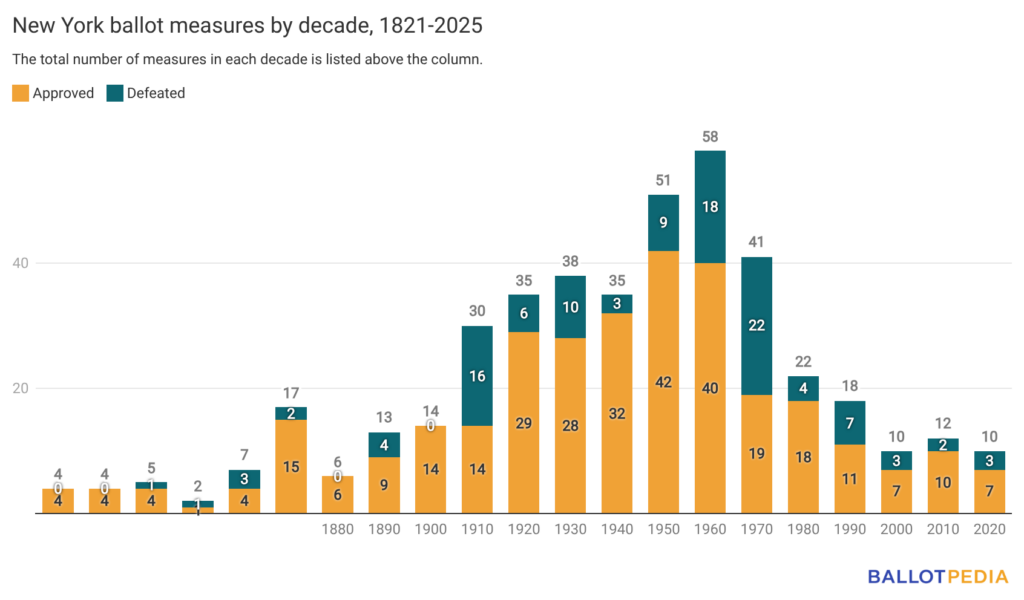
Ballotpedia's Historical Ballot Measure Factbooks document nearly 200 years of direct democracy in the United States. This ongoing research effort will provide an unparalleled resource for researchers, reporters, and voters on how ballot measures have evolved, the issues they've covered, and the role they have played in our civic life.
Click here to see our New York factbook.