


Welcome to the Wednesday, June 24, 2026, Brew.
By: Briana Ryan
Here’s what’s in store for you as you start your day:
- California billionaire’s tax qualifies for the Nov. 3 ballot
- Five candidates are running in the open Republican primary for Missouri's 6th Congressional District
- This year marks the 10th time since 1960 that a former Alaska governor is running for a non-consecutive term
California billionaire’s tax qualifies for the Nov. 3 ballot
On June 17, the California Secretary of State announced that the California One-Time Wealth Tax for State-Funded Healthcare, Education, and Food Assistance Programs Initiative, which would levy a one-time 5% tax on the net worth of the state's billionaires, qualified for the Nov. 3 ballot. The California Secretary of State reported that at least 980,438 of the more than 1.6 million signatures filed were valid.
The Service Employees International Union-United Healthcare Workers West (SEIU-UHW West), a labor union for healthcare workers, is sponsoring the initiative. The tax would be retroactive and apply to any billionaire residing in the state as of Jan. 1, 2026. The tax would be due with an individual's 2027 tax filings. The initiative would allow individuals to pay the tax in five equal installments beginning in 2027, with each subsequent payment subject to an annual deferral charge of 7.5% of the remaining unpaid balance.
The initiative would create the 2026 Billionaire Tax Reserve Fund, where all taxes, interest, and penalties resulting from the initiative would be deposited. The initiative would fund reductions in federal spending or state appropriations; Medi-Cal and other health coverage programs for low- and moderate-income individuals; health care access, benefits, and services; public education from K-14; and food assistance programs such as CalFresh, CalFAP, CalFood, or California's Universal Meals Program for school meals.
U.S. Sen. Bernie Sanders (I-Vt.), U.S. Rep. Ro Khanna (D-Calif.), California Democratic Socialists of America, Teamsters California, and UNITE HERE Local 11 support the initiative.
Economists Emmanuel Saez and Gabriel Zucman argued that "California’s tech sector produces billionaires faster than any other state’s. Its superrich — who have benefited from the state’s infrastructure, universities and networks of people and businesses — have accumulated enormous fortunes almost tax-free. The proposed billionaire tax would finally make them contribute in modest proportion to their gains. In November, California’s voters should show the nation the way forward."
Governor Gavin Newsom (D), U.S. Rep. Kevin Kiley (I-Calif.), San Francisco Mayor Daniel Lurie, and gubernatorial candidate Steve Hilton (R) oppose the initiative.
Newsom said, “It’s really damaging to the state. ... The evidence is in. The impacts are very real — not just substantive economic impacts in terms of the revenue, but start-ups, the indirect impacts of … people questioning long term-commitments, medium-term. That’s not what we need right now, at a time of so much uncertainty. Quite the contrary.”
The deadline to qualify or withdraw an initiative in California is June 25 — 131 days before the election. Politico's Jeremy B. White reported that Newsom has been trying to negotiate with the union to withdraw the initiative from the ballot before the deadline. SEIU-UHW West Chief of Staff Suzanne Jimenez said the union was "fully open to collaborating on concrete solutions that solve the problems created by Congress."
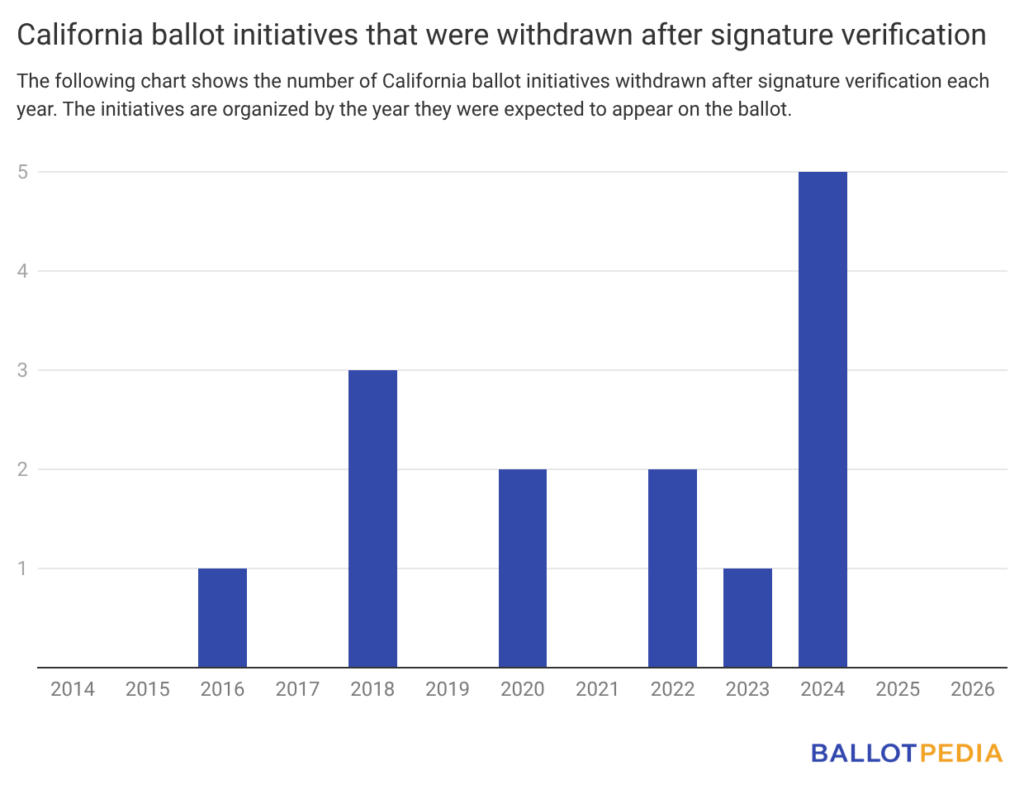
Since the law authorizing initiatives to be withdrawn from the ballot was enacted in 2014, 14 initiatives have been withdrawn after qualification.
Building a Better California, whose primary funder is Google co-founder Sergey Brin, is funding two ballot initiatives to nullify the billionaires' tax. Sponsors filed signatures for the initiatives on May 4, and the final random sample counts are due June 24. The initiatives are constitutional amendments that would:
- prohibit the enactment of new taxes after Jan. 1, 2026, on ownership or accumulation of retirement holdings, individually-owned assets, and other forms of personal savings
- require state laws or ballot initiatives levying a new special tax, which is any tax imposed for specific purposes, enacted after Jan. 1, 2026, to undergo state audits to determine program effectiveness and cost-saving measures
One initiative on the ballot this year that would not affect the billionaires' tax, but would affect future measures like it, is the California Require Healthcare Union Member Approval for Ballot Measure Campaign Spending Initiative. The initiative would require healthcare labor unions to inform members annually how member dues are being spent on political activities and require a majority of members to approve contributions and expenditures on state and local ballot measures.
Click here for more information about the California One-Time Wealth Tax for State-Funded Healthcare, Education, and Food Assistance Programs Initiative, and here to check out the other 13 measures California voters will decide this year.
Five candidates are running in the open Republican primary for Missouri's 6th Congressional District
Five candidates are running in the Aug. 4 Republican primary for Missouri's 6th Congressional District — a race that the Missouri Independent's Jason Hancock wrote, "could become a proxy war between Trumpworld and Jeff Roe's political universe."
Roe is a political consultant, former chief of staff to the District's incumbent Rep. Sam Graves (R), and founder of the Republican political firm Axiom Strategies. In 2024, Roe supported Gov. Ron DeSantis' (R-Fla.) presidential bid. According to Politico's Daniel Lippman, President Donald Trump (R) and his advisers "told down-ballot Republican candidates not to hire Republican strategist Jeff Roe or his political consulting firm after Roe worked to elect Ron DeSantis."
Graves, who was first elected in 2000, is not seeking re-election. Two of the candidates running to succeed him — Chris Stigall (R) and Nathan Willett (R) — lead in media attention.
Roe has not commented publicly on the race, though Willett has referenced him in campaign releases. After Graves endorsed Stigall, Willett posted on X, "For 26 years Congressman Sam Graves has represented North Missouri. He and his anti-Trump (Jeff Roe) political consultant are trying to hand pick the next person to come after him for the next 26 years." Graves is one of 22 retiring members of the U.S. House of Representatives who endorsed a successor this year.
Stigall said that he was unaware of Graves' retirement: "I didn't know anything about him even leaving his seat until — what was it, a week ago? I knew a couple of days before he made it public that he was going to retire ... But I was not privy to it."
Stigall is a radio host and former field representative for Graves. He has campaigned on his experience in broadcasting, saying it will prepare him to communicate with constituents: "[A]fter 25 years of being behind a microphone, talking about the issues, doing battle, communicating with politicians, understanding and studying the ways of Washington — I thought the effort needs better communicators ... So I'm going to head to DC, and I hope to communicate with people a little bit better about what I see and what's going on and how to better voice their concerns."
Willett is a member of the Kansas City City Council. He is campaigning as an outsider and criticized Graves' endorsement of Stigall: "As conservatives, we don't believe in rigging elections — [Graves] tried to with his last minute retirement announcement but I am giving the voters a choice. The people of North Missouri should decide their next Congressman — not the DC swamp."
Jim Ingram (R), Cody Oshel (R), and Nathanael Schultz (R) are also running in the Republican primary.
Click here to read more about the Republican primary for Missouri's 6th Congressional District. Also, if you're a Utah voter, check out our Sample Ballot Lookup here to prepare for Election Day.
This year marks the 10th time since 1960 that a former Alaska governor is running for a non-consecutive term
On June 1, former Alaska Gov. Bill Walker (I) filed to run for governor, marking the 10th time a former Alaska governor ran for a non-consecutive term.
Walker served as governor from 2014 to 2018. In 2022, Walker ran for a non-consecutive term as governor. In the four-candidate general election, Walker came in third with 21% of the vote behind Les Gara’s (D) 24% and incumbent Gov. Mike Dunleavy’s (R) 50%.
Since 1960, there have been 135 instances in which 102 former governors ran for non-consecutive terms. Some of those governors ran more than once for a non-consecutive term.
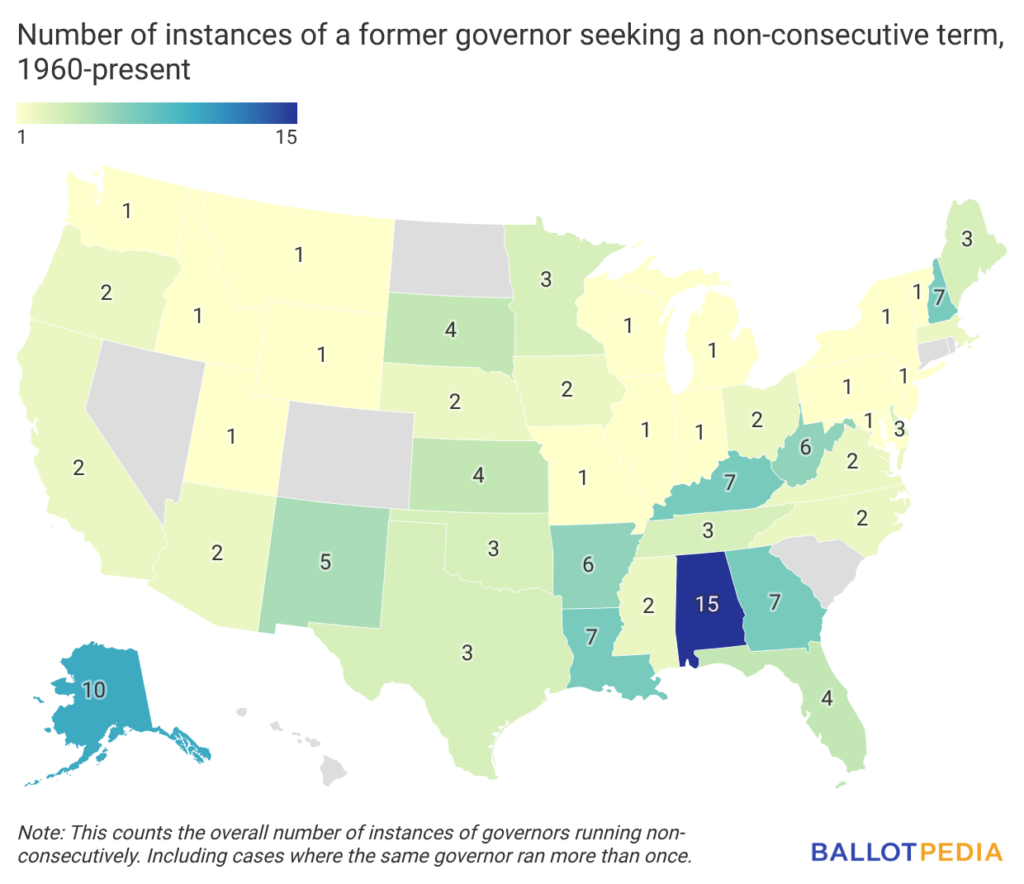
Alaska has the second-highest number of former governors who ran for non-consecutive terms, with 10 instances across nine elections. The first instance happened in 1962 when former territorial Gov. Mike Stepovich (R) ran for governor of the state. In the general election, William Egan (D) defeated Stepovich 52% to 48%.
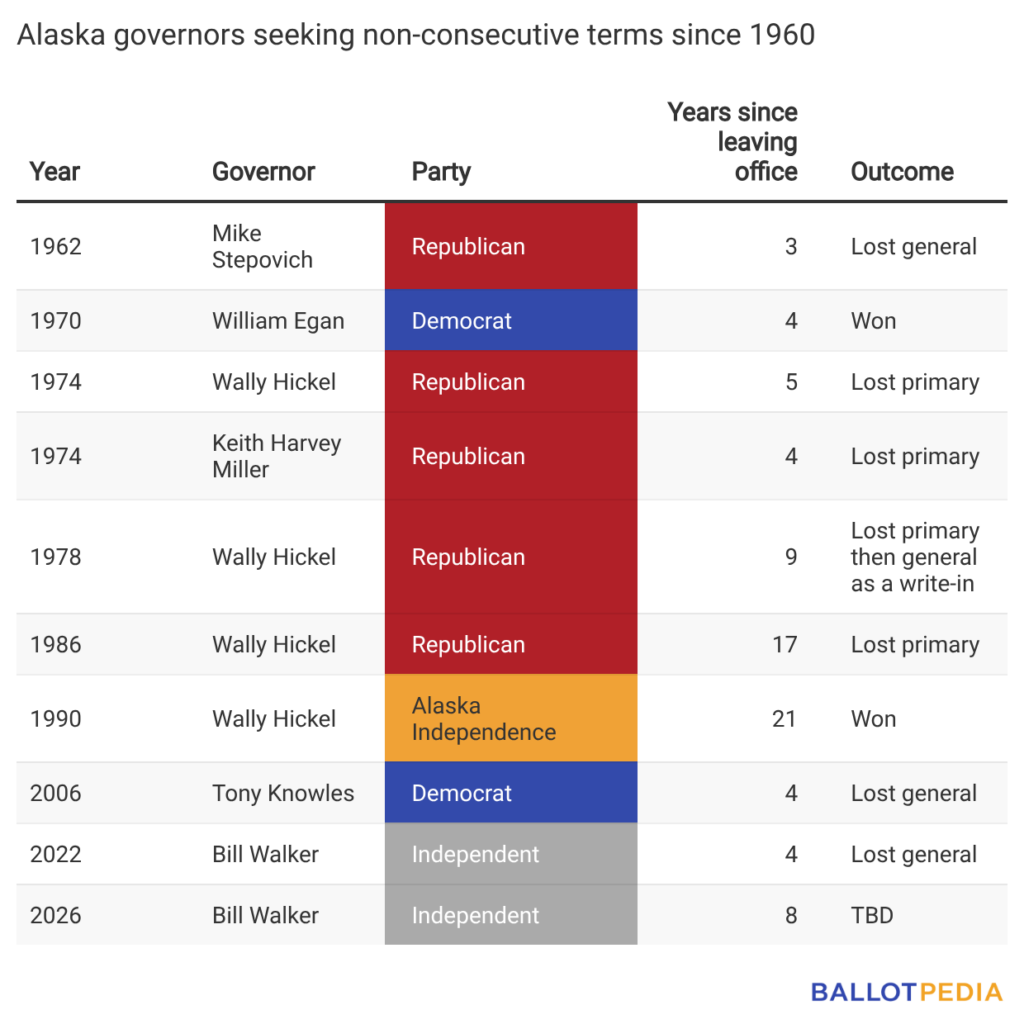
The former governor who ran for non-consecutive terms the most was Wally Hickel. He ran three times as a Republican, and once as a member of the Alaska Independence Party.
In 1974, Hickel lost the Republican primary. In 1978, he lost both the Republican primary and the general election as a write-in candidate. In 1986, Hickel lost the Republican primary again. In 1990, he won the general election as a member of the Alaska Independence Party. Walker is the only other Alaska governor to run for a non-consecutive term more than once, running in 2022 and 2026.
Nationally, former governors have waited an average of eight years after leaving office before they ran for a non-consecutive term. Former Minnesota Gov. Harold Stassen (R) had the longest gap between leaving office and running for a non-consecutive term, at 39 years.
In Alaska, former governors have waited an average of 7.9 years after leaving office before they ran for a non-consecutive term. Hickel had the longest gap between leaving office and running for a non-consecutive term, at 21 years.
Only two former Alaska governors have won non-consecutive terms since 1960 — Egan in 1970 and Hickel in 1990.
Nationally, Walker is the only governor running for a non-consecutive term this year. Former Kansas Gov. Jeff Colyer (R) announced a campaign, but ultimately did not file to run.
Click here to read more about the gubernatorial election in Alaska this year, and here for more information about all of the gubernatorial elections happening this year.