


Welcome to the Monday, June 29, 2026, Brew.
By: Lara Bonatesta
Here’s what’s in store for you as you start your day:
- U.S. House campaign committees are targeting a combined 74 districts this election cycle
- Two California initiatives challenging billionaires’ tax initiative qualify for the ballot
- Seventy-eight years ago today, North Dakota voters approved a measure to ban parking meters
U.S. House campaign committees are targeting a combined 74 districts this election cycle
The Democratic Congressional Campaign Committee (DCCC) and the National Republican Congressional Committee (NRCC) are targeting a combined 74 congressional districts this election cycle.
The DCCC and NRCC are subsidiaries of the Democratic Party and the Republican Party, respectively. The goal of both committees is to elect members of their parties to the U.S. House of Representatives. Both committees provide the candidates running in their respective target districts with research, polling, and funding.
Among the 74 districts, the DCCC is targeting 45, and the NRCC is targeting 29. Among the 74 districts, the DCCC is targeting 45, and the NRCC is targeting 29. 
The DCCC's 45 target districts
The DCCC is targeting three Democratic-held districts and 42 Republican-held districts. Two of those Democratic-held target districts and eight of those Republican-held target districts are open.
Of the three Democratic-held target districts, Rep. Jared Golden (D), who is not running for re-election in Maine's 2nd Congressional District, had the narrowest margin of victory (MOV) in the 2024 general election. Golden defeated Austin Theriault (R) 50.3% to 49.7%. Representative Greg Casar (D) in Texas' 35th Congressional District had the largest MOV in the 2024 general election. Casar defeated Steven Wright (R) 67.4% to 32.6%. The boundaries of District 35 changed when Texas adopted a new congressional map in 2025. After redistricting, major race forecasters changed their race ratings from Solid/Safe Democratic to Lean/Likely Republican.
Of the 42 Republican-held target districts, Rep. Mariannette Miller-Meeks (R) in Iowa's 1st Congressional District had the narrowest MOV in the 2024 general election. Miller-Meeks defeated Christina Bohannan (D) 50% to 49.8%. Rep. Andy Barr (R) in Kentucky's 6th Congressional District had the largest MOV in the 2024 general election. Barr defeated Randy Cravens (D) 63.4% to 36.6%.
Democrats are also targeting North Carolina's 3rd Congressional District, where Rep. Gregory Murphy (R) ran without major party opposition in 2024. This year, he has a Democratic opponent, Raymond Smith Jr. (D).
The DCCC is targeting six districts that Kamala Harris (D) won in the 2024 presidential election, and 39 districts that President Donald Trump (R) won.
Of the six districts that Harris won, Pennsylvania's 1st Congressional District had the narrowest MOV, with Harris defeating Trump 49.7% to 49.4%. California's 6th Congressional District had the largest MOV, with Harris defeating Trump 52.6% to 44.2%.
Of the 39 districts that Trump won, Virginia's 2nd Congressional District had the narrowest MOV, with Trump defeating Harris 49.5% to 49.3%. Ohio's 10th Congressional District had the largest MOV, with Trump defeating Harris 54.5% to 44.7%.
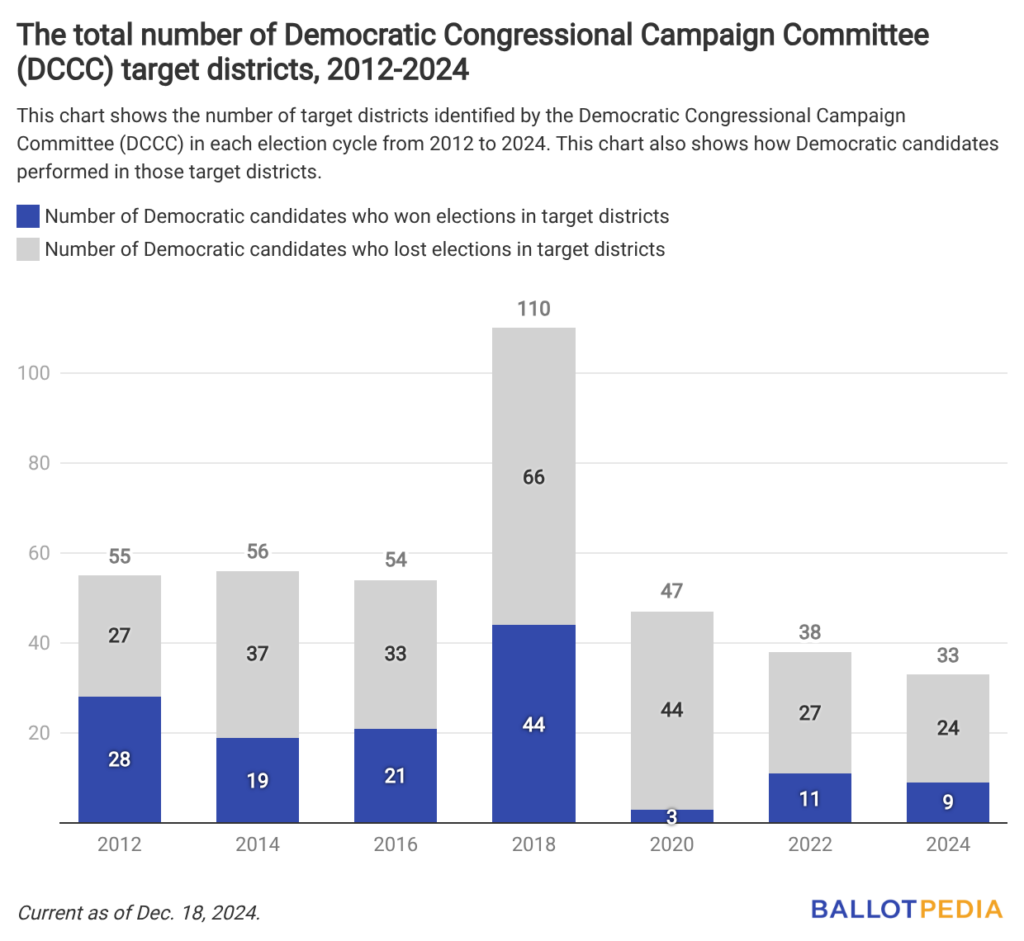
From 2012 to 2024, the DCCC identified a total of 394 target districts. The DCCC won a total of 135 (34.3%) target districts and lost 258 (65.5%).
The NRCC's 29 target districts
The NRCC is targeting 29 Democratic-held districts, five of which are open.
Of the 29 target districts, Rep. Adam Gray (D) in California's 13th Congressional District had the narrowest MOV in the 2024 general election. Gray defeated incumbent Rep. John Duarte (R) by 187 votes. The boundaries of District 13 after California adopted a new congressional map in 2025. In 2024, Donald Trump defeated Kamala Harris 51.4 to 46% in the district. Under the new map, Harris would have defeated Trump 48.84% to 48.38.% in the district.
The NRCC is also targeting Texas' 9th Congressional District. In 2024, incumbent Rep. Al Green (D) ran without major party opposition in 2024. This year, following the state’s adoption of a new congressional map in 2025, Green ran unsuccessfully in the 18th District, and the 9th District is open.
Like the DCCC, the NRCC is also targeting Texas' 35th Congressional District. Casar had the largest MOV among the incumbents of the NRCC's 29 target districts.
The NRCC is targeting 16 districts that Harris won in the 2024 presidential election, and 13 districts that Trump won.
Of the 16 districts that Harris won, California's 13th Congressional District and Indiana's 1st Congressional District had the narrowest MOVs. In California's 13th Congressional District, Harris defeated Trump 48.8% to 48.4%. In Indiana's 1st Congressional District, Harris defeated Trump 49.4% to 49.0%
Harris' largest MOV among the target districts was in California's 27th Congressional District, where she defeated Trump 53.3% to 43.7%.
Of the 13 target districts that Trump won, Nevada's 3rd Congressional District and New Jersey's 9th Congressional District had the narrowest MOVs. In Nevada's 3rd Congressional District, Trump defeated Harris 50% to 49%. In New Jersey's 9th Congressional District, Trump defeated Harris 49% to 48%. Trump's largest MOV among target districts was in Maine's 2nd Congressional District, in which he defeated Harris 53.5% to 44.5%.
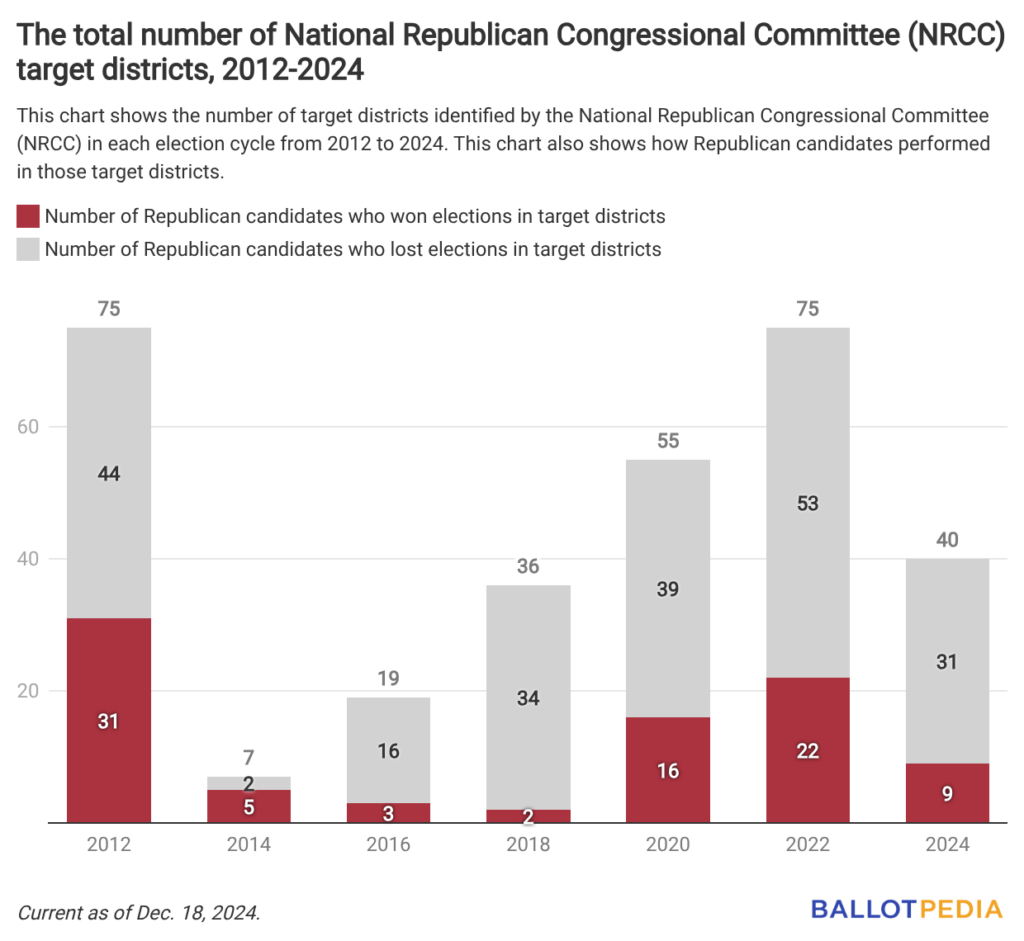
From 2012 to 2024, the NRCC identified a total of 307 target districts. The NRCC won a total of 88 (28.7%) target districts and lost 219 (71.3%).
Click here to read more about the DCCC's target districts, and here to read more about the NRCC's target districts. Also, click here to check out information about this year's U.S. House elections.
Two California initiatives challenging billionaires’ tax initiative qualify for the ballot
California voters will decide a slate of competing tax measures in November. The secretary of state reported that two ballot initiatives that challenge provisions of the billionaires’ tax initiative, which qualified for the ballot on June 24. The initiatives are both constitutional amendments.
- The Prohibit Excluding New State Taxes from Spending Limit and Require Special Tax Audits Initiative would prohibit the enactment of new taxes after Jan. 1, 2026, on the ownership or control of retirement holdings, individually owned assets, and other forms of personal savings. It would also prohibit retroactive taxes that impose liability based on conduct, activities, or a status that occurred or existed before the tax took effect.
- The Prohibit New Taxes on Retirement Holdings, Personal Assets, and Savings and Limit Retroactive Taxes Initiative would require state laws or ballot initiatives enacted after Jan. 1, 2026, that impose new special taxes undergo state audits evaluating program effectiveness and potential cost savings. It would also prohibit the state from enforcing any tax enacted or taking effect on or after Jan. 1, 2026, that is exempt from or excluded from the state spending limit.
SEIU-UHW, a labor union representing the state’s healthcare workers, sponsored the billionaires' tax, which qualified for the ballot on June 17. The initiative would enact a one-time tax of 5% on an individual's net worth exceeding $1 billion. The tax would be retroactive and apply to any billionaire residing in the state as of Jan. 1, 2026. Revenue from the tax would restore or address reductions in federal funding or state appropriations in programs such as:
- Medi-Cal and other health coverage programs for low- and moderate-income individuals
- health care access, benefits, and services
- public education from K-14 (which includes traditional K-12 education plus two years of community college)
- food assistance programs such as CalFresh, CalFAP, CalFood, or California's Universal Meals Program for school meals.
Both initiatives challenging the billionaires’ tax say they would prevail over competing measures if they get more yes votes.
The Prohibit Excluding New State Taxes from Spending Limit and Require Special Tax Audits Initiative states that if it receives more votes than a competing measure, it would prevail in its entirety over any other measures related to taxing personal assets.
The Prohibit New Taxes on Retirement Holdings, Personal Assets, and Savings and Limit Retroactive Taxes Initiative states that ballot measures appearing on the same statewide election ballot that either impose different audit rules or impose a state tax exempt from the state spending limit would be deemed in conflict with it. If the initiative is approved and receives more yes votes than the competing measure, it prevails over the other measure in its entirety. If both measures are approved and the competing measure receives more yes votes but is later ruled invalid, the initiative would take effect.
The group backing the Prohibit Excluding New State Taxes from Spending Limit and Require Special Tax Audits Initiative is called Californians to Protect Retirement and Life Savings. The campaign submitted more than 1.6 million signatures. The secretary of state reported that more than 1 million were valid or projected to be valid from a random sample count.
Californians for a More Transparent and Effective Government is leading the campaign in support of the tax audit initiative. The campaign submitted more than 1.5 million signatures for verification, of which 979,433 were valid or projected to be valid. The signature requirement for initiated constitutional amendments is 874,641 valid signatures (8% of the votes cast in the last gubernatorial election).
All of the contributions for both measures were from Building a Better California, which has received $57 million from Google co-founder Sergey Brin. Together, the campaigns reported raising more than $56.4 million as of March 30, the last campaign finance deadline.
In California, the deadline to qualify for the ballot was June 25 (131 days before the election). Sponsors of qualified ballot initiatives had until 5 p.m. on that day to withdraw qualified measures. Cal Matters reported Gov. Gavin Newsom (D) and state leaders were negotiating with the sponsors of the billionaires’ tax in hopes of keeping it off the ballot. Proponents ultimately did not withdraw the measure.
Two dueling ballot initiatives backed by Uber and Consumer Attorneys of California were removed from the ballot after qualifying last week. Since 2014, when the state authorized campaigns to withdraw qualified initiatives from the ballot 131 days before the election, sponsors have withdrawn 19 ballot initiatives.
There are 14 measures on the California ballot in November, including nine ballot initiatives and five legislative referrals. To see the complete list of measures, click here.
Click here to read more about California’s 2026 ballot measures.
Seventy-eight years ago today, North Dakota voters approved a measure to ban parking meters
On this day, June 29, 1948, North Dakota voters approved a ballot measure to ban parking meters on all public streets.
The measure, which appeared on the ballot as Initiative 2, prohibited the use of parking meters, or any devices "requiring the deposit therein of coins or tokens for the privilege of parking cars or vehicles", in all political subdivisions across the state. Voters approved Initiative 2, 50.66% to 49.34%.
Howard Henry — a farmer and the Democratic Party's 1948 gubernatorial nominee — led support for Initiative 2 after he received parking tickets on his regular business commute to Minot.
On Nov. 2, 1948, voters defeated another ballot measure, Initiative 1, that would have repealed the parking meter ban. Voters defeated Initiative 1 55.64% to 44.36%.
Since then, the North Dakota Legislative Assembly has attempted to repeal the ban on two occasions.
In 1951, the Legislature passed a law by a two-thirds vote to repeal the ban. The law was put to a referendum — which Howard Henry led once again — and appeared on the ballot on June 24, 1952, as Referendum 1. Voters defeated Referendum 1 50.95% to 49.05%, upholding the parking meter ban.
In 2017, the Legislature attempted to pass Senate Bill 2247 (SB 2247). The North Dakota Senate initially approved SB 2247 33-10, while the North Dakota House of Representatives approved an amended version 53-38. After a joint conference committee, the state Senate approved the committee-adopted version 33-13 vote, but the state House rejected it 59-29.
At the time, Gov. Doug Burgum (R) said he was "disappointed that we've missed an overdue opportunity to restore a small, missing piece of local control to political subdivisions and that [North Dakota will] continue to be the only state in the nation denying cities a tool that helps support locally owned retailers and boosts economic activity in core business districts."
Click here to learn more about the 1948 parking meter initiative in North Dakota.