


Seventeen months into President Donald Trump's (R) second administration, a historically high number of ambassador posts remain vacant. According to the American Foreign Service Association (AFSA), an unprecedentedly high percentage of ambassadors appointed during Trump's second term have been political appointees.
Ambassadors are the highest-ranking U.S. representative to their appointed countries or international organizations. Article II, Section 2, Clause 2 of the U.S. Constitution grants the president the authority to appoint ambassadors with the advice and consent of the U.S. Senate.
When an ambassadorial post is vacant, a chargé d’affaires ad interim serves as the senior officer in charge of the mission. According to the Wall Street Journal, these officials do not have the same level of access and influence as an ambassador.
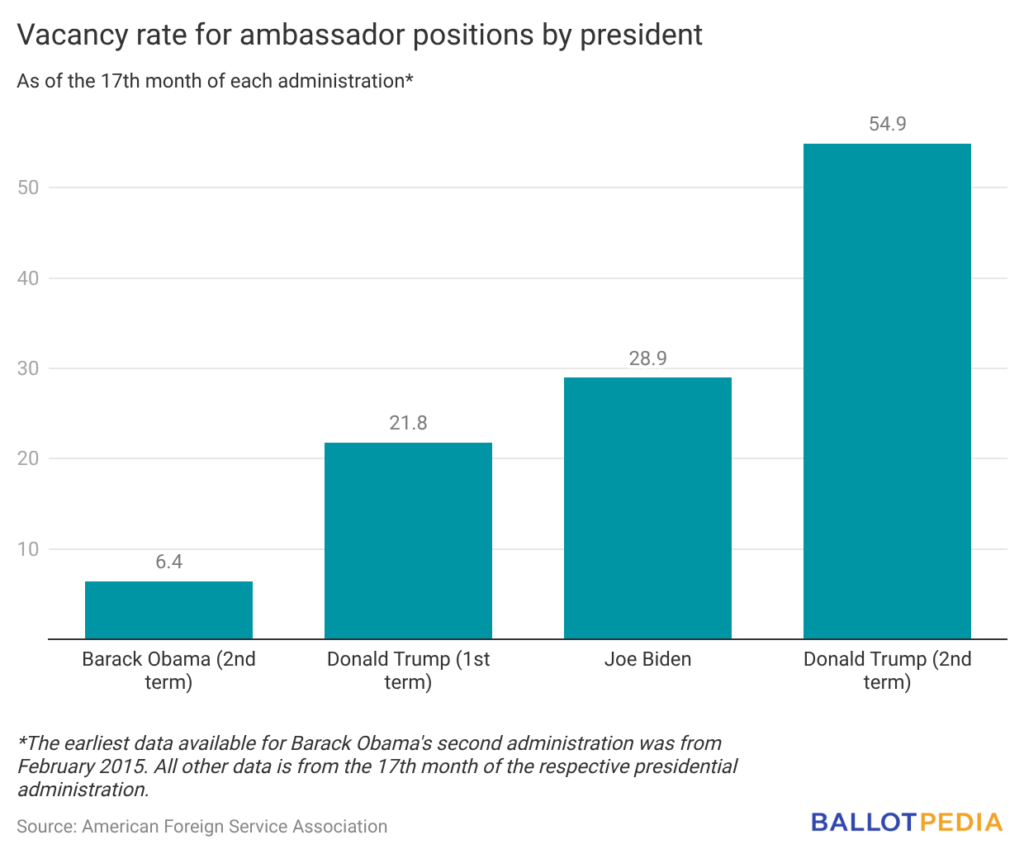
The current vacancy rate for ambassador posts is 54.9%. Out of 195 positions, 107 are vacant. Thirty-four nominees are awaiting Senate confirmation. There are 73 vacant positions for which no one has been nominated. At this point in Trump’s first term, the vacancy rate was 21.8%.
At this point in the Biden administration, the vacancy rate was 28.9%. The earliest available data from the AFSA for the Obama administration shows a vacancy rate of 6.4% in February 2015.
Former diplomatic officials have expressed a variety of views about the vacancies.
Tom Shannon, a former senior career diplomat who served in the Obama and first Trump administrations, said the number of vacancies "really limits an administration’s foreign policy in terms of its ability to respond to crises, to communicate effectively with the highest levels of foreign governments."
Similarly, former Obama administration U.S. ambassador to Israel Dan Shapiro said, "Senate-confirmed ambassadors are the only senior U.S. officials who spend all day, every day in dialogue with foreign leaders. So they simply have greater access to key players in their host governments, knowledge of how they reach decisions, and ability to ensure they hear the views of the United States than do more junior diplomats."
Former Trump administration National Security Council chief of staff Alexander Gray said the number of vacancies "stems from multiple causes, including the arcane Senate confirmation process and the frequent holds placed by senators on ambassadorial nominees over unrelated issues. ... The approval process for all presidential nominees, including ambassadors, needs a major overhaul by congressional leadership. President Trump has been diligent in nominating high-quality, non-career diplomats for critical posts."
Jason Greenblatt, who served as White House Middle East Envoy during the first Trump administration, said of ambassador vacancies in the Middle East, "The leadership and senior diplomats in those countries have strong and trusted relationships with President Trump and with the group doing much of the day-to-day work. ... In this region, those trusted relationships, direct lines of communication and confidence from the president are more valuable than having an ambassador in place."
According to the Foreign Service Act of 1980, “An individual appointed or assigned to be a chief of mission should possess clearly demonstrated competence to perform the duties of a chief of mission, including, to the maximum extent practicable, a useful knowledge of the principal language or dialect of the country in which the individual is to serve, and knowledge and understanding of the history, the culture, the economic and political institutions, and the interests of that country and its people.”
There are generally two types of appointments to ambassadorial positions: career diplomats and political appointees. According to the Columbia Political Review, in most cases, career diplomats from the Foreign Service serve as ambassadors for around three years, while political appointees typically resign at the end of their respective presidential administration.
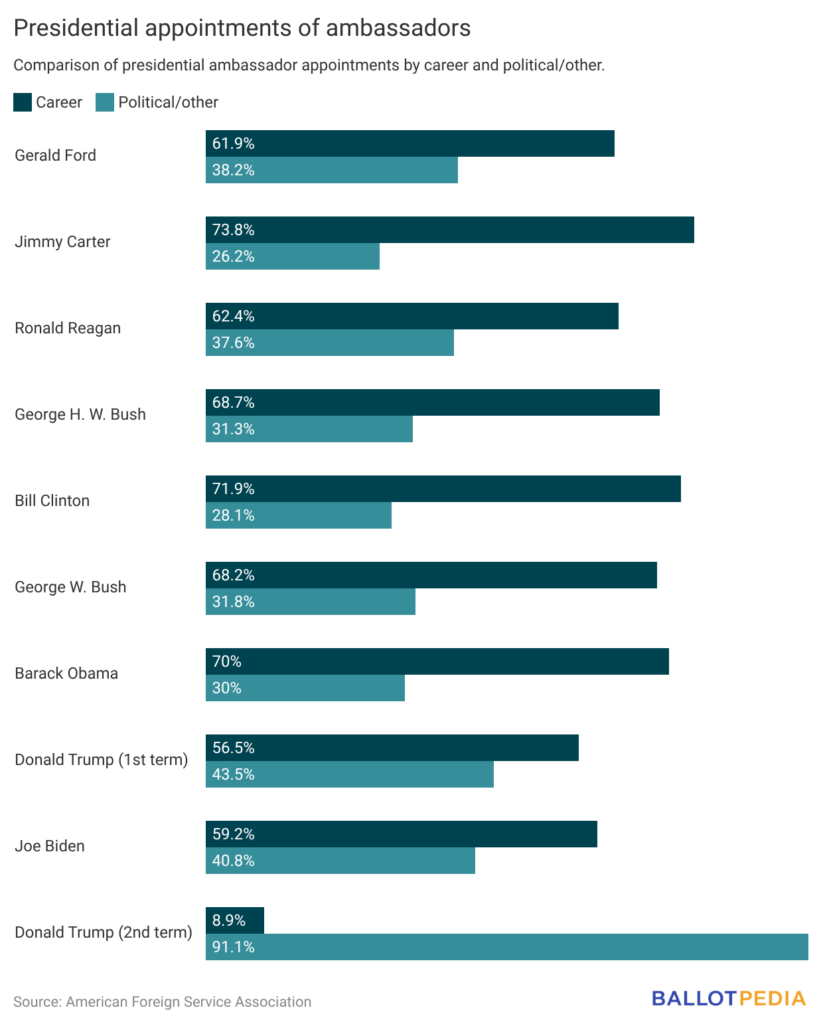
In his second administration, Trump has appointed 8.9% career Foreign Service officers and 91.1% political appointees.
Prior to the first Trump administration, presidents since Gerald Ford (R) appointed an average of 68.1% career Foreign Service officers to ambassadorial positions and 31.9% political appointees, according to data from the AFSA.
In his first administration, Trump appointed 56.5% career Foreign Service officers and 43.5% political appointees, close to 12 percentage points more political appointees than the previous average. Joe Biden (D) appointed 59.2% career Foreign Service officers and 40.8% political appointees.
Additional reading: