


President Donald Trump (R) addressed the nation in a speech on July 16, 2026, during which he said that China gained illicit access to 220 million U.S. voter files, including names, addresses, phone numbers, and political party preferences.
Each state is legally required to maintain voter files, or digital databases of information about registered voters. States can sell voter file information to individuals or groups, and each state has its own guidelines for who is eligible to purchase that information and what the voter file can be used for.
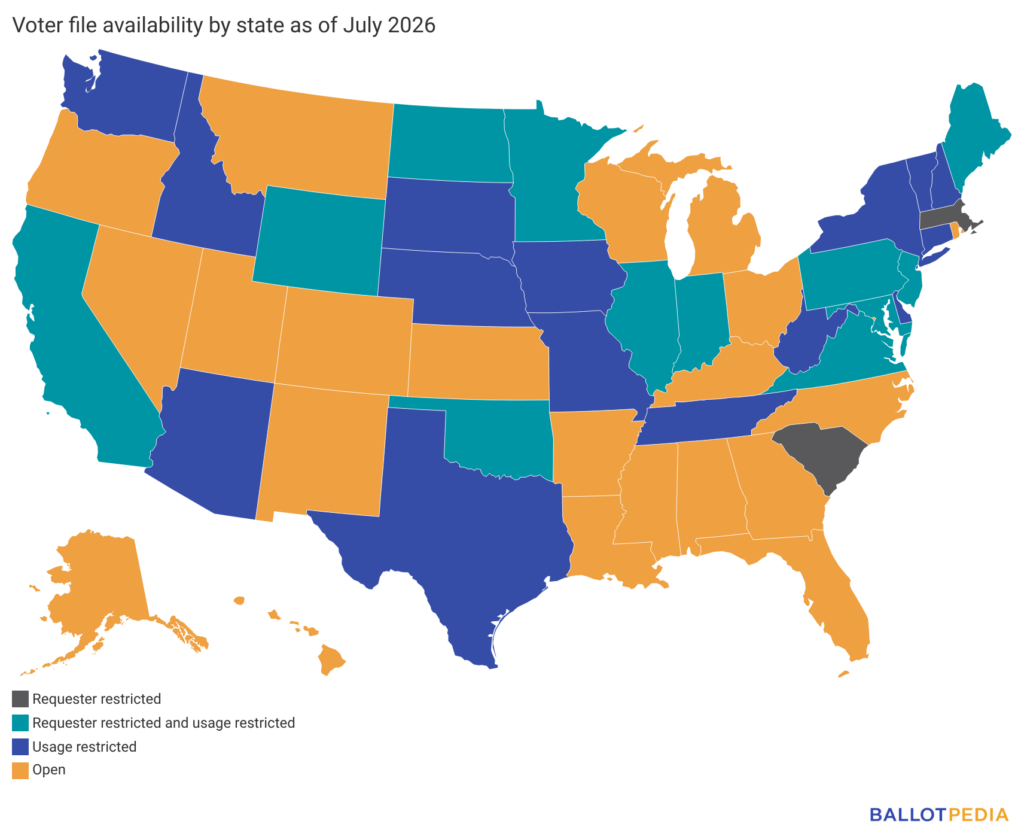
As of July 2026, twenty-one states and Washington, D.C., have open availability of voter files, meaning there are effectively no restrictions on who can request or purchase the voter file, and the only restrictions on how the voter file can be used are commercial use restrictions.
Two states have requester-restricted availability, meaning that only certain groups or individuals can request or purchase the voter file. Common examples of permitted requesters include candidates for office, current officeholders, political parties, political action committees, and nonprofits engaged in get-out-the-vote efforts.
Fifteen states have usage-restricted availability, meaning that the use of the voter file is limited to certain purposes beyond commercial use restrictions. Common examples of usage restrictions include prohibiting the use of voter files for advertising purposes, prohibiting posting voter files on the internet, and requiring voter files to be used only for political or electoral purposes.
Twelve states have both requester-restricted and usage-restricted availability, meaning that only certain groups or individuals can request or purchase the voter file, and only for certain purposes. Two states that restrict the use of voter files, Oklahoma and Vermont, specifically prohibit the disclosure of voter files to foreign entities.
The cost for voter files also varies by state. As of July 2026, eight states provide voter files for free to qualified requesters, and thirty states and Washington, D.C., charge a maximum cost for voter files between $1 and $1,000. Ten states charge a maximum cost between $1,001 and $10,000, and one state charges a maximum cost above $10,000. In one state, the cost varies based on the time taken to produce the report.
Most states have a process for voters to request that certain personal identifying information be kept confidential, but the type of information that can be confidential and the criteria individuals must meet to have their information withheld vary by state.
Additional reading: