


Since 1950, Hawaii voters have decided on 144 ballot measures. Of those, 121 (84%) were approved, and 23 (16%) were defeated.
In Hawaii, the state legislature can refer constitutional amendments and state statutes to the ballot. However, citizens of Hawaii do not have the power to initiate statewide ballot measures, and the state has never voted on an amendment to authorize the initiative and referendum process.
Ballot measures can also come in the form of an automatic constitutional convention question, which appears on the ballot every 10 years, per the Hawaii Constitution. The state legislature cannot refer a constitutional convention question to the ballot.
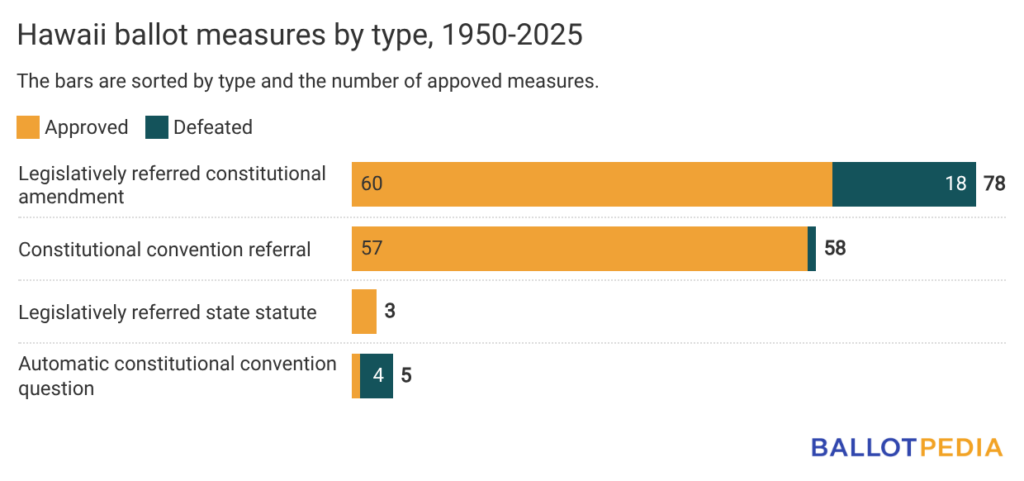
The Hawaii State Legislature referred 81 measures to the statewide ballot, including 78 constitutional amendments and three statutes. Voters have also decided on five automatic constitutional convention questions and 58 constitutional convention referrals.
Throughout Hawaii's history, 60 (77%) of the legislatively referred constitutional amendments were approved, and 18 (23%) were defeated. All three (100%) legislatively referred state statutes that have appeared on the ballot have been approved. Of the automatic constitutional convention questions, one (20%) has been approved, and four (80%) have been defeated. However, constitutional convention referrals have been approved at a higher rate, with 57 (98%) being approved and one (2%) being defeated.
Hawaii ballot measures have addressed 85 unique topics, with some addressing multiple topics in a single measure. The top topics included redistricting policy (13 measures), criminal trials (10 measures), state judicial selection (10 measures), public education governance (9 measures), and bond issues (8 measures). For a more detailed list, see here.
- In November 1950, Hawaii voters approved the Hawaii Constitution Ratification Election, ratifying a constitution drafted in preparation for potential statehood. The measure received 75% of the vote. Congress later accepted the constitution through the Hawaii Admission Act of 1959, and it took effect on August 21, 1959, when Hawaii was admitted to the Union as the 50th state.
- In June 1959, Hawaii voters approved three propositions required under the Hawaii Admission Act before the territory could become a state:
- Proposition 1 approved Hawaii's admission into the United States as a state.
- Proposition 2 accepted the boundaries of the new state as defined in the Hawaii Admission Act and relinquished claims to land and sea outside those boundaries.
- Proposition 3 accepted additional provisions of the Hawaii Admission Act, including the federal government's reservation of authority over certain lands and property and the conditions governing property transferred to the state.
- The 1950 Hawaii Constitution divided the state into geographic areas for legislative representation. It assigned a majority of the state Senate to the islands of Hawaii, Maui, and Kauai, while House seats were apportioned according to registered voters. After the original Senate arrangement was invalidated under the U.S. Constitution, Hawaii voters approved three amendments between 1968 and 1990 concerning the role of basic island units in legislative redistricting. These units grouped the state by its islands and were intended to preserve an island-based political structure within a population-based apportionment system.
- In 1968, voters approved Amendment 3, which guaranteed each basic island unit at least two senators and three representatives. When a unit received additional legislators to meet those minimums, the amendment required those legislators to cast fractional votes based on the unit’s initial allocation.
- In 1988, voters approved Amendment 7, which required legislative districts to be apportioned on the basis of population rather than registered voters. It also removed the minimum number of senators and representatives guaranteed to each basic island unit.
- In 1990, voters approved Amendment 5, which required reapportionment plans to preserve basic island units whenever possible and to the maximum extent practicable. The amendment therefore retained island geography as a redistricting consideration but did not restore the minimum representation requirements removed in 1988.
- In 1968, voters approved Amendment 9, which provided that a person convicted of a felony would regain eligibility to vote upon final discharge from the sentence or earlier if authorized by state law.
- In 1978, voters approved several amendments concerning Native Hawaiian rights, institutions, culture, and language. The measures originated at the 1978 Hawaii Constitutional Convention, which took place during what Hawaiʻi Public Radio described as “a time of profound change, particularly in the rebirth of Native Hawaiian awareness and pride.”[1] Amendment 20 prohibited discrimination based on sex, in addition to race, religion, or ancestry, in public educational institutions. It also required the state to promote the study of Hawaiian culture, history, and language and to provide a Hawaiian education program covering those subjects in the public schools.
- Amendment 29 required the state to protect rights customarily and traditionally exercised for subsistence, cultural, and religious purposes by ahupuaʻa tenants descended from Native Hawaiians who inhabited the islands before 1778. These rights could include traditional access, gathering, fishing, subsistence, and religious practices associated with particular lands and resources. The amendment retained the state’s authority to regulate the exercise of those rights.
- Amendment 28 established the Office of Hawaiian Affairs (OHA) as a public trust institution for Native Hawaiians and Hawaiians. It created an elected board of at least nine trustees, with representation from Oahu, Kauai, Maui, Molokai, and Hawaii. The amendment authorized the board to manage designated property and revenues, including Native Hawaiians’ share of income from the state’s public land trust; formulate policy concerning Hawaiian affairs; and exercise control over property transferred to OHA for Native Hawaiian beneficiaries.
- Amendment 27 required the Legislature to make sufficient funding available for the Hawaiian home lands program. The amendment covered the development of residential and agricultural lots, loans to beneficiaries, rehabilitation programs intended to improve Native Hawaiian welfare, and the administrative and operating expenses of the Department of Hawaiian Home Lands.
- Amendment 31 amended the constitutional preamble to refer to Hawaii’s “Hawaiian heritage and uniqueness as an island State” and to incorporate the philosophy expressed in the state motto. It also stated that the state included the islands’ reefs and territorial and archipelagic waters, designated English and Hawaiian as the official languages of Hawaii, and placed the state motto, “Ua mau ke ea o ka ʻāina i ka pono,” in the constitution.
- In 1978, voters approved three measures concerning energy and natural resources:
- Amendment 26 prohibited the construction of a nuclear fission power plant or the disposal of radioactive material in Hawaii unless first approved by a two-thirds vote in each chamber of the state legislature.
- Amendment 25 gave the state authority to manage and control marine, seabed, and other resources within Hawaii’s boundaries, including its archipelagic waters. It provided that fisheries in state waters would remain open to the public, subject to existing rights and state regulation, except those located within fishponds, artificial enclosures, or state-licensed mariculture operations. The amendment also required mariculture operations to be established under legislative guidelines protecting the public’s use and enjoyment of reefs.
- Amendment 23 provided that, “for the benefit of present and future generations,” the state and its political subdivisions must “conserve and protect Hawaii’s natural beauty and all natural resources.” It also established that “each person has the right to a clean and healthful environment, as defined by laws relating to environmental quality,” and authorized enforcement of that right through appropriate legal proceedings, subject to reasonable limitations and regulation provided by law.
- In 1988, voters approved Amendment 4, which provided that Hawaii “asserts and reserves its rights and interests” in its exclusive economic zone. The amendment applied to the exploration, use, conservation, and management of living and nonliving natural resources in the seabed, subsoil, and waters above them.
- Amendment 20 established that persons in public employment have the right to organize for collective bargaining as provided by law.
- In 1972, voters approved Amendment 1, which added the following guarantee to the state constitution: “Equality of rights under the law shall not be denied or abridged by the State on account of sex.”
- In 1978, voters approved Amendment 3, which provided that “the right of the people to privacy is recognized and shall not be infringed without the showing of a compelling state interest.”
- In 1978, voters approved Amendment 11, which limited state spending growth, required taxpayer refunds of certain budget surpluses, restricted deficit spending, and required state funding for certain county mandates.
- In 1998, voters approved Question 2, which specified that the state legislature had the power to reserve marriage to opposite-sex couples.
- In 2024, voters approved the Remove Legislature Authority to Limit Marriage to Opposite-Sex Couples Amendment, which removed the constitutional provision stating that "the legislature shall have the power to reserve marriage to opposite-sex couples."
Of the 144 measures that Hawaiians have decided on, none have been decided by less than a percentage point of the vote.
The measure with the closest margin was in 1996, when voters in the state decided whether to hold a constitutional convention. While the measure was initially approved by voters — receiving 50.57% of the vote — the Hawaii Supreme Court overturned it for not satisfying the supermajority requirements since it did not include a majority vote when blank ballots were included.
The measure with the widest margin was Proposition 3, which accepted the provisions of the Hawaii Admission Act, including federal reservations of authority and conditions governing grants of land and other property to the state. The measure was approved, with 94.58% of voters approving and 5.42% rejecting it, resulting in a margin of 89.16%.
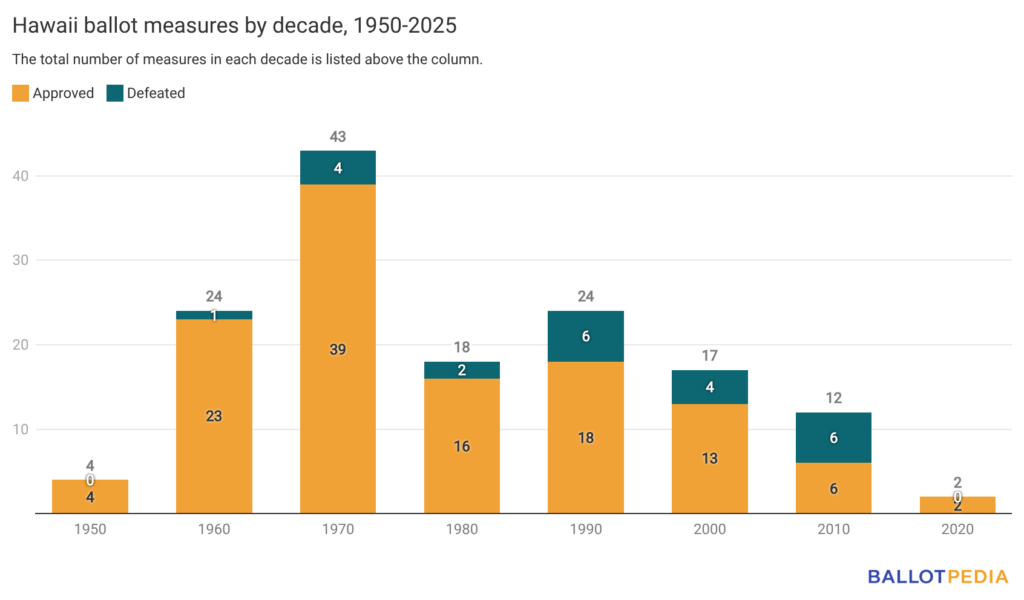
The decade with the most ballot measures was the 1970s, at 43. 39 (90.7%) were approved, and four (9.3%) were defeated. The decades with the highest approval rating — both at 100% — were the 1950s (four measures) and the 2020s (two measures). The decade with the lowest approval rate was the 2010s, with six (50%) measures being approved and six (50%) being defeated.
The inventory of Hawaii statewide ballot measures is part of Ballotpedia's Historical Ballot Measure Factbooks, which document nearly 200 years of direct democracy in the United States. This ongoing research effort will provide an unparalleled resource for researchers, reporters, and voters on how ballot measures have evolved, the issues they've covered, and the role they have played in our civic life.