


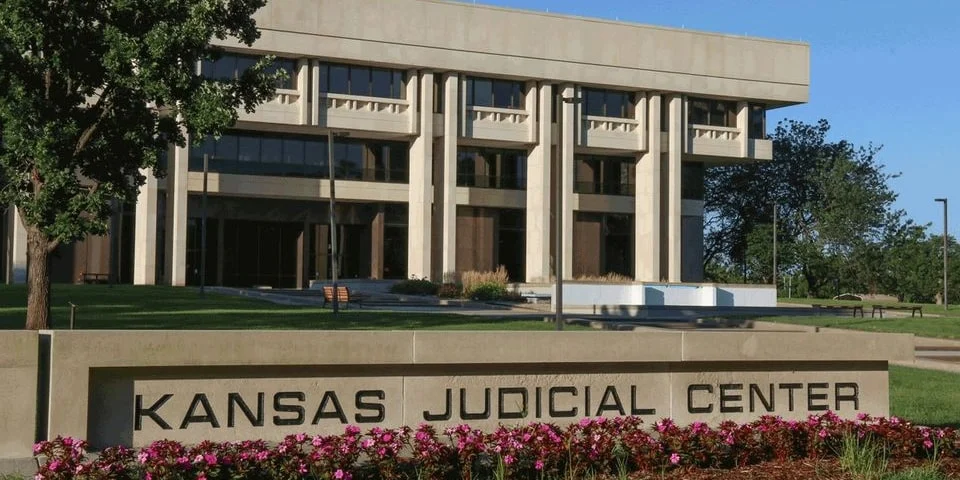
Kansas voters will head to the polls on Aug. 4 for the state’s primary and are set to also decide on a constitutional amendment that would provide for the election of the Kansas Supreme Court. Currently, the seven justices are selected through assisted appointment and must stand for retention at the next even-year general election following their appointment and every six years thereafter. Under the current system, a nine-member nominating commission recommends candidates to the governor. Five commission members are attorneys elected by members of the bar, while four are nonattorneys appointed by the governor.
The amendment would abolish the existing Kansas Supreme Court Nominating Commission and provide for staggered direct elections of the justices. It also would authorize the state legislature to develop rules regarding the elections, including whether the elections would be partisan or nonpartisan. Justices' terms would remain the same at six years, and vacancies would be filled by election as provided for by law.
The amendment would also repeal a provision prohibiting justices from directly or indirectly making contributions to, holding any office in a political party or organization, or taking part in political campaigns. This prohibition would still apply to lower court judges holding office under a nonpartisan method, except when such a judge is seeking election to a position on an appellate court.
The selection of state Supreme Court justices varies by state. Nonpartisan elections for Supreme Court justices are held in 13 states, and partisan elections for Supreme Court justices are held in eight states. Five states use gubernatorial appointment, two states provide for legislative election of justices, and the remaining 22 states use an appointment method, except for Michigan, which uses a process that combines nonpartisan general elections preceded by a partisan candidate selection process.
The state legislature referred the amendment to the ballot. It passed with 93% of voting Republicans supporting it and no support from Democrats.
Supporters of the amendment argue the existing system has produced judicial decisions that are out of step with the preferences of most Kansas voters. Adam Peters, the Ellis County GOP chairman, said, "[The existing system] means that no matter who voters elect as their governor, Kansas Bar Association members can effectively tie his or her hands. The result has been a series of state Supreme Court decisions which have been wildly out of step with what most Kansans want. It’s why the Supreme Court was able to usurp decisions about school funding from the legislature, throw out laws on late-term abortion, and keep the Carr brothers from being executed."
Opponents of the amendment argue that Republican legislators want to change how state Supreme Court justices are selected because they have disliked the outcome of several cases related to abortion and education. Micah Kubic, executive director of ACLU of Kansas, said, "This is a blatant attack by the legislators on our justices, and it’s part of a decades-long pattern of politicians attempting to punish the judicial branch for issuing decisions on education and reproductive freedom that they disagree with. ... Partisan elections quickly become fights between out-of-state, big money interests. These elections become less about the voters and constituents of the state and more an opportunity for out-of-state big money interests to wage war against one another. And now, lawmakers would like our state’s highest court to be smack in the middle of that war."
The cases referred to above include a 6-1 decision by the Kansas Supreme Court in 2019 in which it ruled that Section 1 of the Kansas Bill of Rights "affords protection of the right of personal autonomy, which includes the ability to control one's own body, to assert bodily integrity, and to exercise self-determination. This right allows a woman to make her own decisions regarding her body, health, family formation, and family life—decisions that can include whether to continue a pregnancy." The case concerned Senate Bill 95 (SB 95), which prohibited the abortion method of dilation and extraction except to preserve the life of the mother.
In 2022, the state legislature referred a constitutional amendment to the ballot that would have provided that nothing in the state constitution creates a right to abortion or requires government funding for abortion and that the legislature has the authority to pass laws regarding abortion. It would have effectively nullified the 2019 decision. Voters defeated the amendment with 59% voting "no" and 41% voting "yes."
Unless otherwise set by the county, polls in Kansas open at 7:00 a.m. and close at 7:00 p.m. on election day.
Additional reading: