


States have enacted 37 bills and resolutions concerning the three powers of direct democracy in the U.S. — the ballot initiative, referendum, and recall election — in 2026, through Aug. 5, 2026. The average number of bills and resolutions enacted per year from 2018 to 2025 was 41.
While most bills are adopted during the first half of the year when state legislatures are in session, additional legislation can still be passed later in the year. So far, this year’s total of 37 is below both the 2018-2025 annual average of 41 and the record high of 78 in 2025.
State comparisons
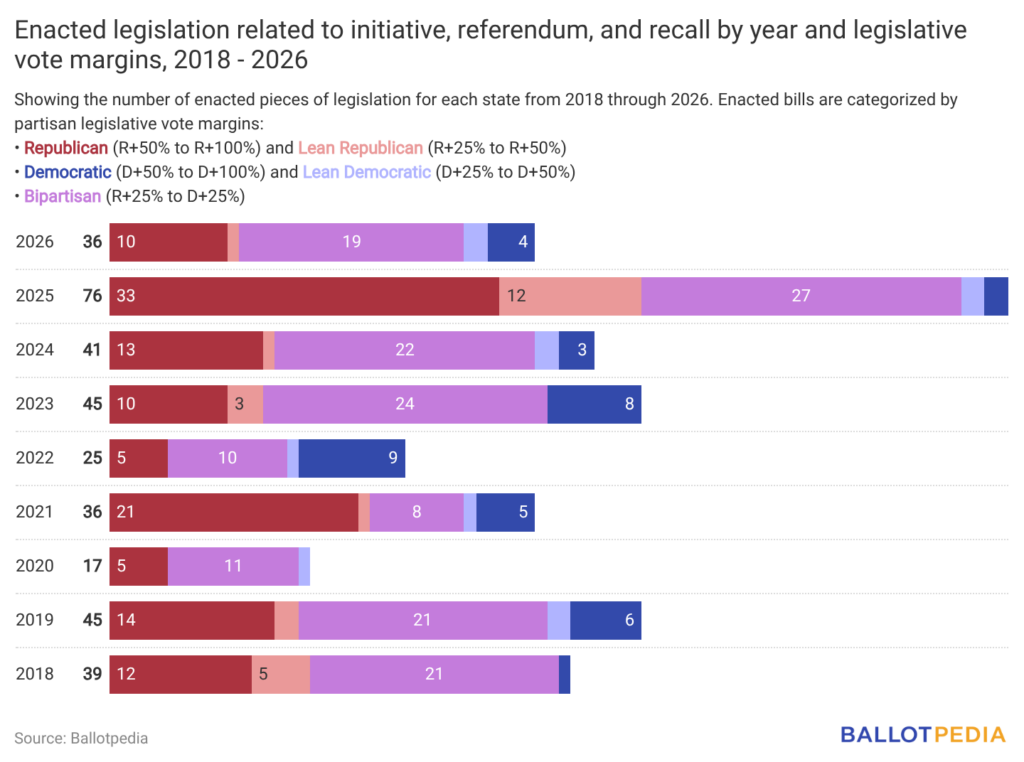
As of Aug. 5, 2026, 37 bills had been enacted into law across 19 states concerning direct democracy, including two constitutional amendments and one state statute that require voter approval for ratification. An additional four bills were passed by legislatures but vetoed by governors.
- Colorado and South Dakota had the most enacted changes, each with four pieces of legislation adopted.
- Alabama and Utah had the second most, each with three pieces of legislation adopted.
- Arizona, Idaho, Iowa, Louisiana, and Nebraska had the third most, each with two pieces of legislation adopted.
Legislative vote margins
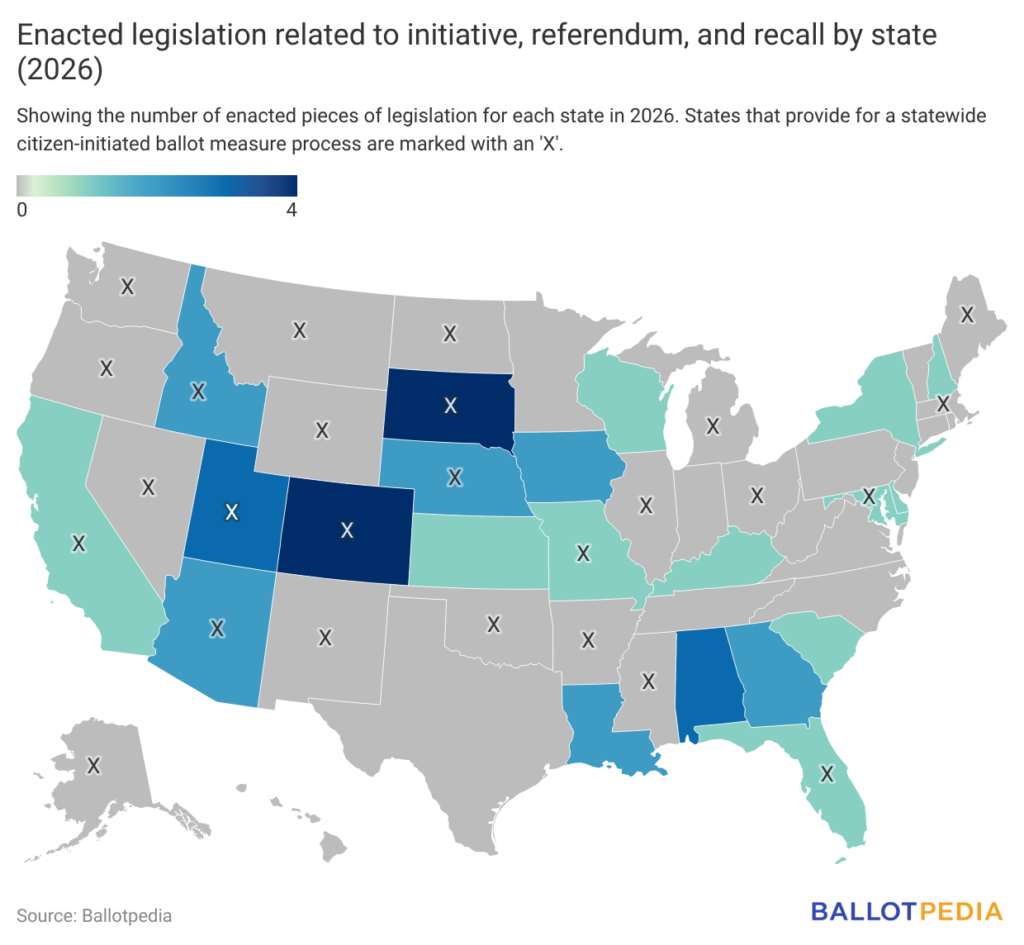
A legislative vote margin refers to the difference in the level of support between Democrats and Republicans in state legislatures. This is similar to an election vote margin, in which a candidate is said to have received, for example, five percentage points more than another candidate. A bill that receives support from 100% of legislative Republicans and 20% of legislative Democrats has a legislative vote margin of R+80%, for instance.
Ballotpedia classifies legislative vote margins on legislation related to the initiative, referendum, and recall as follows:
- Republican: R+50.1% to R+100%
- Lean Republican: R+25.1% to R+50%
- Bipartisan: R+25% to D+25%, including 0%
- Lean Democratic: D+25.1% to D+50%
- Democratic: D+50.1% to D+100%
In 2026, 19 of the 37 enacted bills (51.4%) received bipartisan backing, 11 (29.7%) were passed with Republican majorities, and six (16.2%) with Democratic majorities. One measure (2.7%) in New Hampshire was passed by voice vote, so the legislative vote margin was unavailable. In 2025, two measures in Maine and New Hampshire were also passed by voice vote.
Ballot measures
In 2026, legislatures in two states — Alabama and Arizona — referred two constitutional amendments and one state statute to the ballot for elections in 2026. These proposals would change ballot measure processes and require voter approval for ratification.
- Alabama School District Consolidation Amendment: The constitutional amendment would establish a process for consolidating two or more county school districts via voter approval.
- Arizona Proposition 144: The constitutional amendment would prohibit foreign nationals from making contributions to state elections, including ballot measures, among other changes.
- Arizona Proposition 319: The state statute would prohibit the government from using traffic photo enforcement systems without voter approval.
In 2025, legislatures in five states — Idaho, Missouri, North Dakota, South Dakota, and Utah — referred seven constitutional amendments to the ballot for elections in 2026. As of Aug. 5, 2026, two of these amendments — Constitutional Amendment 1 in North Dakota and Amendment 4 in Missouri — have been voted on, with the former being approved and the latter being defeated.
- Idaho HJR 4: The constitutional amendment would provide that only the state legislature has the authority to legalize marijuana, narcotics, or other psychoactive substances.
- Missouri Amendment 4: The constitutional amendment would have required voter approval of citizen-initiated constitutional amendments in each congressional district, rather than statewide; added language prohibiting foreign nationals and foreign adversaries, as defined, from spending to support or oppose ballot measures, with penalties for violations; and added language regarding penalties for ballot initiative signature petition fraud, among other changes. The measure was defeated, with 80.32% of the vote against it.
- North Dakota Constitutional Measure 1 (June 2026): The constitutional amendment created a single-subject requirement for constitutional amendments. The measure was approved, receiving 66.43% of the vote.
- North Dakota Constitutional Measure 1 (Nov. 2026): The constitutional amendment would require constitutional amendments to receive a 60% supermajority vote to be adopted.
- South Dakota Constitutional Amendment L: The constitutional amendment would require a 60% supermajority of voters to approve constitutional amendments.
- Utah 60% Vote Requirement for Ballot Initiatives to Increase or Expand Taxes Amendment: The constitutional amendment would require citizen-initiated ballot measures to receive at least 60% voter approval to make certain tax-related changes, including (a) imposing a new tax; (b) expanding an existing tax to apply to additional items or transactions; (c) increasing an existing tax rate; or (d) adjusting a property tax rate in a way that reduces the rate less than it would decrease under current law.
- Utah Publication Requirements for Constitutional Amendments Measure: The amendment would require that constitutional amendments be published, in a manner provided by the legislature, for 60 days immediately before the next general election.
Policy issue trends
Three of the most common areas of legislative changes in 2026 were: (1) laws governing readability requirements for ballot measures; (2) laws governing foreign spending in ballot measure campaigns; and (3) laws governing referendums for local tax changes.
- Changes to readability requirements for ballot measures: Legislatures passed three bills requiring officials to use plain, simple, clear, or easily understood language when writing ballot questions, titles, summaries, or explanatory statements. No bills were adopted to eliminate such requirements.
- Changes to laws governing foreign spending in ballot measure campaigns: Legislatures passed four bills prohibiting or increasing restrictions on foreign donor contributions to ballot measure campaigns. No bills were adopted to permit or decrease such restrictions.
- Changes to laws governing referendums for local tax changes: Legislatures passed four bills requiring referendums for local tax changes. No bills were adopted to remove such requirements.
Enacted legislation compared to proposed legislation
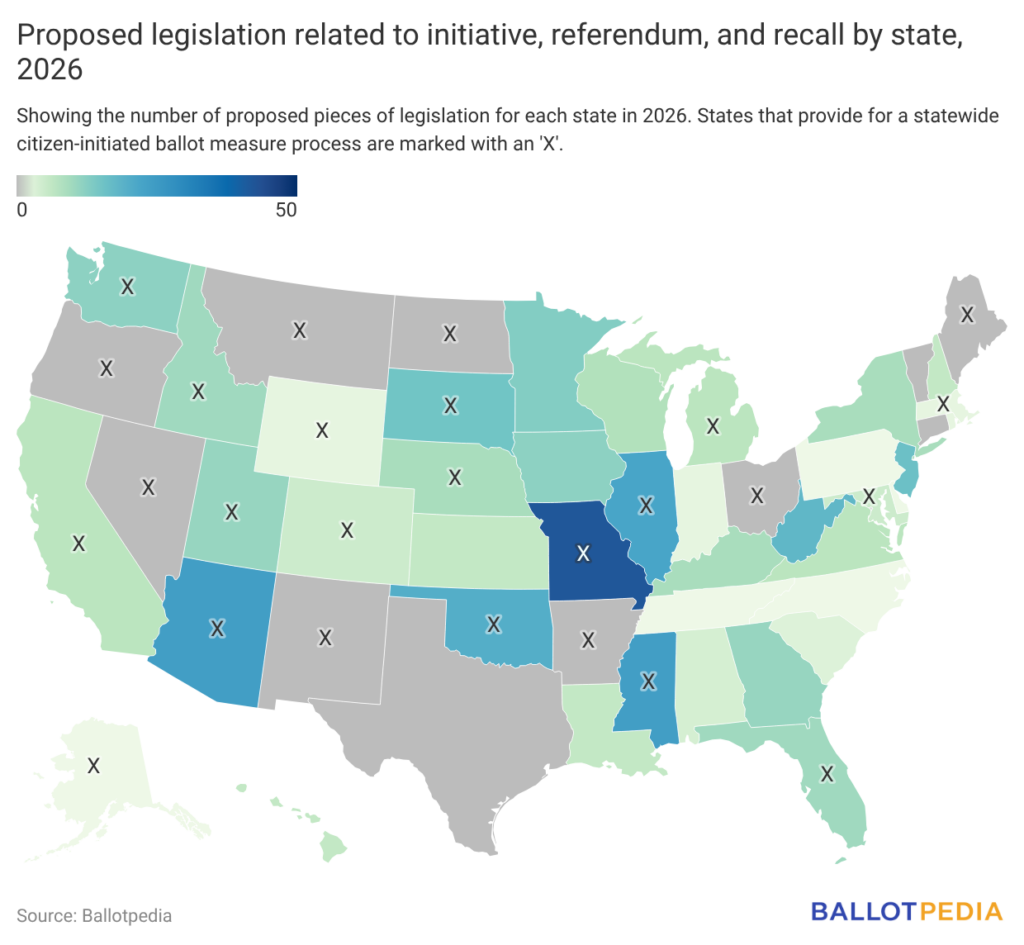
As of Aug. 5, 2026, 39 states introduced 370 legislative proposals related to ballot measures. Among the years Ballotpedia has tracked ballot measure legislation (2018-2026), 2026 recorded the third-highest number of proposed bills, tying with 2021. 2023 had the second-highest number of proposed bills at 385, and 2025 had the highest number at 623.
Of the 370 proposals introduced in 2026, 37 (10%) had been enacted. Missouri introduced the most proposals, at 42, enacting one. Arizona and Mississippi introduced the second most proposals — both at 24 — with the former enacting two (contingent on voter approval), and the latter enacting none.
The majority of legislative proposals were in states with Republican state government trifectas. Of the 370 measures introduced, 206 (55.7%) originated in Republican trifecta states, 94 (25.4%) in Democratic trifecta states, and 70 (18.9%) in states with divided government.
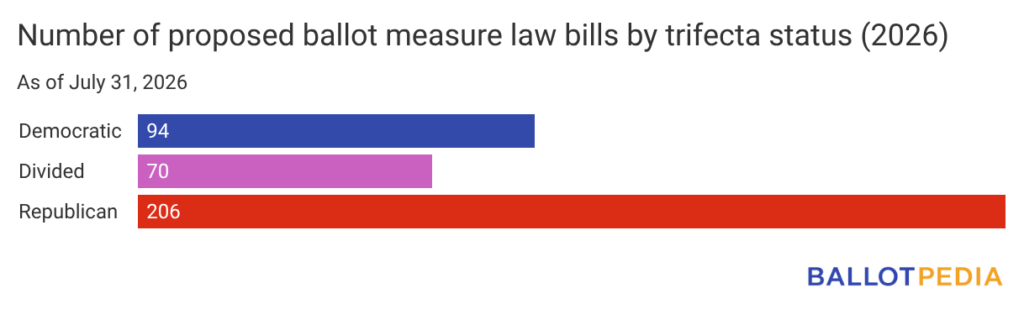
States with Republican trifectas introduced the second-highest number of proposals (206) since at least 2018, with 2025 having the highest number of such proposals (385). Based on a state's trifecta status during a given year from 2018 to 2026, 1,652 (52.6%) bills were proposed in states with Republican trifectas, 965 (30.7%) were proposed in states with Democratic trifectas, and 526 (16.7%) were proposed in states with divided governments.
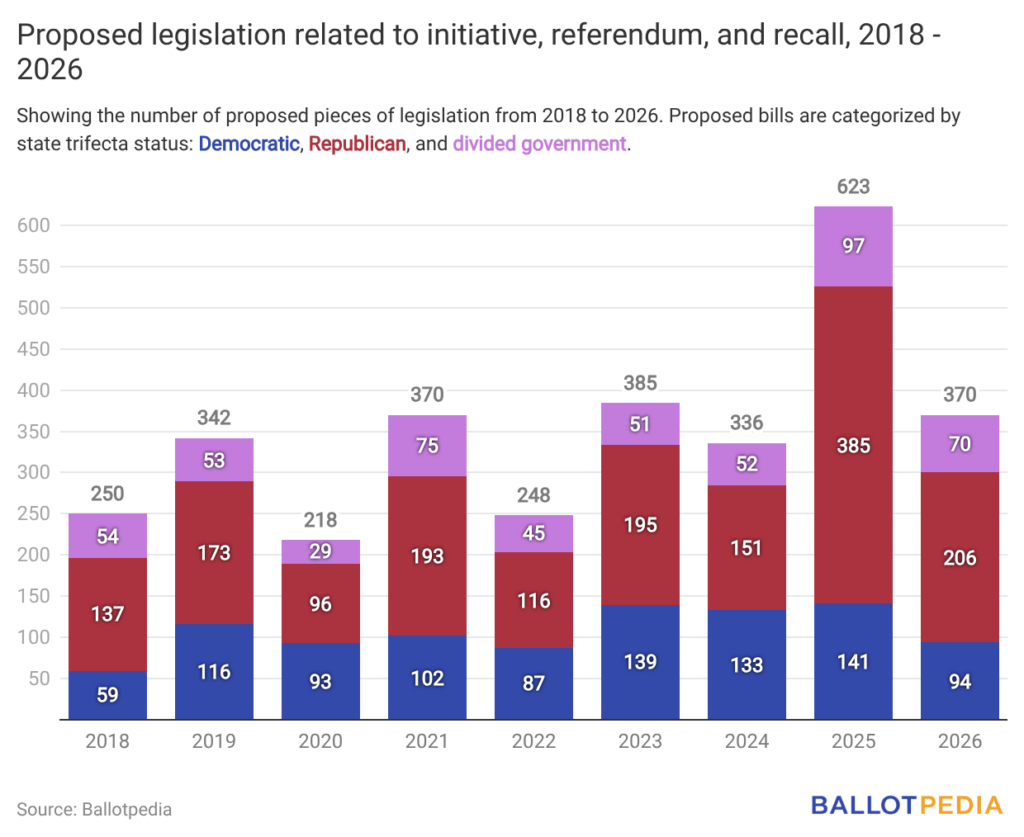
From 2018 to 2026, a total of 3,143 pieces of legislation related to initiative, referendum, and recall were introduced in state legislatures. Of these, state governments have enacted 363 (11.5%).
Additional reading: