


On Nov. 3, voters in nine states will decide 13 ballot measures to establish, expand, or repeal rights in state constitutions. State constitutional rights affect the relationship between individuals and state and local governments. The U.S. Constitution establishes a minimum level of protection that states cannot violate, while state constitutions may establish more specific rights. Therefore, establishing, expanding, or repealing a right in a state constitution can affect what government actions are permitted and the legal protections available within a specific state.
Ballotpedia classified the 13 measures according to ideological orientation based on legislative votes or endorsements:
- Progressive/Liberal: This category includes legislative referrals approved by Lean Democratic or Democratic legislative majorities, based on Ballotpedia's partisanship analysis of legislative referrals, as well as initiatives endorsed by state Democratic parties or Democratic elected officials, or sponsored by organizations with self-stated progressive or liberal alignments.
- Conservative: This category includes legislative referrals approved by Lean Republican or Republican legislative majorities, as well as initiatives endorsed by state Republican parties or Republican elected officials, or sponsored by organizations with self-stated conservative alignments.
- Other: This category includes referred measures that received bipartisan support in state legislatures and initiatives endorsed or sponsored by organizations with both progressive/liberal and conservative alignments. It also includes measures for which the available endorsements are insufficient to assign an ideological alignment.
Progressive/liberal state constitutional rights measures
Voters in Nevada, Virginia, and Vermont will decide six measures classified as progressive, liberal, or Democratic-leaning.
In Nevada, voters will see Question 6, which was approved in 2024, back on the 2026 ballot for its second consideration. The initiated constitutional amendment, which would provide a right to abortion, needs to be approved at two even-numbered-year elections to be added to the state constitution. It has received endorsements from former Vice Pres. Kamala D. Harris (D), U.S. Sen. Jacky Rosen (D), Planned Parenthood Votes Nevada, Reproductive Freedom for All Nevada, and ACLU of Nevada.
In Virginia, voters will decide on three progressive/liberal amendments related to abortion, marriage, and voting rights. Question 1 would establish a right to reproductive freedom in the state constitution. As of 2026, abortion is legal up until the third trimester based on a woman's last menstrual period in Virginia. The Democratic majority in the state legislature referred it to the ballot; all voting Republican legislators opposed it.
Question 2 would remove a provision in the state constitution that states marriage is between one man and one woman; add a provision stating that "marriage is one of the vital personal rights essential to the orderly pursuit of happiness;" and prohibit the state from denying a marriage license to two adults based on their sex, gender, or race. It received support from 100% of voting Democrats in the state legislature and 15% of voting Republicans. Beginning in 2020, four states have approved ballot measures to repeal a same-sex marriage ban in their state constitutions.
Question 3 would provide that persons convicted of felonies lose their right to vote only while incarcerated and have their political rights, including voting, restored upon release. The amendment was placed on the ballot with support from 100% of voting Democrats and one Republican representative. The remaining voting Republicans opposed the amendment.
Vermont ballots will also feature two progressive/liberal ballot measures related to state constitutional rights. Proposal 3 would establish a state constitutional right for employees to organize or join a labor organization for collective bargaining and prohibit laws that ban agreements requiring union membership as a condition of employment (right-to-work laws). All voting Democrats and 75% of voting Republicans supported the amendment.
Voters will also decide Proposal 4, which would prohibit denying rights to an individual based on race, ethnicity, sex, religion, disability, sexual orientation, gender identity, gender expression, or national origin. All voting Democrats and 71% of voting Republicans supported the amendment.
Conservative state constitutional rights measures
Voters in Arizona, Arkansas, Colorado, Missouri, and Wisconsin will decide on six measures classified as Conservative.
In Arizona, voters will decide Proposition 142, which would prohibit the state and government agencies, including public education institutions, from requiring an individual to endorse preferential treatment toward or discrimination against another individual based on race or ethnicity. It was placed on the ballot with 100% support from voting Republicans and no Democratic support.
Arkansas voters will decide on a constitutional amendment to provide that the right to keep and bear arms is "a natural, fundamental, and individual right that shall not be infringed." Forty-five states have a right to bear arms in their constitutions. Five states — California, Maryland, Minnesota, New Jersey, and New York — do not. The amendment was carried with support from 100% of voting Republicans and 24% of voting Democrats.
In Colorado, voters will decide on an initiative granting consumers the right to purchase natural gas for cooking or heating in homes or businesses, and allowing distributors and utilities to sell natural gas to consumers. The amendment was sponsored by Advance Colorado, which describes itself as a “team of professionals and allies [who] are at work every day to push back on the progressive policies that have put our state on the wrong track.” State Rep. Julie McCluskie (D-13) opposes the initiative and said, "Providing a constitutional right comes with a heavy and weighted responsibility.”
Missouri voters will decide on Amendment 3, which proposes repealing the constitutional right to reproductive freedom, which voters ratified in 2024, and prohibiting gender transition surgeries for minors. It was placed on the ballot with support from 100% of voting Republicans and no support from Democrats.
In Wisconsin, two amendments are classified as conservative based on legislative votes. The first would prohibit the state or any political subdivision from ordering the closure of or forbidding gatherings in places of worship in response to a state of emergency, including public health emergencies. The second would prohibit any governmental entity from discriminating or granting preferential treatment based on race, sex, color, ethnicity, or national origin in public employment, public education, public contracting, or public administration. Both amendments received support from at least 97% of voting Republicans. No Democrats supported the amendment prohibiting affirmative action, and 3% of voting Democrats supported the amendment prohibiting the closure of places of worship.
One measure in Montana that would add initiative and referendum power to the state’s Declaration of Rights has not been classified because it has not received enough endorsements. It is a citizen-initiated amendment.
Campaign finance
The measure with the most contributions so far is Missouri Amendment 3. The support committees reported $1.6 million in contributions, and the opposition committees reported over $5.3 million in contributions through June 30. For more information on campaign finance, endorsements, and polling for these measures, click here.
Historical measures
Between 2022 and 2026, voters in 26 states have or will decide on 43 measures related to state constitutional rights. Of the 43 measures, 28 were legislative referrals, and 15 were citizen-initiated. Referrals were evenly split between Progressive/Liberal and Conservative rights, while 12 of the 15 initiatives were classified as Progressive/Liberal.
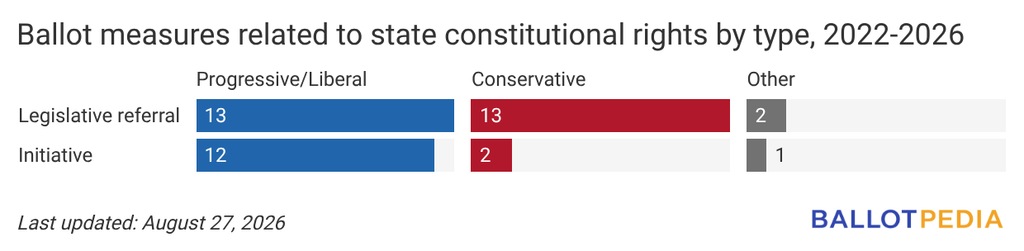
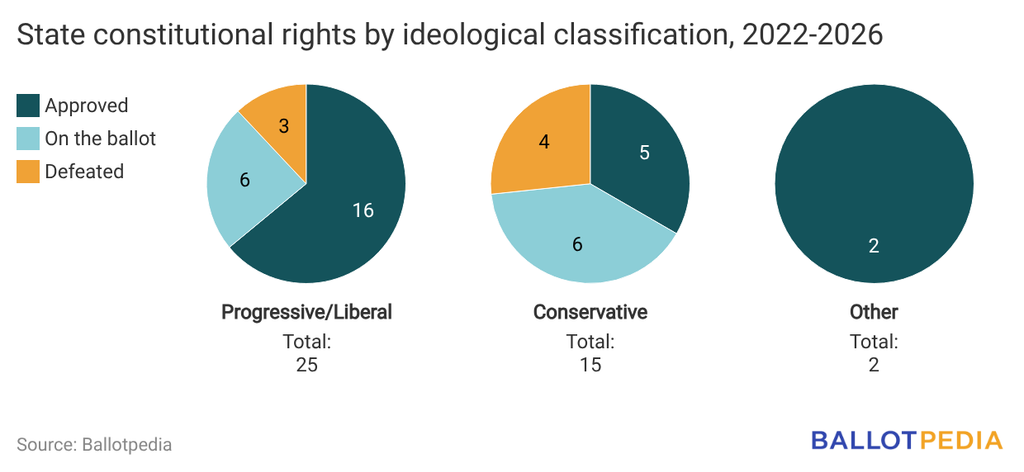
Progressive/Liberal rights were approved at a higher rate (84%) than Conservative rights (56%). The charts below show the outcomes by ideological classification.
Additional reading: