


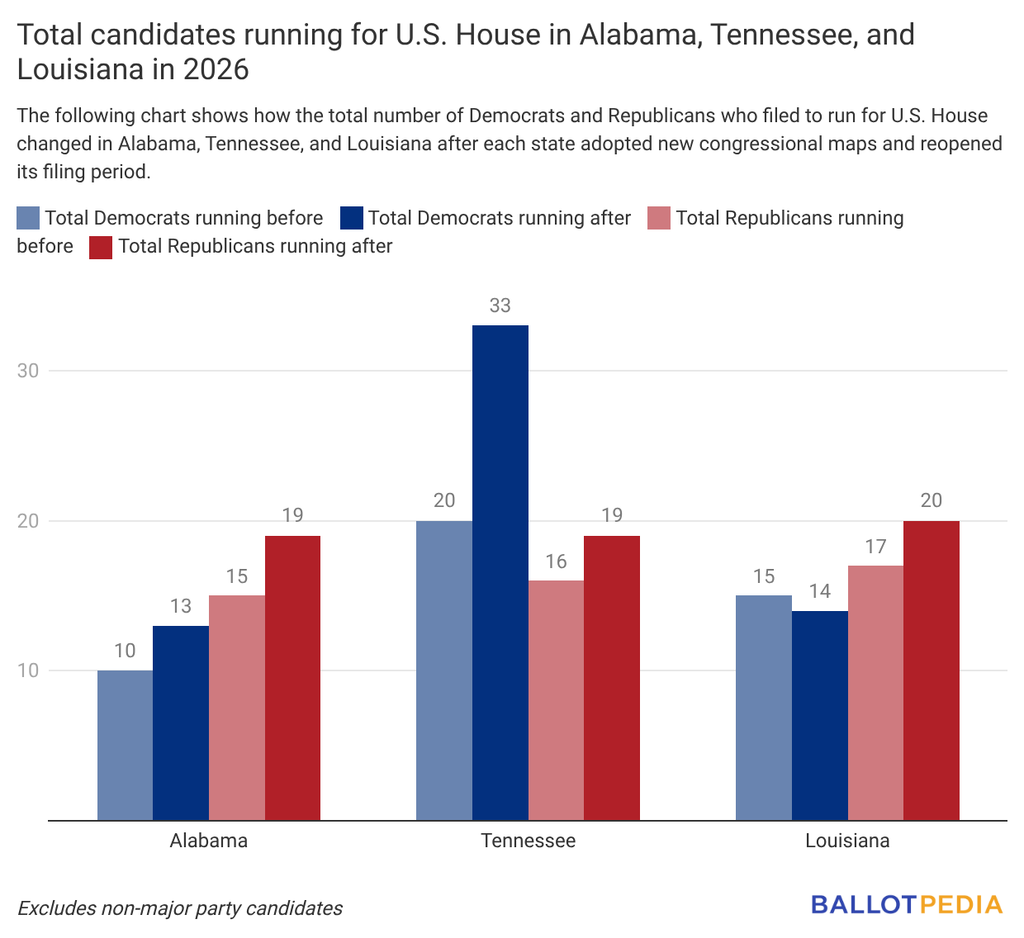
This year, the number of candidates in three states' primaries for the U.S. House of Representatives increased after they reopened their filing deadlines.
Alabama, Louisiana, and Tennessee each adopted new congressional maps after their candidate filing deadlines had passed. Each state then reopened its filing period, giving candidates additional time to file under the new district boundaries. Based on the 2024 presidential election results, each state's new maps would result in Republicans gaining control of one Democratic-held district.
The number of candidates for Alabama's seven districts increased from 25 to 32, resulting in the second-most candidates in the state dating back to 2014.
In Tennessee's nine districts, the number of candidates increased from 36 to 52, resulting in the most candidates in the state dating back to 2014.
In Louisiana, the number of candidates for its six districts increased from 32 to 39, driven mostly by five minor-party and independent candidates. This reflects the state's change back to its majority-vote system, in which all candidates, regardless of party, run on a single ballot rather than in separate party primaries.
Here's a closer look at how other candidate filing data changed in each state after the deadlines reopened.
Alabama
Alabama moved its filing deadline from Jan. 23 to May 22. Seven more candidates filed to run at the later deadline, increasing the number of contested primaries from six (two Democratic and four Republican) to nine (three Democratic and six Republican.) The number of open districts remained the same at one. The number of incumbents running in contested primaries also remained the same at three Republicans.
The number of Democrats running in Alabama increased from 10 to 13, and the number of Republicans increased from 15 to 19.
The Democratic primary in the 6th Congressional District became contested when the number of Democrats who filed to run increased from one to four. According to the district lines used in 2024, Donald Trump (R) defeated Kamala Harris (D) 69% to 30% in the district. According to the district lines that will be used in 2026, Trump would have defeated Harris 66.8% to 32.1%.
Two additional Republican primaries became contested. In the 2nd Congressional District, where one Republican initially filed, six Republicans filed to run when the deadline reopened. According to the district lines used in 2024, Harris defeated Trump 54% to 45%. According to the district lines that will be used in 2026, Trump would have defeated Harris 56.8% to 42.4%.
In the 7th Congressional District, where no Republicans initially filed, two Republicans filed to run. This means Democrats and Republicans filed to run in all the districts. According to the district lines used in 2024, Harris defeated Trump 61% to 38% in the district. According to the district lines that will be used in 2026, Harris would have defeated Trump 58.5% to 40.7%.
Seven Republicans initially filed to run in the 1st Congressional District, and four filed to run after the filing deadline reopened. According to the district lines used in 2024, Trump defeated Harris 77% to 22% in the district. According to the district lines that will be used in 2026, Trump would have defeated Harris 67.6% to 31.5%.
Tennessee
In Tennessee, contested primaries increased from nine (five Democratic and four Republican) to 12 (eight Democratic and four Republican) after the deadline reopened following redistricting. The filing deadline was March 10 and was reopened until May 15.
The number of Democrats running increased from 20 to 33, and the number of Republicans increased from 16 to 19. Democrats and Republicans filed to run in all districts, both before and after the deadline was reopened.
The number of open districts also increased from one to two after Democratic incumbent Steve Cohen (TN-9) announced his retirement when his district changed from a Solid/Safe Democratic District to a Solid/Safe Republican District, according to major race forecasters. Cohen’s retirement reduced the number of incumbents running in contested primaries from three — one Democrat and two Republicans — to two. Both of the incumbents running in contested primaries are Republicans.
According to the district lines used in 2024, Harris would have defeated Trump 71% to 27% in the 9th Congressional District. According to the district lines that will be used in 2026, Trump would have defeated Harris 59.9% to 38.8%. The number of Democrats running in the district remained the same before and after the deadline reopened, at four. The number of Republicans running increased from two to four.
Louisiana
Louisiana moved its filing deadline from Feb. 13 to Aug. 7. In Louisiana, contested primaries decreased from nine (five Democratic and four Republican) to six. This drop is a result of the state's return to a majority-vote system because there are six primaries out of a possible six rather than nine primaries out of a possible 12.
Due to a law enacted in 2024, Louisiana’s 2026 elections for U.S. House, U.S. Senate, Louisiana Supreme Court, Public Service Commission, and the Board of Elementary and Secondary Education were set to be the first in which Democratic and Republican candidates in the state ran in separate U.S. House primaries scheduled for May 16. On May 14, after the U.S. Supreme Court’s ruling in Louisiana v. Callais, Gov. Jeff Landry (R) signed HB 842. The law moved the state's 2026 U.S. House races from May 16 to the state's majority-vote system election — with the first round on Nov. 3. In future years, U.S. House races will use the semi-closed party primary system.
The number of Democrats running in Louisiana decreased from 15 to 14, while the number of Republicans increased from 17 to 20. The number of incumbents running in contested primaries also increased from three — one Democrat and two Republicans — to four. Among those incumbents are one Democrat and three Republicans. Republican incumbent Clay Higgins (LA-3), who was not running in a contested primary before the deadline reopened, will now face five other candidates.
Democratic incumbent Cleo Fields (LA-6) announced his retirement, bringing the number of open districts from one to two, after his district changed from a Solid/Safe Democratic District to a Solid/Safe Republican District, according to major race forecasters. Fields was initially the only Democrat running in the district. After the deadline reopened, three Democrats filed to run. Four Republicans initially filed to run, increasing to six after the deadline reopened. According to the district lines used in 2024, Harris would have defeated Trump 57% to 42% in the district. According to the district lines that will be used in 2026, Trump would have defeated Harris 64.2% to 34.1%.
As in Alabama, a Republican filed for a district — the 2nd Congressional District — in which no Republicans had filed before the deadline reopened following redistricting. As a result, Democrats and Republicans filed to run in all the districts. According to the district lines used in 2024, Harris defeated Trump 65% to 33% in the district. According to the district lines that will be used in 2026, Harris would have defeated Trump 72.7% to 25.3%.