


Forty states have partially or fully appropriated funds for their increased share of Supplemental Nutrition Assistance Program (SNAP) administrative costs under federal law. Beginning on Oct. 1, states are responsible for funding 75% of the administrative costs of running the program in their state, while the federal government covers the remaining 25%. Previously, states split administrative costs evenly with the federal government.
The change is one of several that the One Big Beautiful Bill Act (OBBBA) — which President Donald Trump (R) signed into in 2025 — made to SNAP. As a result, states are obligated to appropriate or disburse additional funds to the program, or reduce the overall cost of SNAP administration to address the funding gap.
Background
The One Big Beautiful Bill Act made various changes to SNAP, including expanding work requirements, limiting noncitizen eligibility, and shifting program costs to the states.
In addition to increasing states’ share of administrative costs — which had been 50% since 1974 — the bill created the first cost share for SNAP benefits themselves. The majority of the program's cost is attributable to benefit payments rather than administrative costs. Beginning in fiscal year (FY) 2028, states will be responsible for a portion of benefit costs if their payment error rate is above a certain threshold. Previously, the federal government paid the full cost of benefits.
While states are still preparing for the new benefits cost share — and members of Congress are debating a delay — the increased administrative costs are now in effect. As a result, states face additional annual administrative cost estimates that range from $670 million (California) to $3 million (Wyoming).
State responses
The majority of states appropriated additional money to SNAP administration in FY2027 to account for the increased costs.
As of Sept. 30:
- Forty states had either fully or partially appropriated money in the state budget to compensate for the increased cost share for FY2027.
- Four states had action pending, or Ballotpedia could not identify a response explicitly tied to SNAP administration.
- This includes some legislatures that were not in session in 2026, or that finalized biennial budgets before the OBBBA became law in 2025 and did not enact a supplemental appropriation.
- Two states – New York and North Carolina – passed increased costs entirely to counties.
- Two states – Arkansas and New Hampshire – declined to increase funding or rejected a specific request to fund the shift.
- Two states – Connecticut and Massachusetts – increased funding for SNAP administration, but the action was not explicitly tied to the state’s increased share of administrative costs.
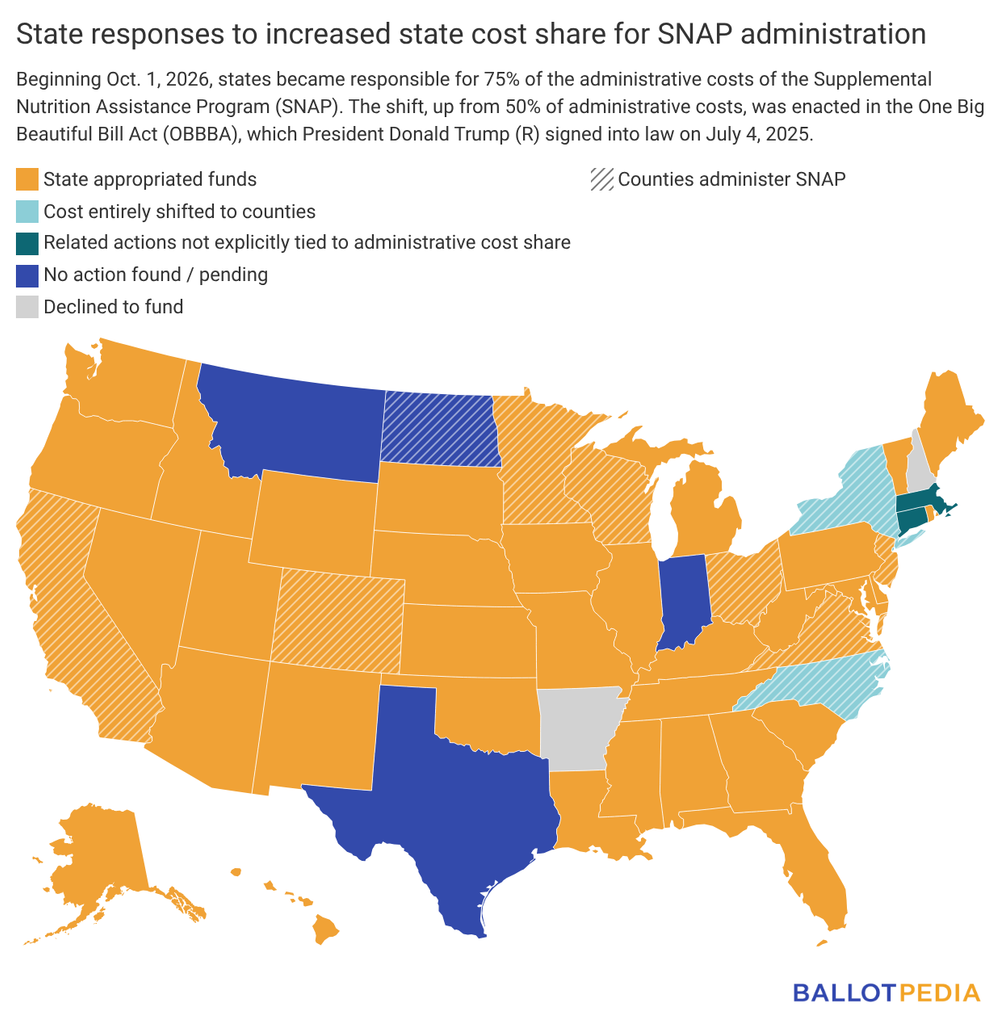
States that appropriated funds either fully or partially to compensate for increased administrative cost share
Of the states that appropriated money for SNAP administration:
- Some states appropriated all necessary funds to make up the estimated lost federal revenue.
- For example, South Dakota appropriated $5.5 million for SNAP administrative costs, meeting Gov. Larry Rhoden's (R) request for FY2027.
- Some states appropriated money to partially compensate for lost federal funds.
- Wyoming appropriated approximately $850,000 for SNAP administrative costs, out of the $6 million requested by the Wyoming Department of Family Services.
- Several states, including West Virginia, Pennsylvania, and Washington, appropriated funds for increased administrative costs for only 9 months of the fiscal year, since their fiscal year began in July, but the administrative cost share shift didn't take effect until October.
Counties that administer SNAP
Counties in 10 statesadminister SNAP benefits. In three of them – New Jersey, New York, and North Carolina – counties bear the full cost of administering SNAP, according to the Food Research & Action Center. In six others – California, Colorado, Minnesota, Ohio, Virginia, and Wisconsin – counties and states share the administrative costs. In North Dakota, the state pays the full cost of SNAP administration for each county.
Of the three states in which counties pay for the entirety of SNAP administration:
- In two – New York and North Carolina – Ballotpedia could not identify any appropriations made to assist counties with the increased administrative costs.
- Both states did appropriate money to some state-level programs related to SNAP, such as to update statewide eligibility systems or explicitly reduce payment errors.
- The third, New Jersey, appropriated money to assist counties with the administrative cost share shift in FY2027.
Of the states that share administrative costs with counties:
- All six of them appropriated more money in SNAP administrative cost share to help offset the increased cost for counties, but counties may still be responsible for resulting shortfalls, such as in Ohio.
- Colorado state law holds that counties are responsible for 20% of the administrative costs, and the state will bear the full 25% increase in administrative costs. Additionally, in 2025, Colorado voters approved Colorado Proposition MM, which limited certain tax deductions for those earning more than $300,000. Some of that increased revenue will be allocated to SNAP administration, according to local sources.
States that did not respond to administrative cost-share shift or had action pending
Several states have budgets spanning two fiscal years, known as biennial budgets. In Indiana, Montana, North Dakota, and Texas, lawmakers finalized their budgets before the OBBBA was enacted, and the budget did not include any appropriations for an increased state administrative cost share for SNAP. These states’ legislatures either did not meet in 2026, or met and did not enact a supplemental appropriation for SNAP administration.
States that made changes to SNAP administration funding, not explicitly tied to administrative cost-share shift
For FY2027, Connecticut appropriated an additional $50 million to the state’s $500 million Federal Cuts Response Fund. Connecticut Gov. Ned Lamont (D) submitted a supplemental plan to draw from the fund in May to address "operational demands resulting from eligibility changes" from the OBBBA.
Massachusetts increased FY2027 staffing appropriations compared to the FY2026 baseline for the Department of Transitional Assistance (DTA), which administers SNAP in the state. But the action was not explicitly tied to changes in the administrative cost share, did not meet the department’s funding request, and is nearly $21 million under the department’s total FY2026 funding after supplemental appropriations. As of Sept. 30, the legislature was considering a supplemental budget proposal from Gov. Maura Healey (D) that would add roughly another $40 million for DTA, including $26.6 million for caseworkers.
States that declined to fund change in cost-share
Arkansas and New Hampshire declined to increase SNAP administrative appropriations to fund the shifting cost-share.
Arkansas uses a biennial budget established in odd-numbered legislative session years, but the legislature convenes in even-numbered years to consider supplemental appropriations. In the 2026 fiscal session, the legislature did not appropriate additional funds for the increased SNAP administrative costs.
Similarly, New Hampshire uses a biennial budget, but rejected proposals to allocate more money to SNAP administration during the 2026 legislative session.
Why does it matter?
According to the Congressional Research Service, changes to SNAP enacted in the OBBBA could decrease federal spending by approximately $187 billion over 10 years by shifting administrative and benefit costs to states and reducing the overall size of the program through eligibility changes.
Between the passage of the July 2025 and July 2026, nationwide enrollment in SNAP fell by 5.2 million people (12.5%), a drop that the Food Research & Action Center — an advocacy group — largely attributes to changes made by the OBBBA. While declining enrollment reduces benefits costs and may ease the administrative workload, many states have sought additional administrative funding to implement other OBBBA changes, such as expanded work requirements, and to lower their payment error rates ahead of the benefits cost share.
The Pew Charitable Trusts described the administrative cost shift and the introduction of the benefits cost share as the"biggest structural change to SNAP since President Lyndon B. Johnson signed the program into law more than 60 years ago."
The U.S. Department of Agriculture estimated that the administrative shifts would add about $17 billion in costs for states and counties over five years.
Rhode Island Budget Director Brian Daniels said he supports giving states a larger financial stake in the program but that implementation deadlines were difficult. Daniels said he sees the logic in giving states "more skin in the game." He added, "It's the timeline that's a challenge because being able to make all those changes in short order is incredibly hard."