


Welcome to the next installment of our series previewing the Nov. 3 elections by office. Next up: Governors.
Thirty-six states are holding gubernatorial elections this year. Of the governorships on the ballot, Democrats and Republicans each hold 18.
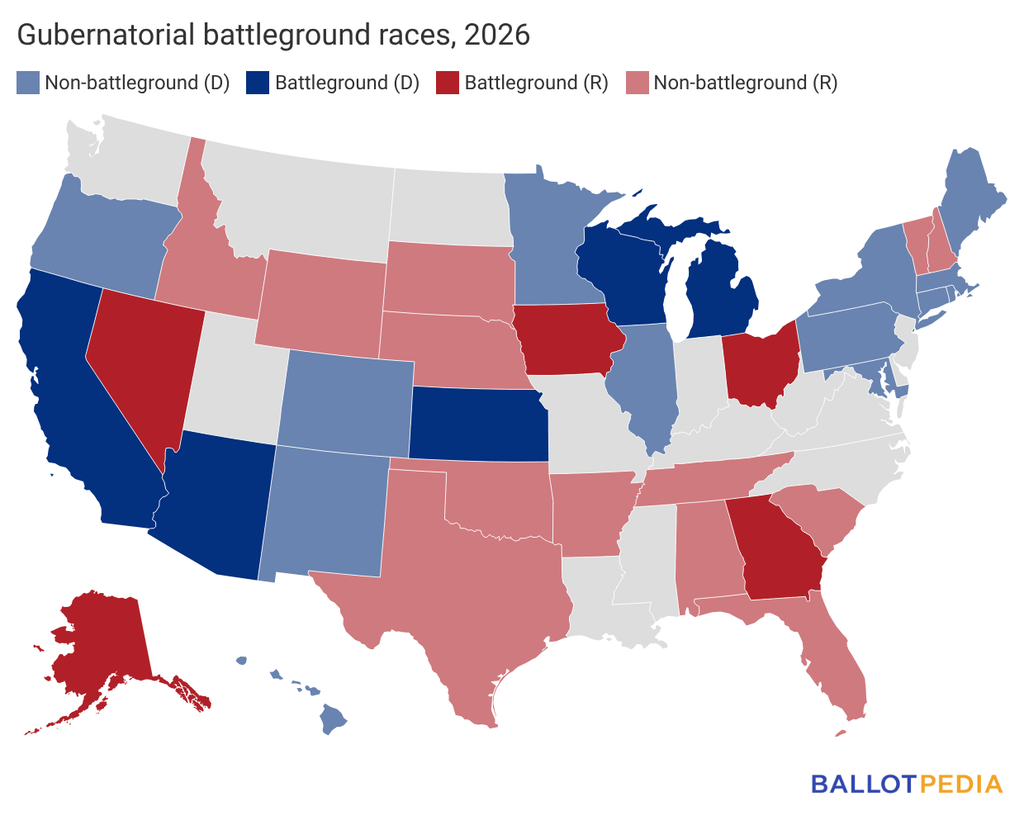
Democrats are defending five governorships in states President Donald Trump (R) won in 2024 presidential election: Arizona, Kansas, Michigan, Pennsylvania, and Wisconsin. Republicans are defending two governorships in a state that Kamala Harris (D) won in 2024: New Hampshire and Vermont.
In 2022, the last time this set of offices was up for election, Democrats were defending one governorship in a state that Donald Trump (R) won in 2020: Kansas. Republicans were defending governorships in six states President Joe Biden (D) won in 2020: Arizona, Georgia, Maryland, Massachusetts, New Hampshire, and Vermont.
Battlegrounds
Ballotpedia has identified 10 races as battlegrounds, split evenly between five Democratic-held and five Republican-held governorships. Eight of the 10 have no incumbent running.
- Alaska: Jonathan Kreiss-Tomkins (D), David Bronson (R), Treg Taylor (R), and Bernadette Wilson (R) advanced to the general election from the top-four primary. Incumbent Gov. Mike Dunleavy (R) is term-limited. A Republican has held the governor’s office since Dunleavy was elected in 2018. Alaska's last Democratic governor, Tony Knowles, left office in 2002.
- Arizona: Incumbent Katie Hobbs (D), Andy Biggs (R), Risa Lombardo (G), and Teri Hourihan (No Labels Party) are running. In 2022, Hobbs was elected 50.3% to 49.6%. In the 2024 presidential election, President Donald Trump (R) defeated Kamala Harris (D) 52.2% to 46.7% in the state. This is one of five governorships Democrats are defending in states Trump won in 2024.
- California: Incumbent Gov. Gavin Newsom (D) is term-limited. Xavier Becerra (D) and Steve Hilton (R) are running. They advanced from the top-two primary on June 2.
- Georgia: Keisha Lance Bottoms (D) and Rick Jackson (R) are running. Incumbent Gov. Brian Kemp (R) is term-limited. The last Democrat elected governor was Roy Barnes in 1998.
- Iowa: Rob Sand (D) and Zach Lahn (R) are running. Incumbent Kim Reynolds (R) is not running for re-election. The last Democrat elected governor of Iowa was Chet Culver (D) in 2006.
- Kansas: Cindy Holscher (D) and Ty Masterson (R) are running. Incumbent Gov. Laura Kelly (D) is term-limited. This governorship is one of five that Democrats are defending this year in a state that Trump won in the 2024 presidential election.
- Michigan: Incumbent Gov. Gretchen Whitmer (D) is term-limited. Jocelyn Benson (D), John James (R), and four other candidates are running in the general election. This is one of five governorships Democrats are defending in states Trump won in 2024. As of October 2026, major election forecasters rated the election Lean Democratic or Tilt Democratic.
- Nevada: Incumbent Joe Lombardo (R), Aaron Ford (D), and Danielle Ford (No Political Party) are running. In the 2024 presidential election, Trump became the first Republican to win Nevada since George W. Bush (R) in 2004. Trump defeated Harris 51% to 48% in Nevada. The state is one of 11 with a divided government, as Lombardo is a Republican while Democrats hold both chambers of the Legislature and the offices of attorney general and secretary of state.
- Ohio: Amy Acton (D), Vivek Ramaswamy (R), and Don Kissick (L) are running. Incumbent Mike DeWine (R) is term-limited. Ohio voters last elected a Democratic governor in 2006 when Ted Strickland (D) defeated J. Kenneth Blackwell (R) 61%-37%.
- Wisconsin: Incumbent Tony Evers (D) is not running for re-election. David Crowley (D), Tom Tiffany (R), and Jamie Jo Carothers (Independent, write-in) are running. This is one of five governorships Democrats are defending in states Trump won in 2024. Trump defeated Harris 49.6% to 48.7% in the 2024 presidential election in Wisconsin. As of October 2026, major election forecasters rated the general election Toss-up or Lean Democratic.
Key Trends to Watch
- Total open offices: A total of 18 gubernatorial elections are open this year. This is more than 2022, when there were eight open offices, but fewer than 2018, when there were 17 in 2018. As we mentioned in our Oct. 9 edition of the Daily Brew, 118 out of the 296 state executive offices up for election have no incumbent running. This is the largest number of open offices since 2018. One contributing factor to this year’s number of open offices is term limits. Fifteen incumbent governors are term-limited: six Democrats and nine Republicans. Seven governors were term-limited in 2022, and 13 were term-limited in 2018. Three governors who were eligible to run for re-election did not: Iowa Gov. Kim Reynolds (R), Minnesota Gov. Tim Walz (D), and Wisconsin Gov. Tony Evers (D). Rhode Island Gov. Daniel McKee (D) ran for re-election and was defeated in a primary.
- Presidential election aftermath: This year’s elections will be the first since the 2024 presidential election. In the lead-up to Election Day, there has been some media speculation about whether there will be a wave election. In 2018, Ballotpedia published a study of wave elections examining the results of the 50 election cycles between 1918 and 2016. In that study, we defined wave elections as the 20 percent of elections resulting in the greatest swing against the president’s party. For governors, the president's party needed to lose seven seats for the year to historically qualify as a wave election. Looking at only even years, the president's party has lost seven or more governorships in 11 of the 54 elections since 1918. Eight of the 11 wave elections happened in a president's first midterm election. The president's party gained governorships in 11 years.
Recent election history
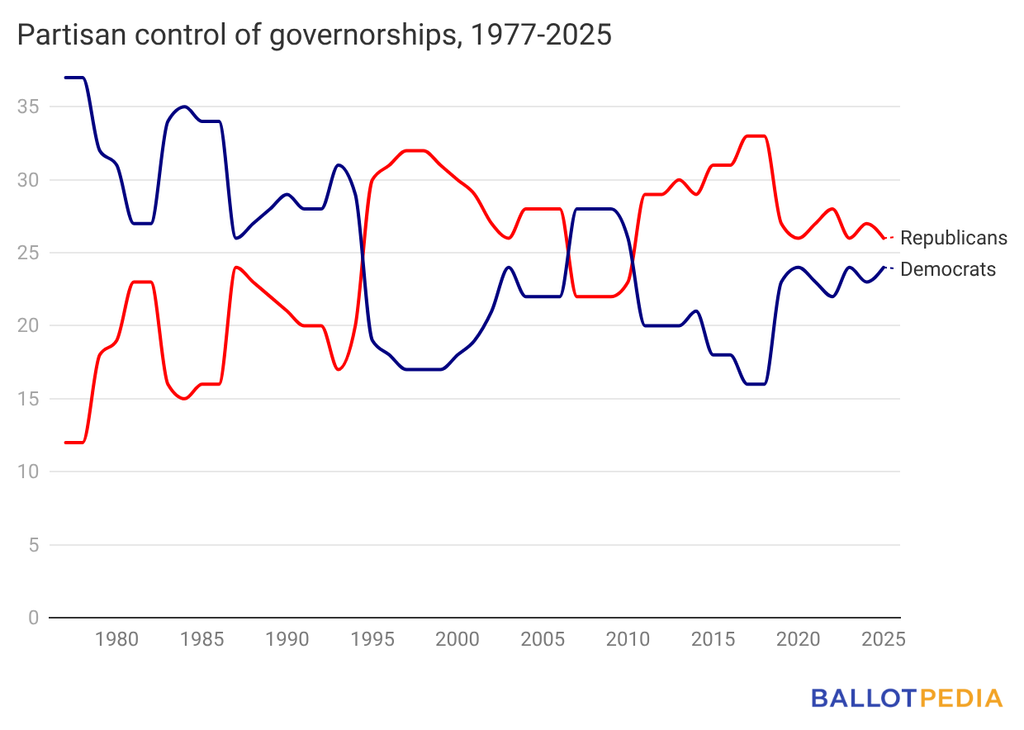
Four offices changed party hands in 2022. Partisan control changed from Republican to Democratic in Arizona, Maryland, and Massachusetts. Partisan control changed from Democratic to Republican in Nevada.
Click here to read more about the 2026 gubernatorial elections.