


The national chapter of the Democratic Socialists of America (DSA) and its local chapters have endorsed 131 candidates on the Nov. 3 ballot in 30 states and the District of Columbia. The groups have also taken positions on 33 state and local ballot measures on the same ballot.
Ten candidates are running for the U.S. House of Representatives, 52 are running for state legislatures, and 69 are running for local offices.
The DSA website describes itself as "the largest socialist organization in the United States because we're a member-driven mass organization. We believe that working people should run both the economy and civil society, and we show our commitment to this principle by being an organization of, by, and for the working class."
They're one of what we at Ballotpedia refer to as a Recognized Endorsement Contributor (REC) — a person or organization that publicly expresses their support for candidates or campaigns. These endorsements provide voters with valuable information and, ultimately, contribute to an information environment that fosters a more civically engaged and informed electorate.
The following includes endorsements and positions on ballot measures from the national chapter and local chapters.
Congressional elections
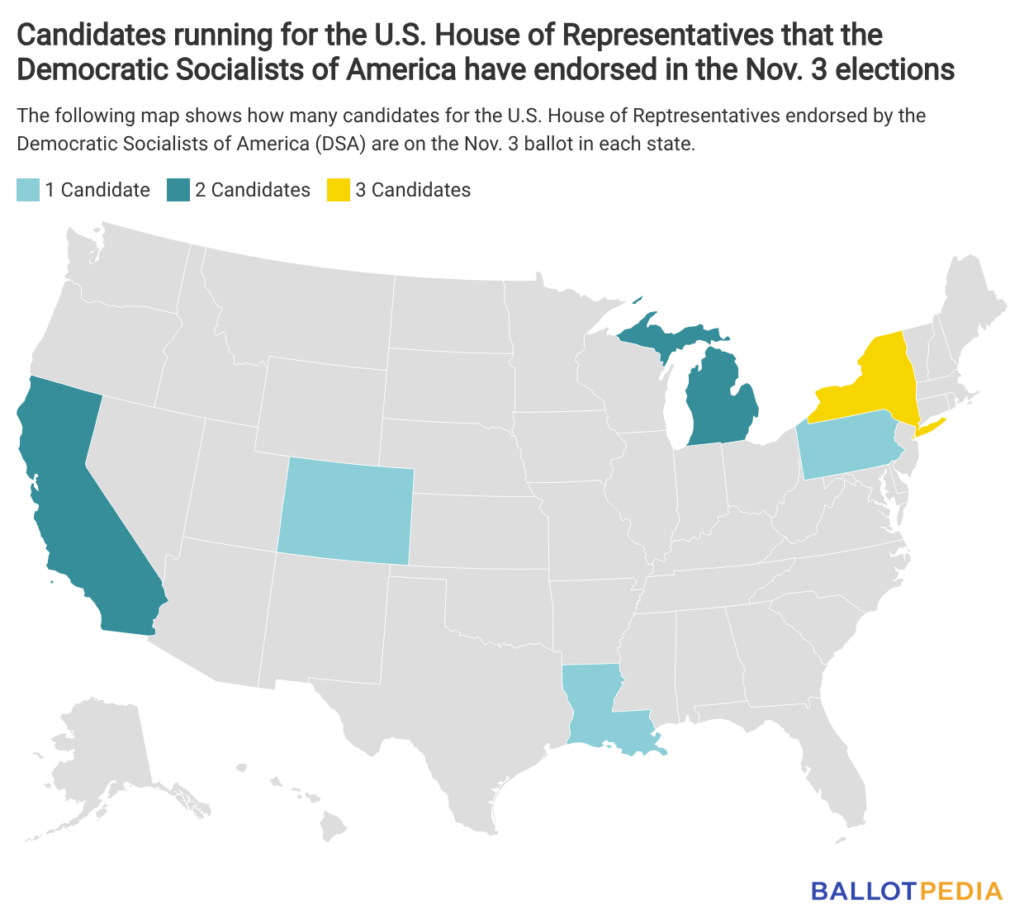
Three DSA-endorsed candidates defeated Democratic incumbents in primaries this year. All three are among nine DSA-endorsed candidates running in districts that four independent race forecasters have rated Safe/Solid Democratic. The other six are two incumbents, two candidates running for open seats, and two candidates in California, where the top-two primary finishers advance regardless of party. In both California races, voters will decide between a DSA-endorsed candidate and a Democratic incumbent.
In the other seven Safe/Solid Democratic elections, voters will not decide between a DSA-endorsed candidate and another Democrat. As a result, the number of DSA-endorsed members of the U.S. Congress could increase from two to at least seven, and to nine if both DSA-endorsed candidates win in California.
One DSA-endorsed candidate is running in a district rated Safe/Solid Republican: Louisiana’s 1st Congressional District, where the candidate is one of four on the ballot and the only Democrat. Louisiana uses a majority-vote system in which all candidates appear on the same ballot regardless of party affiliation.
State legislative elections
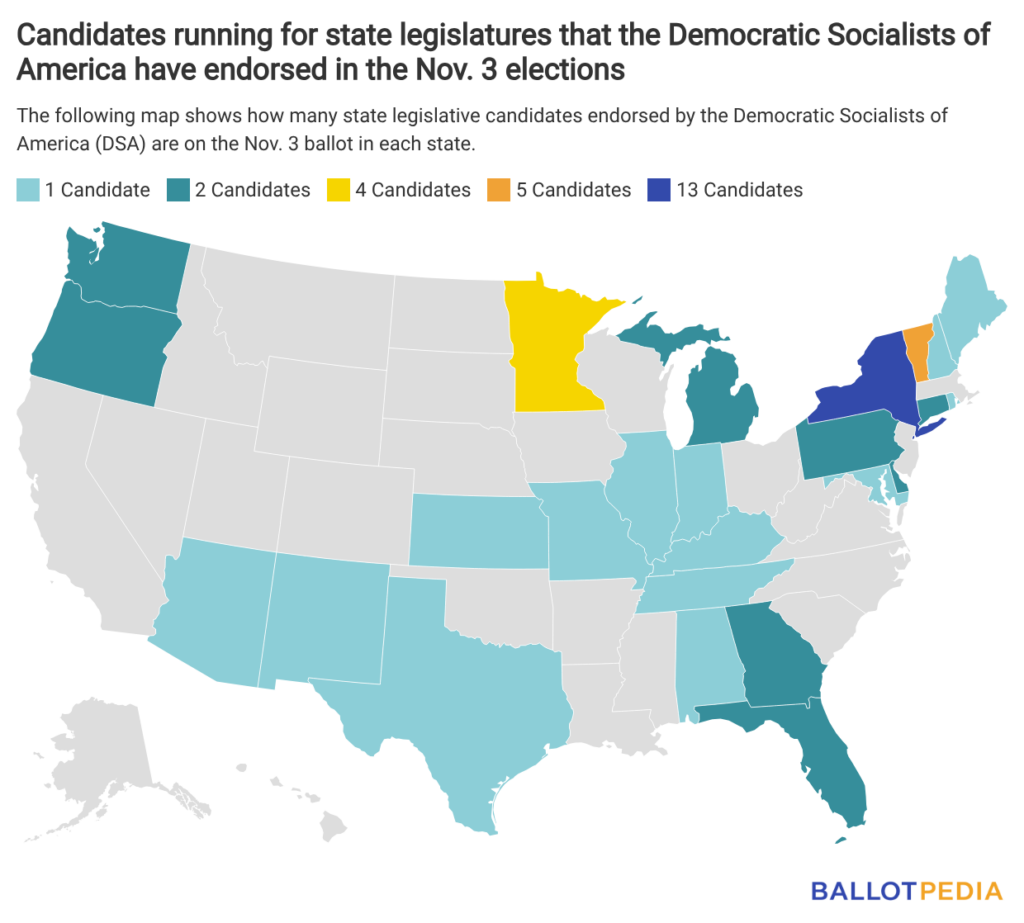
Fifty-two DSA-endorsed candidates are running for state legislative seats across 25 states and 31 chambers. Sixteen are incumbents, five of whom are in New York.
Of the 36 DSA-endorsed candidates who are not incumbents, nine defeated incumbents in Democratic primaries, so there will not be an incumbent on the Nov. 3 ballot. One other DSA-endorsed candidate is running in a multi-member district in Arizona. The candidate defeated one of the district’s two Democratic incumbents in the primary and will appear on the general election ballot alongside the other.
Another 13 DSA-endorsed candidates will appear on the Nov. 3 ballot alongside incumbents, 10 of whom are Republicans and two of whom are Democrats. In New Hampshire, the candidate advanced from the primary along with the district’s Democratic incumbent, and both will be on the Nov. 3 ballot with the district’s Republican incumbent.
The remaining 13 are running for open seats where no incumbent is running for re-election.
New York has the most DSA-endorsed candidates, with 11 running for the State Assembly. The Vermont House of Representatives has the second-most, with three. The other 38 candidates are spread across 29 chambers.
Local elections
DSA-endorsed candidates will be on the Nov. 3 ballot for mayor in two of the 100 most populous U.S. cities: Los Angeles, California, and Louisville, Kentucky. The Democratic incumbent mayors of both cities will also be on the ballot. A third DSA-endorsed candidate is running for mayor of Washington, D.C., where the office is open. In all, 10 DSA-endorsed candidates are running for mayor.
They are among a total of 69 DSA-endorsed candidates running for local offices, 37 of whom are running in California. Minnesota has the second-most, with six, and the remaining 26 are running across 17 other states and Washington, D.C.