


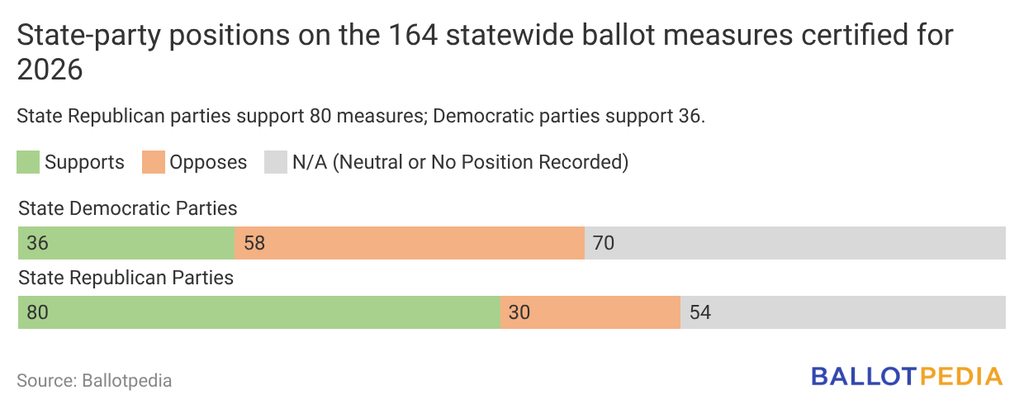
State Democratic and Republican parties agreed on six statewide ballot measures this year, and disagreed on 70.
On 50 state ballot measures, the state Republican Party supported them, and the state Democratic Party opposed them. On 20, Democrats supported, and Republicans opposed. Both parties supported three measures and opposed three others.
Of the remaining 88 measures, 52 received a support or opposition position from only one state party. Neither party recorded support or opposition on the other 36.
Overall, state Republican parties supported 80 measures (48.8%), opposed 30 (18.3%), and were neutral or had no recorded position on 54 (32.9%).
State Democratic parties supported 36 measures (22.0%), opposed 58 (35.4%), and were neutral or had no recorded position on 70 (42.7%).
Voters will decide 145 of this year’s 164 statewide ballot measures on Nov. 3. The other 19 appeared on ballots earlier in the year.
Parties took opposite positions on 70 measures
Of the 70 measures with opposing state-party positions, 41 (58.6%) were legislatively referred and 29 (41.4%) were citizen-initiated, including veto referendums. Some of these disagreements included measures concerning voter identification, abortion, sex-based sports requirements, medical procedures for transgender minors, and taxes, among others.
- Voter identification: State Republican parties supported and state Democratic parties opposed five voter identification measures: Arizona Proposition 144, California Proposition 39, Colorado Amendment 84, North Carolina’s Voter Identification Amendment, and Ohio Issue 3. The Nevada Republican Party supported Question 7, with no position recorded for the state Democratic Party. The Oklahoma Democratic Party opposed State Question 846, with no position recorded for the state Republican Party.
- Abortion policy: State Democratic parties supported and state Republican parties opposed Idaho Proposition 1 and Virginia Question 1, which would establish statutory and constitutional rights related to abortion access, respectively. Republicans supported, and Democrats opposed, Missouri Amendment 3, which would repeal the constitutional right to reproductive freedom approved in 2024 and prohibit abortion with specified exceptions, among other changes. The Nevada Democratic Party supported Question 6, which would establish a constitutional right to abortion, with no position recorded for the state Republican Party.
- Sex-based sports requirements: State Republican parties supported and state Democratic parties opposed all four measures concerning sex-based requirements for school sports: Arizona Proposition 318, Colorado Proposition 134, Nebraska Initiative Measure 442, and Washington Initiative 638.
- Medical procedures for transgender minors: State Republican parties supported and state Democratic parties opposed both Colorado Proposition 135 and Missouri Amendment 3.
- Income and wealth taxes: State Democratic parties supported and state Republican parties opposed California Proposition 3, which would extend higher-income tax rates for education funding; California Proposition 40, which would impose a one-time wealth tax; and Colorado Amendment 87, which would replace the flat income tax with graduated rates. Republicans supported, and Democrats opposed, the other six measures, which would restrict, reduce, or repeal income or wealth taxes: California Proposition 42, Colorado Proposition 136, Iowa Amendment 1, Missouri Amendment 5, North Carolina’s Income Tax Rate Cap Amendment, and Washington Initiative 645.
Both parties supported three measures and opposed three others
State Democratic and Republican parties in the same state supported:
- California Proposition 38, which would authorize $8.4 billion in general obligation bonds for immunology and immunotherapy research. Half of the bond revenue would go to a research institute affiliated with the University of California through a required state partnership. The remaining funds would support grants to California-based public and nonprofit medical research institutions.
- Louisiana Amendment 7, which would amend the state constitution to authorize public funds for maintaining drinking water utility service lines affected by hazardous materials on property owned by utility customers.
- Massachusetts Question 1, which would make records held by the legislature and governor’s office subject to the state’s public records law. Exceptions would include documents related to developing legislators’ or the governor’s policy positions and communications between legislators’ offices and constituents concerning access to government services.
State Democratic and Republican parties in the same state opposed:
- California Proposition 44, which would require nonprofit federally qualified health centers to spend at least 90% of their annual total revenue on expenses that advance the health center’s mission.
- Colorado Proposition 137, which would allow the state to retain and spend sales tax revenue from sporting goods and equipment on water, land, forests, wildfire prevention, and outdoor recreation rather than refunding it under the Taxpayer’s Bill of Rights (TABOR). A no vote would leave the revenue subject to existing TABOR requirements.
- Massachusetts Question 3, which would replace separate political party primaries for state elections with a single primary listing all candidates on the same ballot, regardless of political affiliation. The two candidates receiving the most votes would advance to the general election.
Legislative votes and party positions differed on five measures
For five measures, a majority of legislators from one party voted to place the measure on the ballot, while the state party organization opposed it. Legislative support percentages exclude absent members and those who did not vote.
- Democrats: Democratic legislative support for referring California Proposition 43 was 96.3%. The measure would require two-thirds voter approval for citizen-initiated local special taxes and prohibit local jurisdictions and ballot initiatives from enacting certain property taxes, with an exception for authorized bond debt-service taxes. Democratic legislative support for referring Utah Constitutional Amendment A was 100%. It would require proposed constitutional amendments to be published for 60 days before the election in a manner specified by the legislature, replacing the requirement for newspaper publication in each county. The state Democratic parties opposed both measures.
- Republicans: Republican legislative support for referring New Mexico’s Bond Question 2 and Bond Question 3 was 100%. Question 2 would authorize up to $20 million in bonds for acquisitions by academic, public school, tribal, and public libraries. Question 3 would authorize up to $230 million in bonds for capital improvements and acquisitions at higher education institutions, special schools, and tribal schools. Both would be funded by a statewide property tax. Republican legislative support for referring Constitutional Amendment 3 was 95.1%. It would establish regents nominating committees, require student appointees to come from lists provided by student governing bodies, and prohibit non-student appointees from changing political parties during the 12 months preceding appointment. The state Republican Party opposed all three measures.
No measures received state-party support when a majority of that party’s legislators voted against placing them on the ballot.
The Nov. 3 results will show which measures voters approved or defeated and how those outcomes aligned with state-party positions. A party’s position prevailed if voters approved a measure the party supported or defeated a measure the party opposed.
Follow the results and their alignment with state-party positions here: ...
Additional reading: