


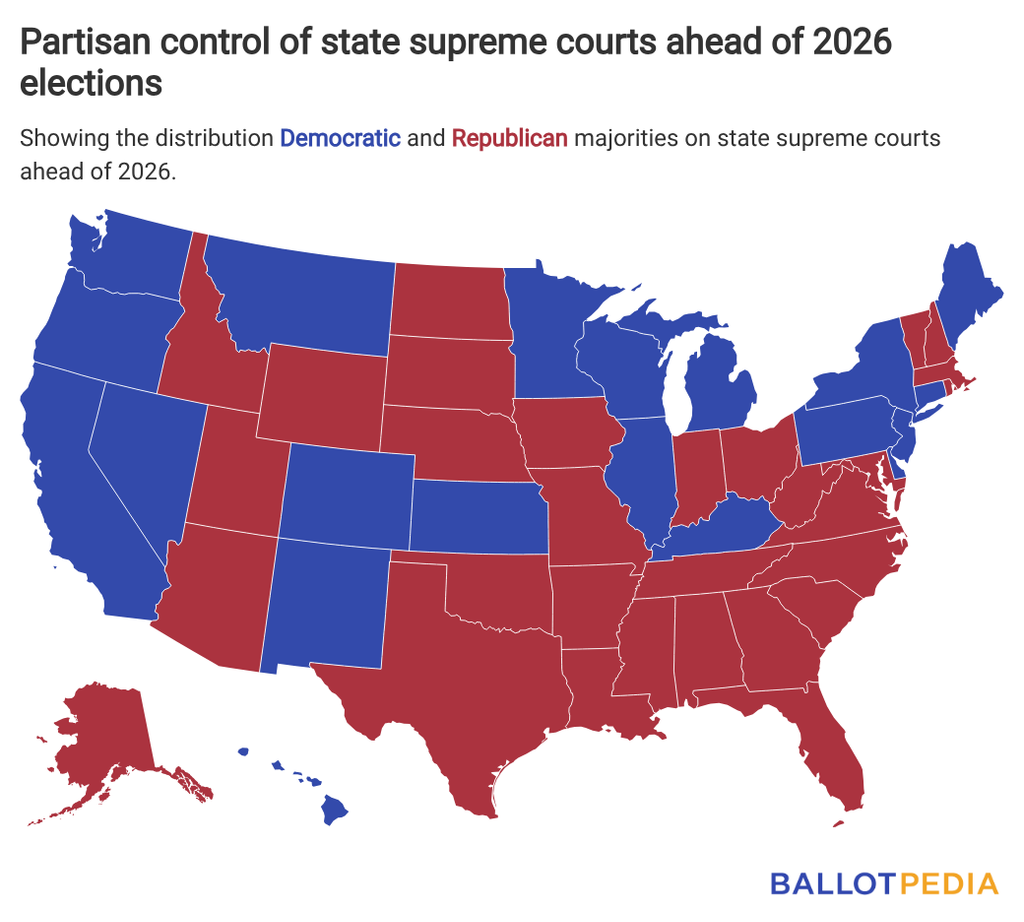
Twenty-five states are holding elections for state supreme courts in November. Of the courts up for election, 13 have a majority of Republican-appointed/elected justices, 11 have a majority of Democratic-appointed/elected justices, and one court is split.
Each state and the District of Columbia has at least one supreme court, or court of last resort. Oklahoma and Texas both have two courts of last resort, one for civil appeals and one for criminal appeals.
These supreme courts hear appeals of the decisions made in lower trial or appellate courts. The number of justices on each court varies between five and nine. The length of a justice's term can be as short as six years or be a lifetime appointment.
Battlegrounds:
Ballotpedia identified six courts as battlegrounds. One state has the majority directly at stake, while the outcomes of others have implications for whether a party can gain a majority of seats in a future election:
- Michigan: Two seats are up for election. The elections are nonpartisan, but parties nominate justices at conventions. Incumbent Justices Megan Cavanagh (D) and Noah Hood (D) face Casandra Morse-Bills (R) and Michael D. Warren Jr. (R). All candidates run on the same ballot. Democrats control the court 6-1. If Republicans win both seats, the court will become 4-3 Democratic, and Republicans could win the court in 2028.
- Montana: Amy Eddy and Dan Wilson are running in a nonpartisan election. This is the only election in 2026 where the majority is directly at stake. According to Bolts Magazine, the court is 4-3 in favor of liberals, with Eddy being a liberal and Wilson a conservative.
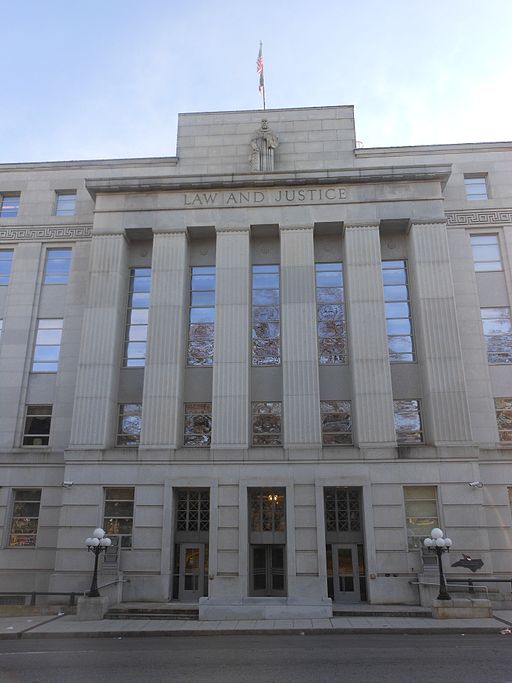
- North Carolina: Incumbent Justice Anita Earls (D) and Sarah Stevens (R) are running. The court currently has a 5-2 Republican majority. Republicans won a majority on the court in 2022. If Earls wins re-election, Democrats could win a majority in 2028 when three Republican justices will be up for election.
- Ohio: Four candidates are running in the partisan general election for two seats. Incumbent Justice Jennifer L. Brunner (D) and Colleen O'Donnell (R) are running for one seat, and incumbent Justice Dan Hawkins (R) and Marilyn Zayas (D) are running for the other. Republicans have a 6-1 majority on the court and have held it since 1986.
- Utah: Justice Jill Pohlman is standing for retention. Bolts Magazine wrote that Republicans had disagreed with the court over redistricting and citizen initiative laws. At the state Republican Party convention in April, chair Robert Axon supported Pohlman’s retention. The Utah State Bar opposes it. Republicans have appointed every justice on the court.
- Washington: Five seats are up for election, three incumbents are running, and two are open. Washington State Standard's Jake Goldstein-Street wrote that a state 9.9% tax on families earning over $1 million, set to go into effect in 2028, has faced legal challenges and become an issue in the race, as the court may hear challenges to the law. Democrats appointed six of the court’s nine justices, and the election could determine how large the court’s Democratic majority is.
Key Trends:
Control for 2028: While Montana has the only election with direct majority control on the line, many contests will determine whether the partisan majority of the courts in 2028.
Ideological balance: Some states will not see their court’s majority change its partisan control, but the outcomes could potentially make for a narrower majority, which may affect the court’s future rulings.
Recent election history:
In 2025, no courts changed ideological control. In 2024, Kentucky went from a Republican-majority court to a divided court. In 2023, liberals gained control of the Wisconsin Supreme Court. In 2022, Republicans gained a majority on the North Carolina Supreme Court.
To read more about state supreme court elections, click here.