


Congressional Republicans made significant use of the Congressional Review Act (CRA) during the 119th Congress to repeal Biden-era regulations, and the mechanics of the legislative review tool may lead Democratic majorities to pursue CRA resolutions in the upcoming 120th Congress.
The CRA is a mechanism of legislative oversight over agency regulations that allows Congress to review and repeal executive agency rules with joint resolutions of disapproval. The CRA is implicated in debates about the separation of powers, and similar agency oversight mechanisms are part of Ballotpedia's legislative control pillar of the administrative state.
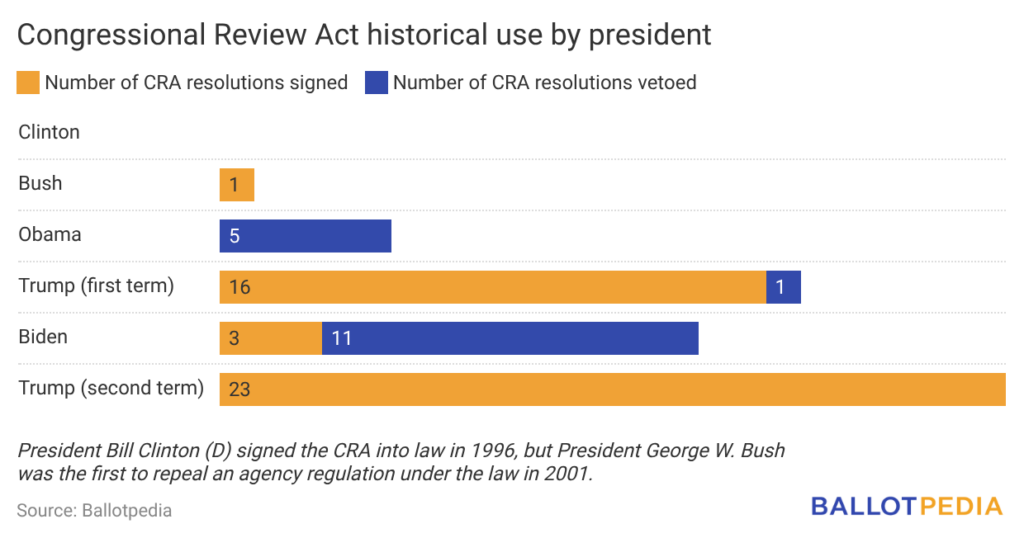
Republicans used their control of Congress and the presidency to disapprove of more regulations during the 119th Congress (23) than during any other Congress. While incoming Democratic majorities in the 120th Congress will face a roadblock to using the CRA in the form of President Donald Trump (R), they may see opportunities to use the tool to advance policy and messaging priorities because advancing resolutions under the CRA is simpler than many other legislative procedures.
Under the CRA, Congress has 60 working days after a rule has been submitted to introduce a joint resolution of disapproval. When rules are submitted to Congress with less than 60 working days left in the congressional session, the subsequent Congress has a lookback period that allows them to submit CRA resolutions as if these rules were submitted on the 15th working day of the new Congress. Joint resolutions of disapproval bypass the Senate filibuster by limiting debate to 10 hours, sometimes less. They are not subject to proposals for amendments, motions to postpone, or motions to proceed to other business. CRA resolutions need a simple majority to pass, but — like other legislation — need a two-thirds majority to override a likely Trump veto.
Enacted CRA resolutions have mostly nullified regulations issued during prior administrations during the CRA's lookback period. All CRA's approved during the 119th Congress did so.
Presidents Barack Obama (D), Donald Trump (R), and Joe Biden (D) all vetoed CRA resolutions from a Congress controlled by the opposing party, and Congress has never overridden a CRA veto.
Expanded use of the CRA under the 119th Congress
Executive branch agencies must submit agency rules to Congress upon publication. Since 2025, the Government Accountability Office (GAO) has issued several decisions expanding the interpretation of what counts as a rule under the CRA, subjecting agency actions to congressional review that once did not receive it. The 119th Congress was also able to nullify regulations from outside of Congress' lookback period as a result of GAO's decision to require agencies to submit additional actions to Congress for review.
Congress also passed CRA resolutions disapproving of several Bureau of Land Management land management plans for the first time as a result of a GAO decision, and used the tool to disapprove of Clean Air Act waivers that the EPA granted to California even though the GAO held that these waivers were not rules.
Read more about our coverage of the evolving use of the CRA here, and learn more about the Congressional Review Act here. Subscribe to our monthly administrative state newsletter to get monthly updates on the CRA.