



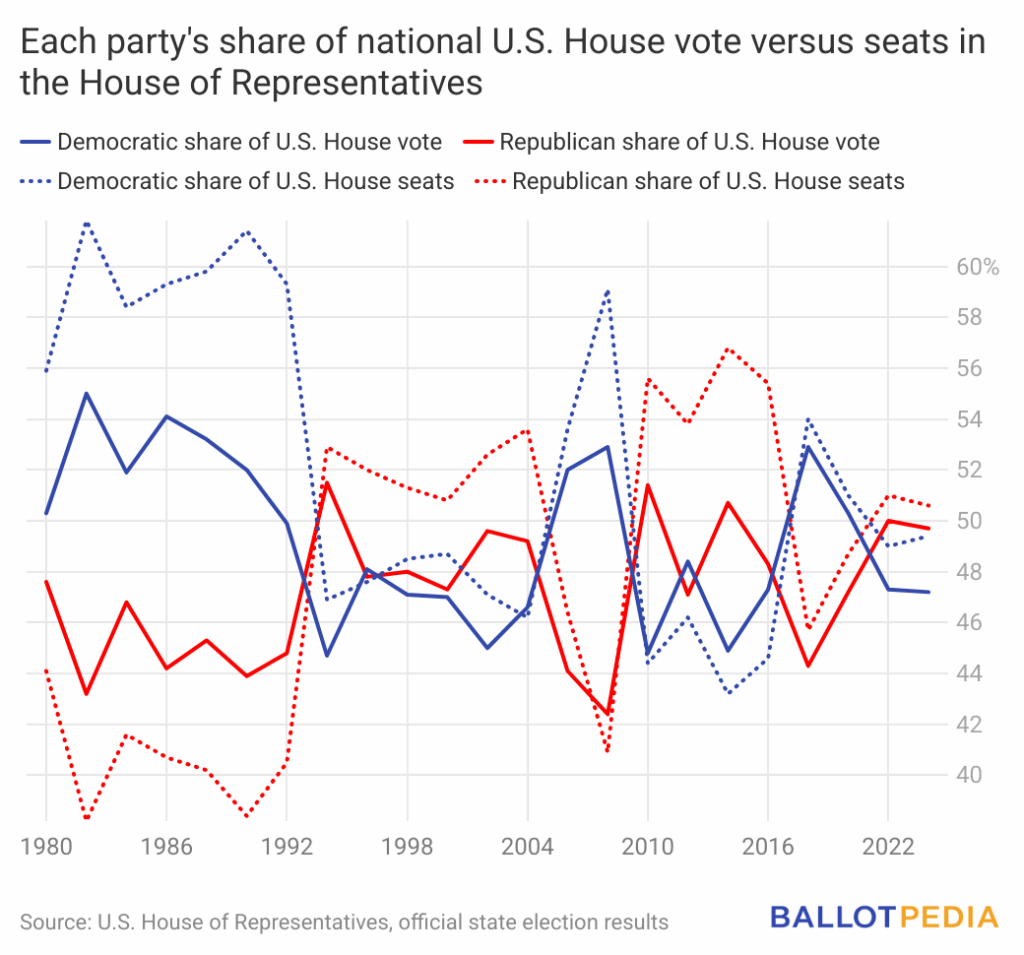
As states implement or consider new congressional district boundaries ahead of the 2026 elections, debates over how votes translate into control of U.S. House seats are in the spotlight. Our review of more than 40 years of data shows that the share of all House votes a party receives across the country does not always align with the number of seats that party controls.
In the 2024 U.S. House elections, Democrats won 47.2% of votes and 49.4% of seats, while Republicans won 49.7% of votes and 50.6% of seats. These types of gaps are not uncommon and have at times been much bigger.
Since 1980, Democrats’ share of seats exceeded their share of the vote in 17 of 23 House elections. Republicans, meanwhile, outperformed their vote share in 15 of 23 elections.
The largest differences between the Democratic Party's share of seats won and its national vote share were in 1990 and 1992. In 1990, Democrats received 52.0% of the vote but won 267 seats (61.4%). In 1992, they received 49.9% of the vote but won 258 seats (59.3%).
For Republicans, the largest difference was in 2016. That year, they received 48.3% of the vote but won 241 seats (55.4%).
In all but two elections, 1996 and 2012, the party with the larger national vote share won a majority in the House. In both cases, Republicans won a majority of seats while earning fewer total votes nationwide.
- 1996: Democrats won 48.1% of House votes nationwide to Republicans’ 47.8%. Republicans won a 226-207-2 majority.
- 2012: Democrats won 48.4% of House votes nationwide to Republicans’ 47.1%. Republicans won a 234-201 majority.
Why mismatches occur
To what extent do redistricting, gerrymandering, geography, population shifts, and the House's structure influence these mismatches? Analysts haven’t agreed on a definitive answer.
The Public Policy Institute of California's Eric McGhee writes: "[S]ingle-member district elections—like the ones for the US House of Representatives—have historically had a natural 'winner’s bonus' that usually gives the majority party a higher seat share than vote share, even without a gerrymander. For example, a party winning 55% of the votes would rarely win exactly 55% of the seats. It would almost always win at least a few percentage points more, and sometimes far more than that. So a modest seats-votes discrepancy is normal and not a sign of gerrymandering." A single-member district is an electoral district that sends one officeholder to a body.
Other factors, such as split-ticket voting, could also contribute. During Ronald Reagan’s (R) presidency in the 1980s, Democrats controlled the House. The Atlantic's Ronald Brownstein writes, "About 190 districts split their votes during landslides for Richard Nixon and Ronald Reagan, largely because many conservative southerners still voted Democratic for the House even as they backed those GOP presidential candidates."
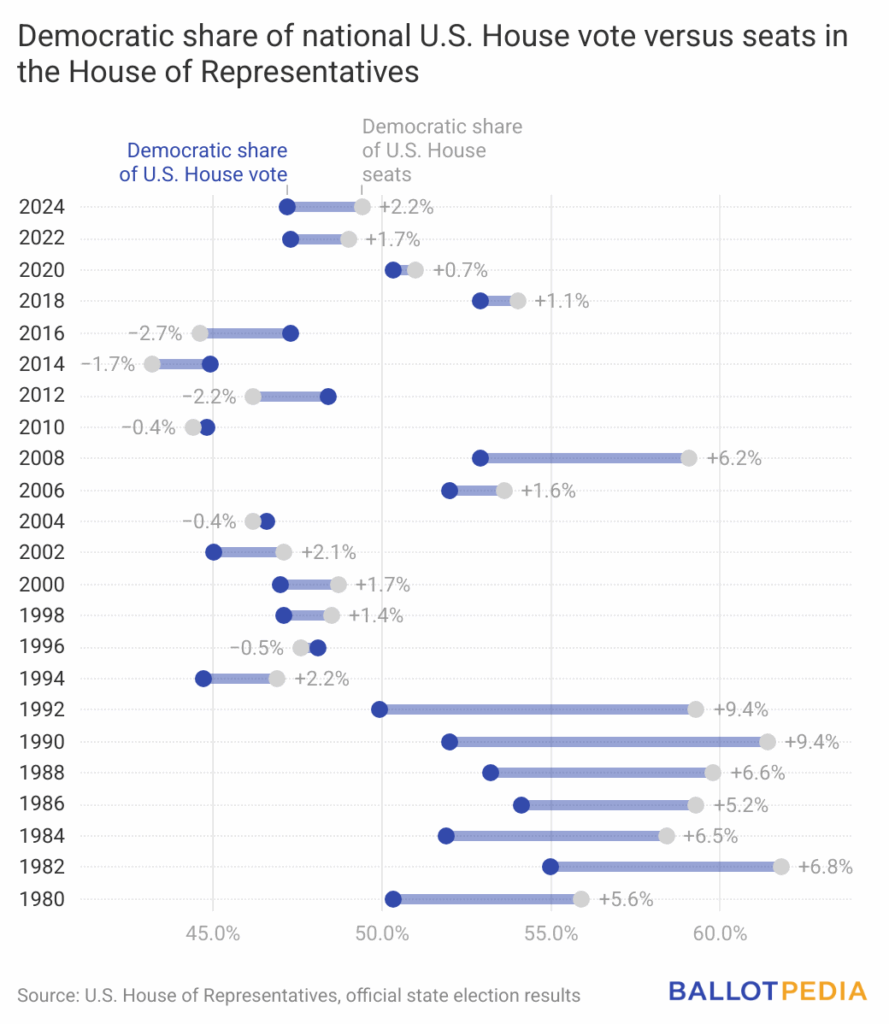
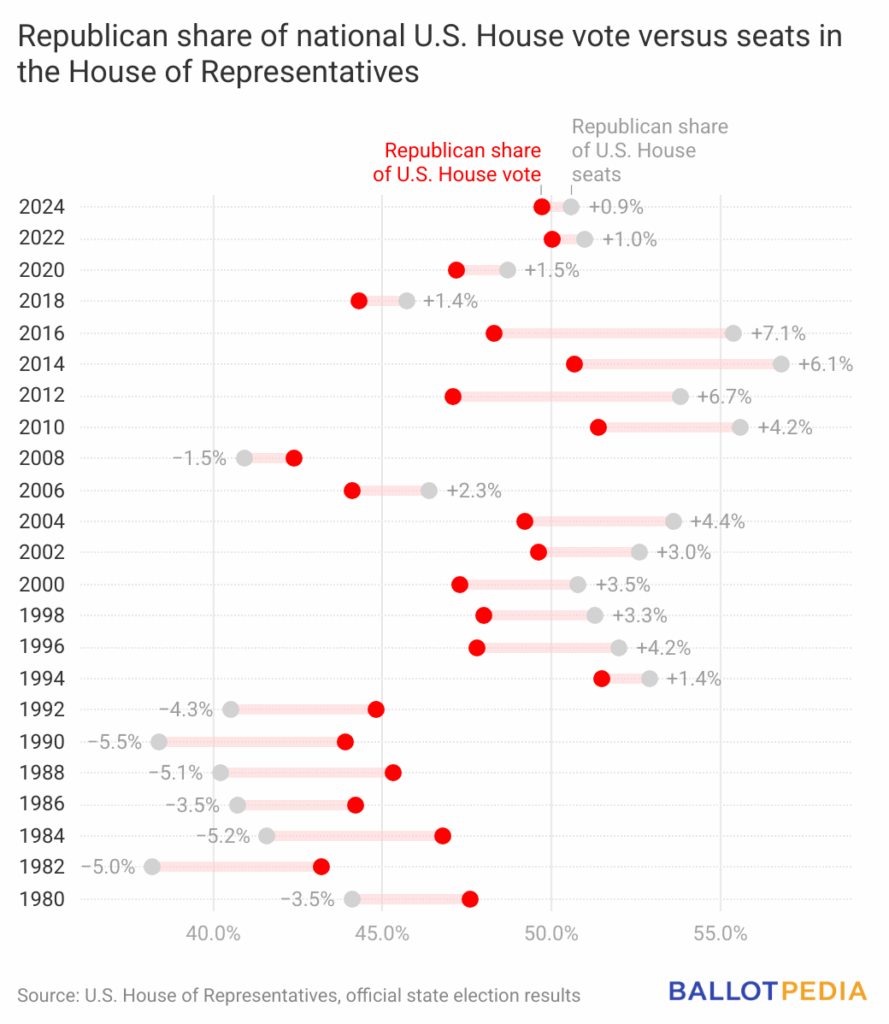
If you’d like to explore the full dataset year by year, click here.