


Welcome to the Dec. 1 edition of Robe & Gavel, Ballotpedia’s newsletter about the Supreme Court of the United States (SCOTUS) and other judicial happenings around the U.S.
There is nothing more innocent
than the still-unformed creature I find beneath soil,
neither of us knowing what it will become
in the abundance of the planet.
It makes a living only by remaining still
in its niche.
One day it may struggle out of its tender
pearl of blind skin
with a wing or with vision
leaving behind the transparent.
…
This same growing must be myself,
not aware yet of what I will become
in my own fullness
inside this simple flesh.
-Linda Hogan
“Innocence”
Follow Ballotpedia on X and Bluesky or subscribe to the Daily Brew for the latest news and analysis.
We #SCOTUS and you can, too!
Grants
SCOTUS has accepted one new case to its merits docket since our Nov. 10 issue. To date, the court has agreed to hear 46 cases for the 2025-2026 term and has issued per curiam decisions on two cases that were not argued. SCOTUS dismissed one case after it was accepted.
Click the links below to learn more about this case:
- Noem v. Al Otro Lado originated from the U.S. Court of Appeals for the Ninth Circuit and concerns the Immigration and Nationality Act.
Arguments
The Supreme Court will hear four arguments this week. Click here to read more about SCOTUS' current term.
Click the links below to learn more about these cases:
Dec. 1
- Cox Communications, Inc. v. Sony Music Entertainmentconcerns a business's liability for copyright infringement.
- The questions presented: "1. This Court has held that a business commits contributory copyright infringement when it ‘distributes a device with the object of promoting its use to infringe copyright, as shown by clear expression or other affirmative steps to foster infringement.’ Metro-Goldwyn-Mayer Studios, Inc. v. Grokster, Ltd., 545 U.S. 913, 919 (2005). The courts of appeals have split three ways over the scope of that ruling, developing differing standards for when it is appropriate to hold an online service provider secondarily liable for copyright infringement committed by users.
“Did the Fourth Circuit err in holding that a service provider can be held liable for ‘materially contributing’ to copyright infringement merely because it knew that people were using certain accounts to infringe and did not terminate access, without proof that the service provider affirmatively fostered infringement or otherwise intended to promote it?
“2. Generally, a defendant cannot be held liable as a willful violator of the law-and subject to increased penalties-without proof that it knew or recklessly disregarded a high risk that its own conduct was illegal. In conflict with the Eighth Circuit, the Fourth Circuit upheld an instruction allowing the jury to find willfulness if Cox knew its subscribers' conduct was illegal-without proof Cox knew its own conduct in not terminating them was illegal.
“Did the Fourth Circuit err in holding that mere knowledge of another's direct infringement suffices to find willfulness under 17 U.S.C. § 504(c)? "
- The questions presented: “Whether a federal court of appeals must defer to the BIA's judgment that a given set of undisputed facts does not demonstrate mistreatment severe enough to constitute ‘persecution’ under 8 U.S.C. § 1101(a)(42)."
Dec. 2
- First Choice Women’s Resource Centers, Inc. v. Platkinconcerns whether a group of faith-based nonprofits that provide pregnancy-related services can challenge the constitutionality of a subpoena from a state attorney general in federal court.
- The questions presented: “Where the subject of a state investigatory demand has established a reasonably objective chill of its First Amendment rights, is a federal court in a first-filed action deprived of jurisdiction because those rights must be adjudicated in state court?”
Dec. 3
- The questions presented: "1. Whether, as the Fifth Circuit holds in conflict with the Ninth and Tenth Circuits, this Court's decision in Heck v. Humphrey bars § 1983 claims seeking purely prospective relief where the plaintiff has been punished before under the law challenged as unconstitutional.
“2. Whether, as the Fifth Circuit and at least four others hold in conflict with five other circuits, Heck v. Humphrey bars § 1983 claims by plaintiffs even where they never had access to federal habeas relief.”
In its October 2025 term, SCOTUS heard arguments in 65 cases. Click here to read more about SCOTUS's previous term.
Opinions
SCOTUS has ruled on two cases since our Nov. 10 edition. The court has issued rulings in two cases so far this term. Forty-six cases are still under deliberation. SCOTUS had released two opinions at this point in its 2024-2025 term.
Click the links below to read more about the specific cases SCOTUS ruled on since Nov. 10:
Nov. 24
Clark v. Sweeney was decided without argument.
The case: Clark v. Sweeneyconcerns theprinciple of party presentation.
- According to United States v. Sineneng-Smith, in theprinciple of party presentation, the parties involved in the legal suit “frame the issues for decision and assign to courts the role of neutral arbiter of matters the parties present.” Essentially, Courts are not meant to present new claims.
The outcome: A jury in Maryland found Jeremiah Sweeney guilty of several crimes, including second-degree murder. Sweeney filed for postconviction relief in state court but was unsuccessful. His appeal for habeas relief to a U.S. District Court was also denied. The U.S. Court of Appeals for the Fourth Circuit reversed the district court’s ruling and ordered a new trial based on a claim that Sweeney never argued. In a per curiam decision, the Supreme Court reversed the court of appeals’s ruling and remanded it to the Fourth Circuit, holding that “the Court of Appeals departed dramatically from the principle of party presentation.”
- Habeas corpus relief is a legal means of challenging whether a person’s imprisonment is lawful.
- To remand means to return a case or claim to a lower court for additional proceedings.
Pitts v. Mississippi was decided without argument.
The case: Pitts v. Mississippi concerns the confrontation clause of the Sixth Amendment, which “guarantees the defendant a face-to-face meeting with witnesses appearing before the trier of fact.”
The outcome: In a per curiam decision, the Supreme Court reversed the decision of the Mississippi Supreme Court and remanded the case to the court. SCOTUS held that although child abuse cases may provide exceptions to the confrontation clause and allow a court to screen a child witness from the defendant, the court has to hear evidence and make a case-specific finding that the screen is necessary.
Federal court action
Nominations
President Donald Trump (R) has announced six new Article III nominees since our Nov. 10 edition.
- David Fowlkes, to the U.S. District Court for the Western District of Arkansas
- Aaron Peterson, to the U.S. District Court for the District of Alaska
- Nicholas Ganjei, to the U.S. District Court for the Southern District of Texas
- Justin Olson, to the U.S. District Court for the Southern District of Indiana
- Brian Lea, to the U.S. District Court for the Western District of Tennessee
- Megan Benton, to the U.S. District Court for the Western District of Missouri
The president has announced 35 Article III judicial nominations since taking office on Jan. 20, 2025. For more information on the president’s judicial nominees, click here.
Committee action
The Senate Judiciary Committee has reported four new nominees out of committee since our Nov. 10 edition.
- Robert Chamberlin, to the U.S. District Court for the Northern District of Mississippi
- William J. Crain, to the U.S. District Court for the Eastern District of Louisiana
- Jimmy Maxwell, to the U.S. District Court for the Northern District of Mississippi
- Alexander Van Hook, to the U.S. District Court for the Western District of Louisiana
Confirmations
The Senate has not confirmed any nominees since our Nov. 10 issue.
Vacancies
The federal judiciary currently has 47 vacancies, 46 of which are for lifetime Article III judgeships. As of publication, there were 12 pending nominations.
According to the Administrative Office of U.S. Courts, there were 8 upcoming vacancies in the federal judiciary, where judges have announced their intention to leave active judicial status.
For more information on judicial vacancies during President Trump’s term, click here.
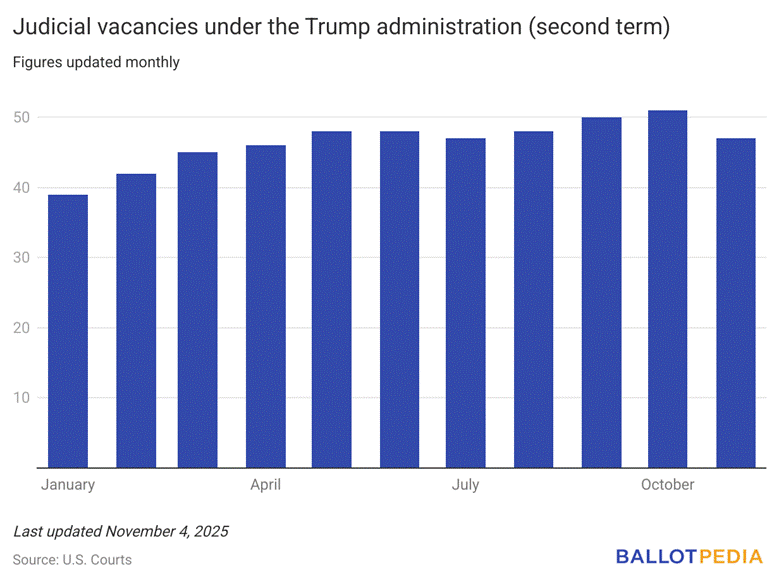
Do you love judicial nomination, confirmation, and vacancy information? We figured you might. Our monthly Federal Vacancy Count monitors all the faces and places moving in, moving out, and moving on in the federal judiciary. Click here for our most current count.
Need a daily fix of judicial nomination, confirmation, and vacancy information? Click here for continuing updates on the status of all federal judicial nominees.
Or, keep an eye on our list for updates on federal judicial nominations.
Spotlight: Supreme Court Justices
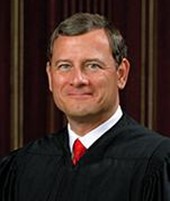
John Glover Roberts, Jr. has been the chief justice of the Supreme Court since Sept. 29, 2005. President George W. Bush (R) first nominated Roberts to the Supreme Court on July 19, 2005, to succeed Sandra Day O'Connor as an associate justice, following her assumption of senior status on Jan. 31, 2006. President Bush withdrew Roberts' nomination following the death of Chief Justice William Rehnquist on Sept. 3, 2005, to renominate Roberts as the 17th Chief Justice of the Supreme Court.
- On Sept. 29, 2005, the U.S. Senate confirmed him with a vote of 78-22.
- He is the longest-serving chief justice since Chief Justice Melville Fuller, who was appointed by President Grover Cleveland (D) in 1888.
- In 2007, Roberts described his vision as chief justice as building more unanimity among the justices and working to issue fewer 5-4 decisions.
- Roberts’ notable opinions include cases concerning the Affordable Care Act, racial discrimination in school admissions, the president’s appointment and removal powers, and the right to abortion. Click here to read more about Chief Justice Roberts' noteworthy opinions.
Looking ahead
We’ll be back on Dec. 8 with a new edition of Robe & Gavel. Until then, gaveling out!
Contributions
Myj Saintyl compiled and edited this newsletter, with contributions from Sam Post and Ellie Mikus.