


Welcome to the Monday, Dec. 15, 2025, Brew.
By: Lara Bonatesta
Here’s what’s in store for you as you start your day:
- Referendum to repeal Missouri’s new congressional map submits signatures for 2026 ballot
- Georgia House district becomes seventh state legislative district to change party control in a special election this year
- This week, On The Ballot, an overview of Texas’s congressional races following the Supreme Court’s decision to uphold the state’s redrawn congressional map
Referendum to repeal Missouri’s new congressional map submits signatures for 2026 ballot
On Dec. 9, the campaign People Not Politicians reported filing more than 300,000 signatures for a veto referendum against Missouri’s House Bill 1 (HB1), which redrew the state’s eight congressional districts. Gov. Mike Kehoe (R) signed HB 1 on Sept. 28, 2025. The bill was approved 21-11 in the state Senate and 90-65 in the House. Missouri has a Republican trifecta.
The new map, which aims to net one additional Republican U.S. House seat, divides Kansas City, Missouri, between three congressional districts. Under the map that was created following the 2020 census, most of Kansas City is within the 5th Congressional District, which Rep. Emanuel Cleaver (D) represents.
A veto referendum is a citizen initiative that asks voters whether to uphold or repeal an enacted law. Missouri is one of 23 states that provide for veto referendums.
Proponents of the veto referendum need to submit between 106,384 and 115,720 valid signatures to qualify the veto referendum for the ballot. That equals 5% of the votes cast for governor in the most recent election in six of the state's eight congressional districts. The total number of signatures required varies based on which six districts meet their respective thresholds.
If enough signatures are verified, the veto referendum will appear on the Nov. 3, 2026, ballot, unless the Legislature calls an earlier special election.
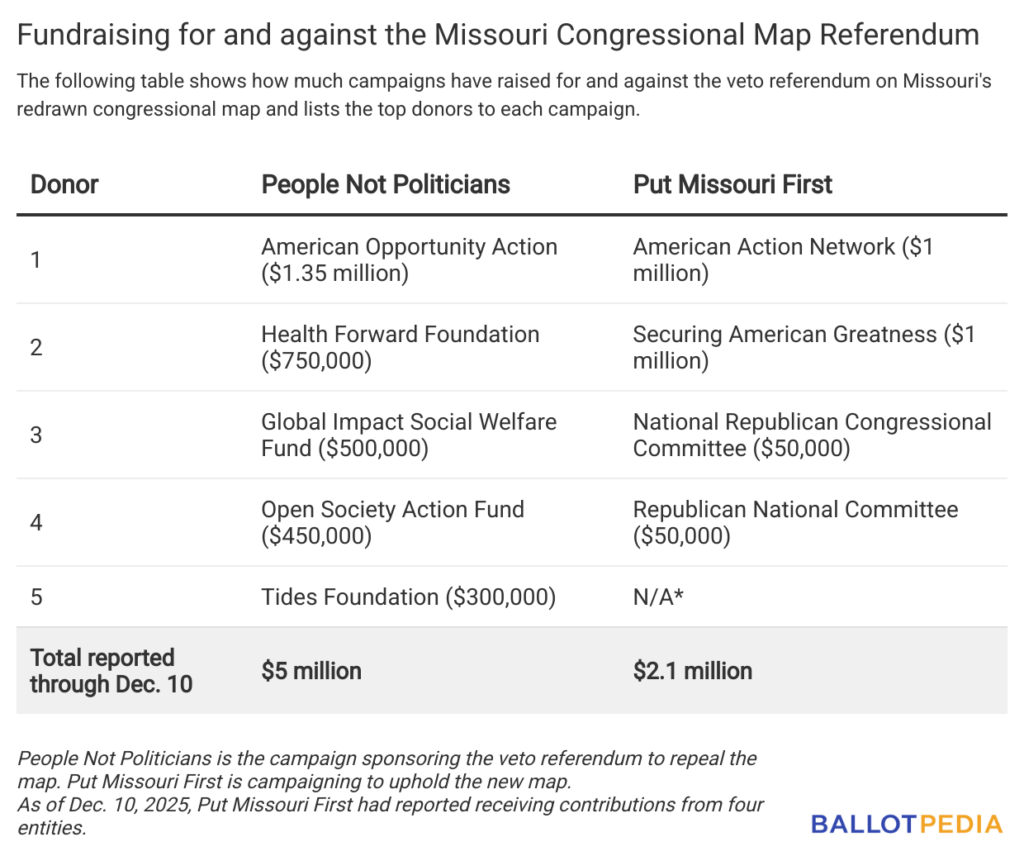
Conflict and litigation
Referendum proponents and Secretary of State Denny Hoskins (R), who oversees the signature verification process, disagree on whether HB 1 is now suspended because signatures have been submitted. They also disagree on whether signatures collected before the ballot title was certified can be counted.
Hoskins said the submission did not suspend HB 1, which took effect on Dec. 11. Richard von Glahn, executive director of People Not Politicians, said, "It is very clear in law and in practice in Missouri that upon the submission of signatures, until the Secretary of State makes a decision to either certify the initiative as sufficient or to certify the petition is insufficient, the map is frozen. As of today, right now, House Bill 1 is suspended pending voter approval." Hoskins said, "The map will not be frozen until I certify the referendum," and that the signature review could take place until late July. He also said, "I’m going to do everything I can to protect Gov. (Mike) Kehoe’s Missouri First Map — the map the General Assembly passed."
Hoskins also said signatures collected between Sept. 15 and Oct. 14 would be considered invalid. He said, "Under Missouri law, no signatures gathered before this approval date are valid, and doing so constitutes a misdemeanor election offense." Von Glahn said that approach violated court precedent in No Bans on Choice et al. v. Ashcroft (2022), in which the Missouri Supreme Court ruled that a state law prohibiting signature gathering for a veto referendum before the referendum's official ballot title is certified violates citizens' constitutional rights to use the referendum process.
The Missouri General Assembly, Secretary Hoskins, and Attorney General Catherine Hanaway (R) sued People Not Politicians in U.S. District Court, arguing that a veto referendum on a congressional redistricting plan in Missouri violated the U.S. Constitution. On Dec. 8, 2025, U.S. District Judge Zachary Bluestone dismissed the case.
Context
The last veto referendum to appear on the ballot in Missouri was Proposition A on Aug. 7, 2018. The vote was 67.5%-32.5%, resulting in the repeal of the state’s right-to-work law. Since the state established its citizen initiative process in 1908, Missouri voters have decided on 25 veto referendums, repealing 24 (96%) of the targeted laws.
The veto referendum on HB 1 would not be the first against a congressional redistricting plan in Missouri. In 1922, voters approved Proposition 17, overturning a congressional redistricting plan.
Missouri is one of several states that have conducted mid-decade redistricting in 2025. Click here to learn more about these efforts in other states.
Click here to learn more about the veto referendum on Missouri’s new congressional map.
Georgia House district becomes seventh state legislative district to change party control in a special election this year
On Dec. 9, Georgia Democrat Eric Gisler defeated Mack Guest IV (R) 50.9%-49.1% in the special general election for Georgia House of Representatives District 121. The seat has been vacant since former incumbent Marcus Wiedower (R) resigned on Oct. 28, 2025.
In the 2024 general election in the district, Wiedower defeated Gisler 61.1%-38.9%.
Following this special election, Republicans will have a 98-80 majority with two vacancies.
This was the seventh special state legislative election to result in a change in partisan control this year, all from Republican to Democratic.
Most recently, on Nov. 4, three special state legislative elections in Mississippi resulted in changes from Republican to Democrat, one in the House and two in the Senate. As a result of these elections, Democrats broke the Republican supermajority in the Mississippi Senate. The other three seats that changed party hands were:
- Jan. 28: Iowa Senate District 35 changed from Republican to Democratic control.
- March 25: Pennsylvania Senate District 36 changed from Republican to Democratic control.
- Aug. 26: Iowa Senate District 1 changed from Republican to Democratic control. As a result of this election, Democrats broke the Republican supermajority in the Iowa Senate.
Between 2010 and 2024, 12% of state legislative special elections resulted in seats changing partisan control.
As of December 2025, 95 state legislative special elections have been scheduled for this year in 23 states. Between 2011 and 2024, an average of 70 special elections took place each year.
Click here to learn more about state legislative special elections in 2025.
This week, On The Ballot, an overview of Texas’s congressional races following the Supreme Court’s decision to uphold the state’s redrawn congressional map
In this week’s new episode of On The Ballot, Texas Tribune reporter Gabby Birenbaum joins host Norm Leahy to talk about the U.S. Supreme Court’s recent decision to allow Texas to use the new version of the state’s congressional map that the Texas Legislature redrew earlier this year.
Birenbaum breaks down what comes next in Texas, how voters and the state’s congressional delegation are responding to the Supreme Court’s ruling, and the races to watch in 2026.
Texas will hold some of the country’s earliest primaries on March 3, 2026. The statewide primary candidate filing deadline was Dec. 8. To learn more about Texas’ 2026 elections, click here.
Birenbaum also explains how what’s happening in Texas fits into the national landscape of redistricting efforts across the country.
As we mentioned above, several other states have redrawn or are considering redrawing their congressional maps ahead of the 2026 elections. Click here to learn more about mid-decade redistricting efforts ahead of the 2026 midterm elections.
To listen to this episode and more, click here. Also, don't forget to subscribe to On the Ballot on YouTube or your preferred podcast app.