


Welcome to the Tuesday, Dec. 16, Brew.
By: Briana Ryan
Here’s what’s in store for you as you start your day:
- A year-end look at the state of election administration legislation
- Five states certify measures on vote thresholds for ballot initiatives and amendments, one additional measure is pending
- Three candidates are advancing to the most important election of the year — Ballotpedia’s Holiday Cookie Election
A year-end look at the state of election administration legislation
As 2025 comes to a close, we’re diving into the election-related legislative activity that happened this year and exploring some of the data in Ballotpedia’s State of Election Administration Legislation 2025 Year-End Report.
The report covers all election-related legislative activity in the 50 states that held legislative sessions between Jan. 1 and Dec. 10, 2025, unless otherwise stated. Click here to read the full report.
This year, we tracked 4,969 election-related bills and resolutions — surpassing the total number of bills in any year since we started tracking election legislation in 2022. Lawmakers passed 627 new election laws in 2025, more than in 2024 (440) but fewer than in 2023 (723).
As in previous years, Republican lawmakers and Republican trifecta states have driven most of this activity. This trend reflects both their advantage in legislative control—holding majorities in 57 of the 99 state legislative chambers—and greater control of state governments in general, with 23 trifectas compared to 15 for Democrats.
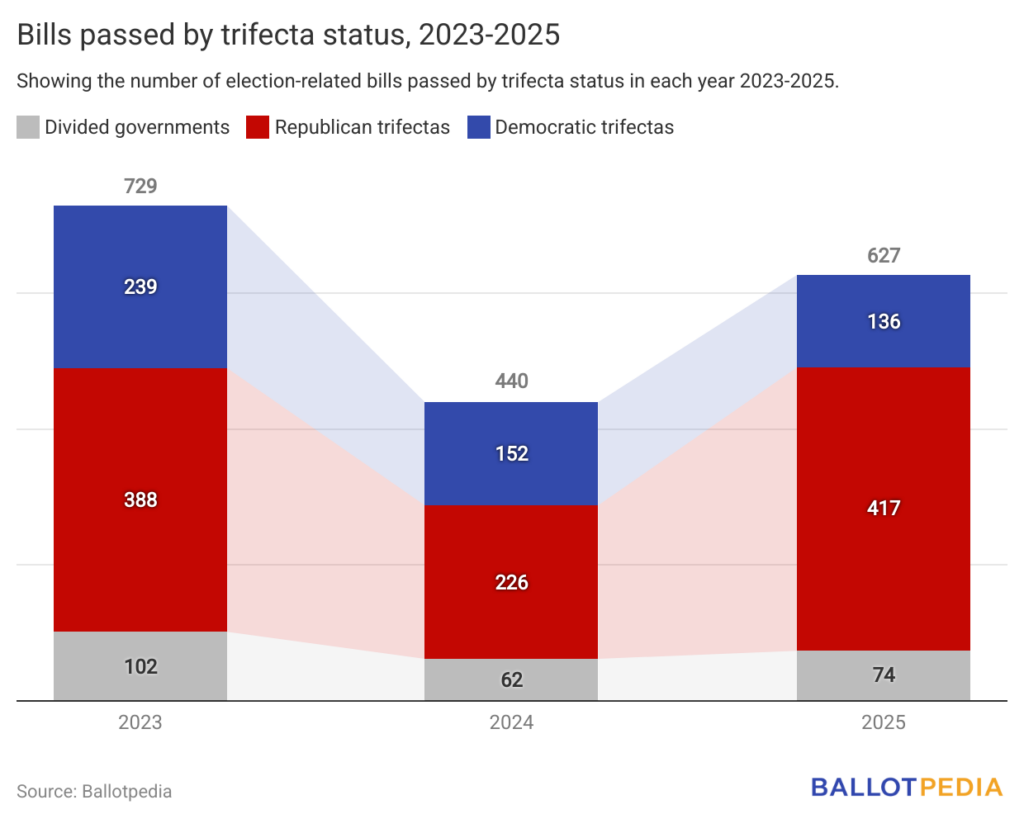
Now, let’s take a look at some of the noteworthy topics in election administration by the lawmakers’ partisan affiliation.
Republican lawmakers passed laws to:
- Implement checks of voters’ citizenship status through new data sources,
- Require absentee/mail-in ballots to arrive by Election Day to be counted,
- Ban ranked-choice voting (RCV), and
- Increase the signature requirement for initiatives to reach the ballot and raise the vote thresholds to approve those amendments once there.
Democratic lawmakers have passed laws to:
- Establish state level voting rights acts (VRAs) that grant a private right of action to enforce election laws,
- Expand automatic voter registration services,
- Provide language accommodations for voting materials and services, and
- Increase drop box availability and security measures.
While election law changes can be contentious, lawmakers have still found common ground. Bipartisan efforts have advanced legislation to:
- Align election dates,
- Revise ballot access rules for candidates,
- Increase the frequency of some voter list maintenance activities, and
- Update ballot processing procedures to speed up election results.
Finally, congressional redistricting emerged as a topic of focus in the final months of the year. Since Aug. 29, five states—including three with Republican trifectas—passed legislation creating new congressional maps for the 2026 elections, or submitting new maps for voter approval. Before this year, only two states had voluntarily adopted new congressional maps between censuses since 1970.
Click here to read Ballotpedia’s State of Election Administration Legislation 2025 Year-End Report.
Five states certify measures on vote thresholds for ballot initiatives and amendments, one additional measure is pending
Heading into the 2026 elections, we're examining some of the themes we're seeing in potential ballot measures. So far, we have covered the following topics: abortion, marijuana and psychedelics, citizenship voting requirements, electoral systems, and sex, gender, and LGBTQ issues. Today, we're focusing on measures related to vote thresholds for ballot initiatives and amendments.
So far, voters in up to six states could decide on ballot measures establishing or changing vote requirements for initiatives and amendments in 2026. Five states have already certified their respective measures for the ballot, and one is a proposed legislative referral that requires additional votes for certification.
Measures certified for the ballot
Measures have been certified in California, Missouri, North Dakota, South Dakota, and Utah. All of them are legislatively referred constitutional amendments and will be on the ballot in November 2026.
California: Assembly Constitutional Amendment 13 would require citizen-initiated constitutional amendments that would raise the threshold for approval of state or local measures to be approved by the same majority requirement that it proposes. For example, a measure that would raise the vote threshold to 60% for initiatives would also need to receive 60% of the vote to pass. Currently, initiated constitutional amendments only need a simple majority to be approved.
Missouri: This measure would require a simple majority in each of the state's congressional districts to approve citizen-initiated constitutional amendments, replacing the current requirement that requires a simple majority statewide. This measure would not apply to amendments the Legislature puts on the ballot. Missouri would also be the first state to require voter approval based on its districts.
North Dakota: This measure would require constitutional amendments to receive a 60% supermajority vote for adoption, applying to citizen initiatives and measures the Legislature puts on the ballot. Currently, constitutional amendments require a simple majority (50%+1) of votes for approval.
South Dakota: This measure would also require a 60% supermajority to approve constitutional amendments, replacing the current simple-majority requirement. The measure would apply to both citizen initiatives and legislatively referred constitutional amendments.
Utah: This measure would raise the vote requirement from a simple majority to 60%, but it would apply only to initiatives that increase or expand taxes. It would not apply to tax measures the Legislature puts on the ballot.
Measures that require additional legislative votes
The one measure related to changing supermajority requirements that has not yet been certified for the ballot is from Hawaii. The measure is a legislatively referred constitutional amendment, and would appear on the November 2026 ballot. The amendment would remove the requirement that constitutional amendments must win a majority of all votes cast in the election to be approved. This change would mean that blank votes on an amendment would no longer have the same effect as no votes.
For a legislative referral to be certified for the ballot in Hawaii, either a two-thirds vote of the Legislature during one legislative session or a simple majority in two successive sessions is required. That would amount to at least 35 votes in the Hawaii House of Representatives and 17 in the Hawaii Senate. This amendment was introduced to the state Senate on Jan. 23, as Senate Bill 1225. The Senate approved 19-6 to approve the bill on March 4.
Supermajority requirements for ballot measures
Currently, 11 states that provide for legislatively referred constitutional amendments require a supermajority vote or other threshold for approval.
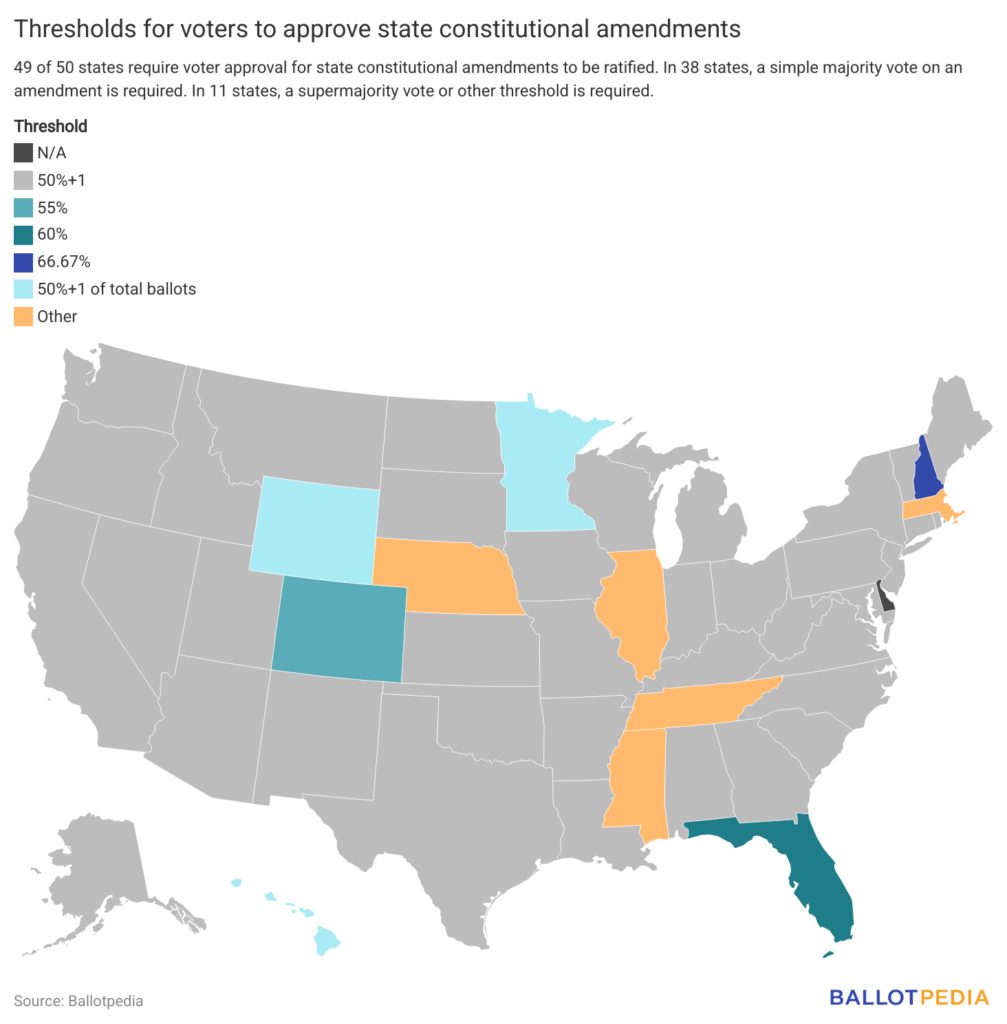
From 2000 to 2024, voters decided on 11 ballot measures regarding supermajority requirements. Seven were defeated, and four were approved.
Click here for more on 2026 ballot measures.
Three candidates are advancing to the most important election of the year — Ballotpedia’s Holiday Cookie Election
The polls closed last week for the 2025 Holiday Cookie Primary Election, and three candidates are moving on to the general election.
The finalists are: Chocolate Chip Cookie, Sugar Cookie, and Snickerdoodle.
General election polls open today, Dec. 16, at 8:00 a.m. EST through Friday, Dec. 19, at 5:00 p.m. EST.
Remember that you can check out candidate profiles for each of the cookies on our website before voting!