Highlights from this edition of Checks and Balances include a Trump administration memo that finds the Consumer Financial Protection Bureau’s funding structure is illegal, and a resolution passed by an association of state utility regulators calling on the Federal Energy Regulatory Commission to respect their authority
In Washington
Trump admin. says CFPB funding structure is illegal
On Nov. 10, Trump administration officials filed a memo with the D.C. Circuit Court of Appeals that declared the Consumer Financial Protection Bureau (CFPB) cannot legally use its funding structure and that the Bureau “anticipates exhausting its currently available funds in early 2026.” While Trump administration officials have previously said they intend to shut down the CFPB, and most of the Bureau’s staff were told to stop work earlier this year, this memo is effectively a formal declaration that the Trump administration plans to close the agency.
The CFPB is an independent federal agency that was created by the 2010 Dodd-Frank Act. Under the Act, the CFPB draws operating funds from the “combined earnings of the Federal Reserve System” by submitting an annual request to the Federal Reserve. The Justice Department’s Office of Legal Counsel sent the memo on Nov. 7, arguing that this language should be interpreted as requiring the CFPB to draw on profits earned by the Federal Reserve System – and that because the System has not earned profits since 2022, the total pool of available funds for the CFPB is zero. The argument used by the Justice Department memo rose to prominence among conservative critics of the CFPB after a 2024 Supreme Court ruling that the Dodd-Frank funding structure was constitutional.
During the Biden administration, then-director of the CFPB Rohit Chopra regularly requested funding through the Dodd-Frank mechanism, despite the Federal Reserve operating at an accounting loss since 2022. In a letter to the Fed on Feb. 8, Russel Vought, head of the Office of Management and Budget (OMB) and Acting Director of the CFPB, requested $0 without challenging the legality of the funding mechanism, stating “that no additional funds are necessary to carry out the authorities of the Bureau.”
The Justice Department memo also notes that the CFPB may request funds from Congress, and argues that a congressional appropriation is the only legal way for the Bureau to receive funding in the absence of available Federal Reserve System profits. On Nov. 20 Vought sent letters to President Trump and congressional leaders reporting that the CFPB would need an appropriation of $279.6 million to operate until Sept. 30, 2026. In these letters, Vought did not explicitly request that these funds be appropriated, and wrote that “to be clear, this figure is provided solely to make the statutorily required report setting out the ‘funding needs’ of the Bureau.”
The CFPB under Russell Vought
President Trump (R) appointed Vought as Acting Director of the CFPB on Feb. 7, a day after he was confirmed by the Senate as head of the OMB. Under the Vacancies Act, officials may serve in an acting role for up to 210 days, unless the President nominates a permanent candidate for the role, in which case the acting official may continue to serve in the role while the Senate considers the permanent nomination. On Feb. 11, Trump nominated Jonathan McKernan to serve as CFPB director, before withdrawing McKernan’s nomination on May 13.
On Nov. 19 (190 days after May 13) Trump nominated Stuart Levenbach, who works under Vought as an associate director in the OMB, to serve as CFPB director. An OMB and CFPB spokesperson called this move a “technical nomination,” and said that “the bottom line is Director Vought’s not going anywhere.” The original Senate sponsor of the CFPB, Sen. Elizabeth Warren (D), criticized Levenbach’s nomination, saying that the move “looks like nothing more than a front for Russ Vought to stay on as Acting Director indefinitely.”
Vought has been a vocal critic of the CFPB, and in a podcast interview on Oct. 15 said that he expected the Bureau to be closed in the next two to three months. Soon after becoming acting director, Vought instructed staff to stop all work tasks, and on April 17, the CFPB announced it was terminating roughly 1,500 of the Bureau’s 1,700 employees. Litigation related to this move is ongoing, with much of the workforce on paid leave, as of Dec. 7. Officials have told CFPB staff that most of the workforce will be furloughed on Dec 31.
Want to learn more?
In the states
State utility regulators assert their authority in resolution to FERC
On Nov. 11, the National Association of Regulatory Utility Commissioners (NARUC), an association of state-level energy utility regulators, passed a resolution which urged the Federal Energy Regulatory Commission (FERC) “to preserve and affirm states’ retail regulatory authority under the Federal Power Act.” The NARUC resolution followed an Oct. 23 letter issued by Energy Secretary Chris Wright directing FERC to adopt new energy regulations to facilitate artificial intelligence (AI) projects.
What is FERC?
FERC is an independent federal agency within the Department of Energy, responsible for regulating interstate electric and natural gas infrastructure. Under the Federal Power Act, FERC is empowered to regulate "the transmission of electric energy in interstate commerce and… the sale of electric energy at wholesale in interstate commerce,” as well as ensuring that wholesale electric “rates and charges shall be just and reasonable."
State-level utility regulators (all 50 of which are members of NARUC) have jurisdiction over retail electricity markets and power lines within their state. Because state-level power infrastructure is interconnected with major national power grids (under FERC’s jurisdiction), the line between state and federal regulatory jurisdiction over electric infrastructure is not always clear-cut.
FERC and the States
Secretary Wright’s Oct. 23 letter and attached Advanced Notice of Proposed Rulemaking
(ANOPR) called on FERC to develop regulations for large load interconnections by April 30, 2026. Large load interconnections are infrastructure which allow power loads exceeding 20 megawatts to be transmitted efficiently across the power grid. The letter acknowledged that “historically, the Commission has not exerted jurisdiction over load interconnections,” but asserted that “the interconnection of large loads directly to the interstate transmission system to access the transmission system and the electricity transmitted over it falls squarely within the Commission's jurisdiction.”
The Oct. 23 letter explicitly mentioned artificial intelligence as an economic sector that “will require unprecedented and extraordinary quantities of electricity and substantial investment in the Nation's interstate transmission system.” The Trump administration has identified AI development as a priority, with Trump issuing a number of executive orders on AI and announcing on Dec. 8 that he intends to sign another order preempting state-level AI regulations.
The NARUC resolution expressed agreement with “the policy priorities expressed by the Secretary, and agree[ment] that ensuring efficient, timely, and non-discriminatory interconnection of large loads, including AI data centers, requires prompt and thoughtful consideration by regulators.” However, it also identified legal concerns with potential FERC rulemaking, calling on FERC to “affirmatively not [assert] jurisdiction over end-use sales, which falls squarely within the exclusive jurisdiction of state retail energy regulatory authorities.” It also mentioned concerns with the management of the power grid under expanded federal jurisdiction, arguing that “any large load interconnections without sufficient available generation capacity could threaten reliable power service to existing retail customers,” and that states face different regulatory landscapes because “in 2023 fifteen states accounted for 80 percent of the national data center load, reflecting the diverse landscape of regional opportunities and challenges presented by large load growth.” “For all of the reasons above,” the resolution continued, “the states strongly encourage FERC to carefully consider the perspectives of state regulators and other stakeholders.”
Want to learn more?
- Federal Energy Regulatory Commission
- Executive Order: Removing Barriers to American Leadership in Artificial Intelligence
- Executive Order: Launching the Genesis Mission
Featured commentary
Does this OIRA deregulation memo face legal challenge? John Lewis, Deputy Legal Director at Governing for Impact, argues that an Oct. 21 Office of Information and Regulatory Affairs memo which urges agencies to expedite deregulation faces potential legal challenges. Click here to read the full article.
Regulatory highlight
Congressional Review Act
The Congressional Review Act (CRA) allows Congress to repeal rules with joint resolutions of disapproval. The 119th Congress had 60 working legislative days from the 15th day of the session (a window that ended in early May) to introduce resolutions to disapprove of regulations the Biden administration issued after Aug. 16, 2024.
- Members of the 119th Congress have introduced 113 CRA resolutions in the 119th Congress to repeal regulations. Most of these regulations are from the Biden administration, but some were issued under the second Trump administration, with Democrats challenging them. Twenty-six (26) resolutions have passed one congressional chamber, 22 have passed both chambers, and as of Dec. 15, Pres. Trump had signed 22 into law. The most recently enacted CRA resolutions nullified five regulations establishing land management policy for various natural resource reserves.
- In his two terms, Trump (R) has signed 38 of the 42 total CRA resolutions ever adopted. President George W. Bush (R) signed one in 2001, and President Joe Biden (D) signed three in 2021.
Notable regulation
- The Office of Information and Regulatory Affairs (OIRA) completed its review of an Environmental Protection Agency interim final rule that extended compliance deadlines set in a 2024 rule establishing emission and performance standards for the oil and natural gas sector. The EPA issued the rule pursuant to Executive Order 14192: Unleashing Prosperity Through Deregulation.
- Want to learn more?
- Congressional Review Act
- National Petroleum Reserve in Alaska Integrated Activity Plan Record of Decision rule (2022)
- Extension of Deadlines in Standards of Performance for New, Reconstructed, and Modified Sources and Emissions Guidelines for Existing Sources: Oil and Natural Gas Sector Climate Review Final Rule
- Executive Order 14192: Unleashing Prosperity Through Deregulation
Pick of the news
Federal
Congressional Democrats introduce bill codifying Chevron deference. Democrats in both houses of Congress introduced a bill which would codify Chevron deference, a judicial doctrine which the Supreme Court struck down in 2024. Government Executive
Schedule Policy/Career draft final regulations released. The Office of Personnel Management released draft final regulations implementing the Schedule Policy/Career job classification created earlier this year. These draft regulations cite “accountability to the
president” as grounds for reclassifying about 50,000 federal workers. Government Executive
Department of Education programs transferred to other agencies. The Trump administration transferred six Department of Education programs to other executive departments, implementing a March executive order to dismantle the Department. Politico
Ninth Circuit rules NLRB administrative law judges are constitutional. The Ninth Circuit Court of Appeals ruled that the National Labor Relations Board’s employment of administrative law judges is constitutional. This contradicts an earlier Fifth Circuit Court of Appeals ruling, making a Supreme Court ruling on this matter more likely. JDSupra
Judge blocks shutdown of four federal agencies. A federal district court judge blocked Trump Administration plans to close the Institute of Museum and Library Services, the Minority Business Development Agency, the Federal Mediation and Conciliation Services, and the U.S. Interagency Council on Homelessness. News From the States
OPM issues memo on senior executive staffing. The Office of Personnel Management issued a memo directing agencies to conduct a workforce assessment and requesting that they reduce senior-level staff positions. Federal News Network
State
NC Supreme Court strikes down state-level Auer deference. The North Carolina Supreme Court struck down state courts’ deference to agencies’ interpretation of regulations (akin to federal-level Auer deference), instead requiring a de novo review standard. JDSupra
Legislative Tracking Update
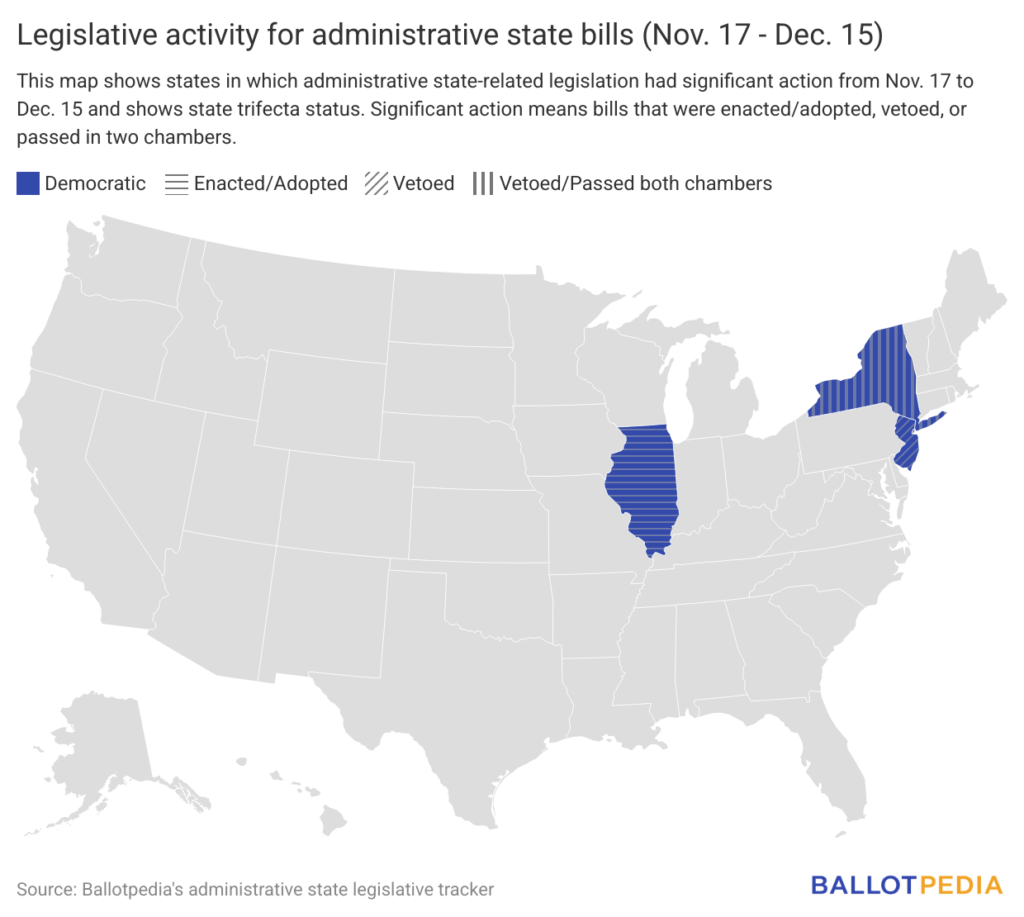
Since our last newsletter edition, Ballotpedia tracked significant legislative action (enactments, vetoes, and passage through both chambers) in three states on four bills related to the administrative state. Illinois Gov. J.B. Pritzker (D) signed one bill, and both houses of the New York legislature passed one bill. New York Gov. Kathy Hochul (D) and New Jersey Gov. Phil Murphy (D) each vetoed a bill. Ballotpedia has tracked a total of 2,312 bills related to the administrative state in 2025 as of Dec. 15.
Ballotpedia has tracked a total of 2,312 bills related to the administrative state in 2025 as of Dec. 15.