


Welcome to the Tuesday, Jan. 6, 2026, Brew.
By: Lara Bonatesta
Here’s what’s in store for you as you start your day:
- Trump ends 2025 with no Cabinet turnover
- Eight candidates are running in the Republican primary for Texas' 19th Congressional District on March 3
- Missouri voters repealed all but one law targeted by referendum
Trump ends 2025 with no Cabinet turnover
President Donald Trump (R) completed the first calendar year of his second term in office, and no members of his 22-person Cabinet have left or changed positions so far.
The Cabinet is a group of senior federal officials who advise the president on the issues and activities of their respective agencies. Because the number of Cabinet members can vary across presidential administrations, today we are comparing turnover among the 15 agency heads who are part of the presidential line of succession.
Two of these 15 agency heads left or changed positions in the first calendar year of Trump's first term. This was the most turnover among these positions of any president's first-term or only term since Ronald Reagan’s (R).
- John F. Kelly, Secretary of Homeland Security – Trump promoted Kelly to replace Reince Priebus as White House chief of staff on July 28, 2017. (Note: While the chief of staff has had Cabinet-rank status in both of Trump’s terms, the position is not in the line of succession.)
- Tom Price, Secretary of Health and Human Services – resigned on September 29, 2017
During Trump's second term, the following offices are also Cabinet-rank positions: White House chief of staff, the administrator of the Environmental Protection Agency, the director of the Office of Management and Budget, the U.S. trade representative, the director of the Central Intelligence Agency, the director of National Intelligence, the administrator of the Small Business Administration, and the ambassador to the United Nations. These positions were also Cabinet-level in Trump's first term.
The following chart shows the amount of turnover presidents since Reagan have experienced in each year of their first terms. Because Trump's second term is nonconsecutive, the following chart compares it to other cases where a president began a term after another president's departure.
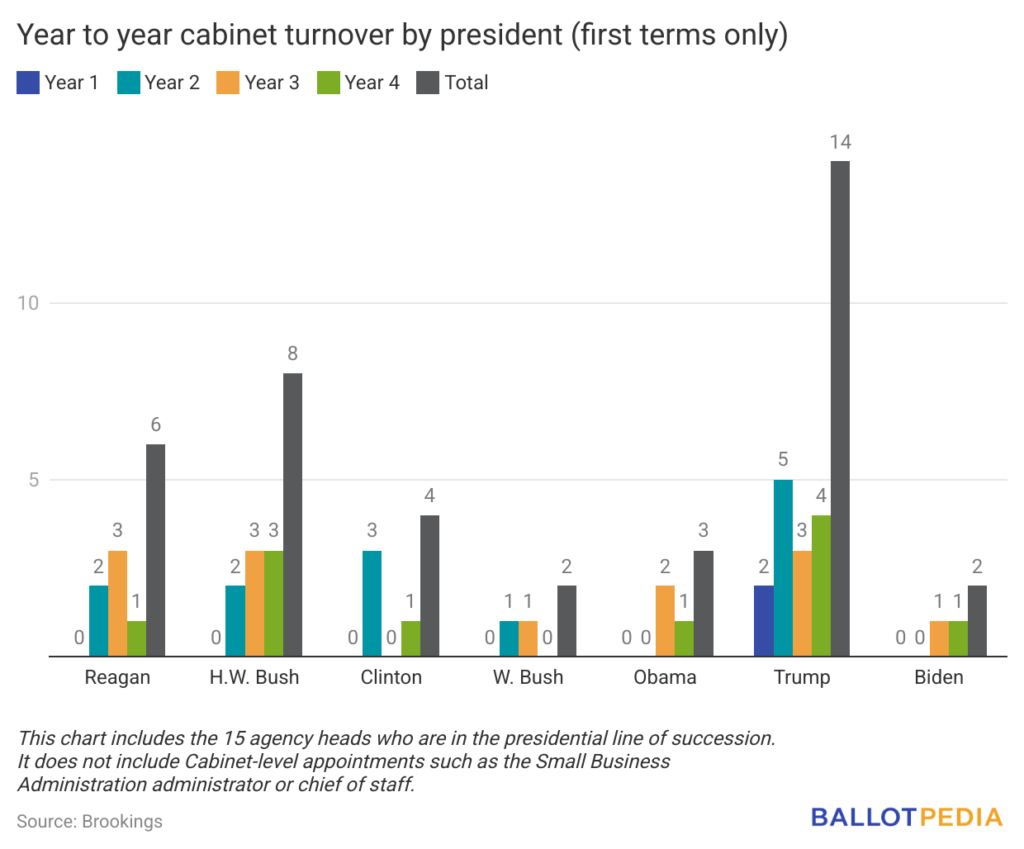
While Trump has not yet had any cabinet departures in his second term, one announced cabinet nominee withdrew from consideration before being officially nominated, and Trump withdrew another nomination.
- Matt Gaetz, who Trump announced as his nominee for Attorney General on Nov. 13, 2024, withdrew from consideration Nov. 21, 2025.
- Trump withdrew his nomination of Elise Stefanik for U.S. ambassador to the United Nations on March 27, 2025.
To learn more about Trump’s second-term cabinet, click here. To learn more about Trump’s cabinet during his first term, click here.
Eight candidates are running in the Republican primary for Texas' 19th Congressional District on March 3
Eight candidates are running in the Republican primary for Texas' 19th Congressional District on March 3. Three candidates lead in media attention: Jason Corley (R), Abraham Enriquez (R), and Tom Sell (R).
Incumbent Jodey Arrington (R) is not running for re-election. The last time the district was open was 2016, when Arrington was first elected. Arrington received at least 70% of the vote in every general election from 2016 to 2024. For a list of U.S. Representatives who are not running for re-election in 2026, click here.
Corley was a member of the Lubbock County Commissioners Court from 2019 to 2025. Corley says he has "[served] Lubbock with integrity, transparency, and conservative conviction" and that he would "deliver that same leadership for Texas and for America." Corley says he would support Texas' oil and gas industries and reduce federal spending to grow the economy. On immigration, Corley says he would "work to ensure that President Trump's border policies outlast his second term in office."
Enriquez is the founder and chair of Bienvenido. According to Bienvenido’s website, the organization's mission is to “empower young Hispanics to lead with traditional and conservative values.” Enriquez says he has "worked with local leaders, national policymakers, and business groups." Enriquez says he would support President Donald Trump’s (R) agenda and would "fight to codify President Trump's border policies into federal law." Enriquez’ campaign website also says that he would “protect oil and gas jobs” and prioritize rural health care.
Sell is the founder of a law firm. He previously worked in former U.S. Rep. Larry Combest’s (R-Texas) office and was the deputy staff director for the U.S. House Committee on Agriculture. Sell says he has "champion[ed] the interests of West Texas producers, families, and communities." Sell says he would support the agriculture industry and that he "played a key role in advancing major legislation that strengthened America's farmers, ranchers, and rural communities." Sell says he would support Trump's agenda and "[stand] for America First policies that protect our values, strengthen our economy, and secure our future."
Also running in the primary are Christopher Adams (R), James Barbee (R), Donald May (R), Matthew Smith (R), and Ryan Zink (R).
As of December 2025, The Cook Political Report with Amy Walter, Inside Elections with Nathan Gonzales, and Larry J. Sabato's Crystal Ball each rated the general election Safe/Solid Republican.
Texas conducted redistricting between the 2024 and 2026 elections. Texas’s 19th District was the only one of the state’s 38 congressional districts that did not change. To review how redistricting took place in Texas, click here. For a list of all states that drew new district lines between 2024 and 2026, click here.
Click here to see our full coverage of the Republican primary for Texas’ 19th Congressional District.
Missouri voters repealed all but one law targeted by referendum
Missouri voters may decide on a veto referendum on the state’s new congressional district map in 2026. If certified for the ballot, this would be the 27th veto referendum on the ballot in state history.
A veto referendum is a citizen-initiated ballot measure that asks voters whether to uphold or repeal a law. Twenty-three states allow veto referendums. Like citizen initiatives, proponents of the veto referendum must collect a certain number of signatures from registered voters in the state to qualify.
Of Missouri’s 26 veto referendums, voters approved one (3.8%) and defeated 25 (96.2%). In other words, Missouri voters upheld one law targeted by a veto referendum and defeated 25.
Proponents of the congressional map veto referendum submitted more than 305,000 signatures on Dec. 9, 2025. Proponents were required to submit between 106,384 and 115,720 valid signatures to qualify for the 2026 ballot. That equals 5% of the votes cast for governor in the most recent election in six of the state's eight congressional districts. The total number of signatures required varies based on which six districts meet their respective thresholds.
The last veto referendum to appear on the ballot in Missouri was Proposition A on Aug. 7, 2018. The vote was 67.5%-32.5%, resulting in the repeal of the state’s right-to-work law. This was the first veto referendum Missouri voters had decided on since 1982.
The only time Missouri voters upheld a targeted law was when they approved Proposition 13 in 1920, which upheld state enforcement of prohibition laws. The vote was 53.4%-46.6%. The federal prohibition on alcohol took effect after the ratification of the 18th Amendment in 1919 and was repealed nationwide after the ratification of the 21st Amendment in 1933.
Missouri’s referendums have covered 45 topics, and some measures included more than one topic. The most frequent topic was administrative organization, with seven referendums addressing it. Other common topics included alcohol laws, local government organization, the state judiciary, workers’ compensation laws, and highways and bridges.
Missouri voters have once before decided on a congressional map veto referendum, in 1922. Proponents gathered enough signatures to put the referendum on the ballot as Proposition 17, and voters rejected the proposed redistricting plan: 38.3% supported upholding the new map, and 61.7% supported repealing it. On Oct. 15, 1922, The St. Louis Star and Times wrote, "At the time of its passage it was asserted that it would insure the election of nine Republican and four Democratic congressmen from Missouri, leaving three districts doubtful. The Republicans assert that the congressional districts as at present arranged give the Democrats normally 9 or 10 congressmen and the Republicans 6 or 7, although 14 of Missouri’s 16 congressmen today are Republicans, having been swept into power by the Republican landslide of 1920."
Between 1906 and 2025, 530 veto referendums appeared on ballots in 23 states. Voters repealed 344 (64.9%) laws and voters upheld 186 (35.1%).
This coverage of Missouri’s veto referendums is part of Ballotpedia’s Historical Ballot Measures Factbook, which contains an inventory of all of Missouri’s ballot measures since 1908. Click here to see a list of veto referendums that appeared on all statewide ballots between 1906 and 2024.