


Welcome to Hall Pass, a newsletter written to keep you plugged into the conversations driving school board governance, the politics surrounding it, and education policy.
In today’s edition, you’ll find:
- On the issues: The debate over third-grade retention policies
- School board filing deadlines, election results, and recall certifications
- Signatures filed for two Washington ballot initiatives on school sports eligibility based on biological sex and certain parental rights in public schools
- Extracurricular: education news from around the web
- Candidate Connection survey
Reply to this email to share reactions or story ideas!
On the issues: The debate over third-grade retention policies
In this section, we curate reporting, analysis, and commentary on the issues school board members deliberate when they set out to offer the best education possible in their district. Missed an issue? Click here to see the previous education debates we’ve covered.
Beginning July 1, 2026, West Virginia schools will require teachers to decide whether to hold back third graders who score in the lowest achievement level on the West Virginia General Summative Assessment (WVGSA). This policy, known as retention, was enacted into law in 2023, when Gov. Jim Justice (R) signed HB 3035, the “Third Grade Success Act.”
According to the Education Commission of the States (ECS), West Virginia will join 26 other states and D.C. in allowing for third-grade retention. In at least 16 of those states, retention is mandatory (though the policies tend to allow for exemptions). In the remaining states, the decision to retain third graders is left to districts.
West Virginia has a Republican trifecta, meaning the GOP controls the state legislature and the governor’s office. A slight majority of the 23 states with Republican trifectas and the 16 states with Democratic trifectas have third-grade retention policies in place. Roughly half of the eleven states with divided governments have the policies.
How should lawmakers, school board members, teachers, and parents think about third-grade retention policies?
University of North Dakota education professors Laura Link and Diana D'Amico Pawlewicz say retention policies often harm the students they’re meant to help and can deepen racial and income disparities in education. Link and Pawlewicz argue the evidence shows retained students tend to continue falling behind their peers in later grades because schools rarely address the barriers to learning that hindered them in the first place. Link and D'Amico Pawlewicz recommend alternatives to retention, like improved teacher training, identifying and focusing on struggling students early, and focusing on subject-matter mastery over behavior and completion of assignments.
Center of the American Experiment Policy Fellow Josiah Padley says retention policies, particularly when implemented in the early grades, raise the cost of academic failure, motivating parents, teachers, administrators, and students to take barriers to learning more seriously. Padley argues the experiences of states like Mississippi, Florida, and Indiana show that retention, when used as a last resort and paired with other policies like robust teacher training, gives students who’re held back confidence in later grades.
Why holding kids back fails − and what to do about it | Laura Link and Diana D'Amico Pawlewicz, New Hampshire Bulletin
“Students held back in the early elementary grades show lower academic achievement in year-end reading scores compared with their promoted peers both during and after the retention year, according to a multiyear study published in 2018. This lag in students’ performance persists through their middle school years.”
“Even more concerning, any short-term academic gains from retention often disappear after the student is promoted the following year, another comprehensive study found. This is partly because students encounter the same teaching and grading methods that didn’t work for them the first time around...”
“...Students held back in elementary school experience increased feelings of shame and alienation, research shows. These feelings linger into adolescence. These students also grapple with lower self-esteem and more anxiety compared with their promoted peers, which could limit their overall social and emotional development.”
Third grade, again: the impact of student retention policies | Josiah Padley, Center of the American Experiment
“Advocates for retention policies argue that the policies help create whole-system reform, which dramatically helps more students than the relatively small number of students who might be hurt socially by retention; they ultimately also create better support systems for retained students.”
“Wider positive social outcomes are documented. Parents of students at risk for retention are likely to reallocate their resources (either time or money) to support not only their struggling children, but also their siblings. Research suggests that these benefits of early grade retention (which also include movement to a higher-performing school) spill over to the younger siblings of identified students.”
“From a policymaker’s perspective, it can be more financially efficient to retain students at third grade. Allowing struggling students a ‘do-over’ year at third grade compassionately safeguards against more costly failures in the future. Retained students are less likely to be retained again or identified for remedial assistance, and conversely, at-risk students who manage to gain a promotion are more likely to take more than four years to graduate high school.”
School board update: filing deadlines, election results, and recall certifications
In 2025, Ballotpedia will cover elections for more than 30,000 school board seats. We’re expanding our coverage each year with our eye on covering the country’s more than 80,000 school board seats.
Below is an early look at the upcoming elections in the first part of this year.
Upcoming school board elections
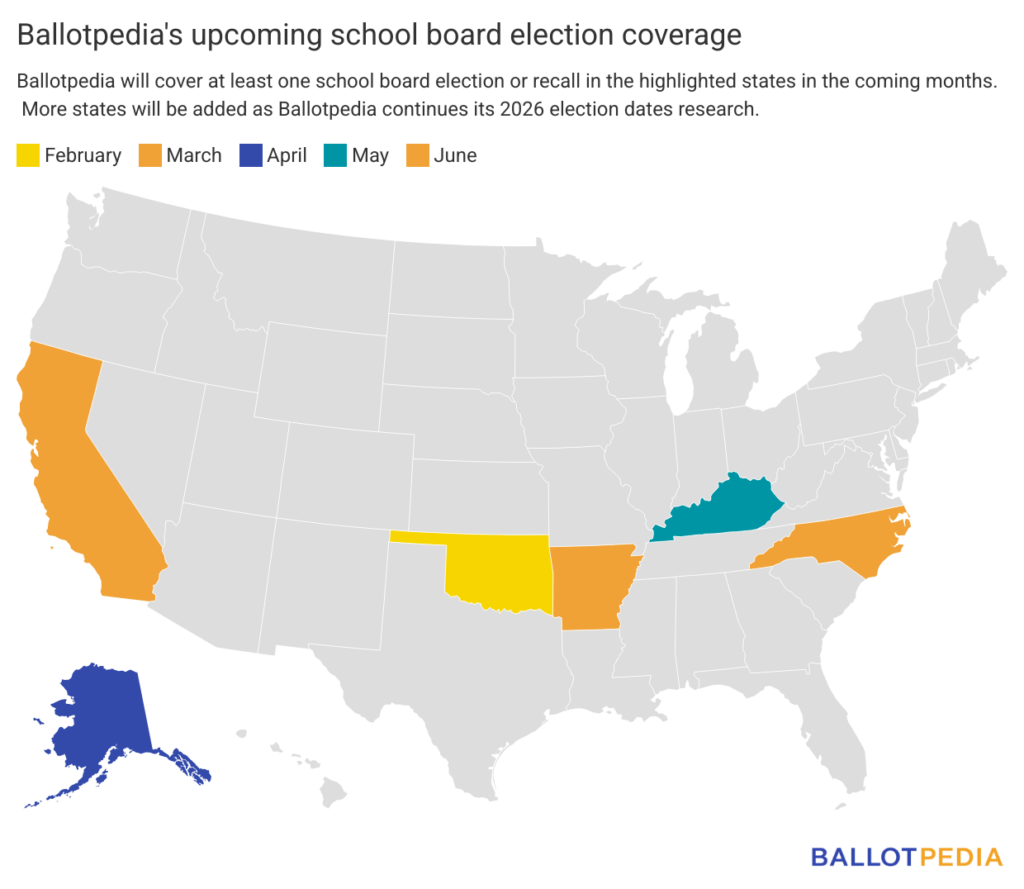
- Oklahoma: School districts across the state will hold primaries on Feb. 10 and general elections on April 7. In Oklahoma, elections are canceled if only one candidate runs for a seat. If there are two candidates, the primary is canceled and both advance to a general election. If there are more than two candidates, a candidate can win the primary outright with more than 50% of the vote. When that doesn’t happen, the two top vote-getters advance to the general.
- Arkansas: Ballotpedia will cover general elections for all seven of the seats on the Little Rock School District school board on March 3. Little Rock School District is the second largest in the state, with roughly 21,000 students.
- North Carolina: Ballotpedia will cover elections for several districts, including Guilford County Schools and Union County Public Schools, on March 3.
Click here to learn more about 2026 school board elections.
Signatures filed for two Washington ballot initiatives on school sports eligibility based on biological sex and certain parental rights in public schools
Statewide measures affecting K-12 education appear on the ballot in one or more states most years, and 2026 seems poised to be no different.
Let's Go Washington, a political action committee (PAC) founded by hedge fund executive and Republican donor Brian Heywood, submitted signatures for two Initiatives to the Legislature on Jan. 2 that address school sports eligibility requirements based on biological sex and certain parental rights in public schools.
At least 308,911 signatures must be verified for each initiative. Let's Go Washington said they submitted 416,201 signatures for the parental rights initiative (IL26-001) and 445,187 for the sports eligibility initiative (IL26-638).
Both measures are Initiatives to the Legislature, a type of indirect initiated state statute where, if enough valid signatures are gathered, the state legislature can choose to: 1) adopt the initiative as written; 2) reject or not act on the initiative, thereby placing it on the ballot for voter approval; or 3) approve an alternative to the proposed initiative, in which case both the original proposal and the legislative alternative are placed on the ballot.
The parental rights initiative
IL26-001 would reenact Initiative 2081, an indirect initiated state statute the Washington State Legislature approved in 2024 and then partially repealed in May 2025. Initiative 2081 provided parents with a right to review educational materials, receive certain notifications, and opt their children out of sexual health education.
On May 20, Gov. Bob Ferguson (D) signed House Bill 1296 into law, amending parts of Initiative 2081. HB 1296, which passed in the legislature along partisan lines with Democrats in favor and Republicans opposed, eliminated the requirement that schools alert parents when medical services are offered to their child except for emergency medical treatment, when medical services or medications are given that could result in a financial impact to the parent or guardian, or when the school has arranged for medical treatment resulting in follow-up care after school hours.
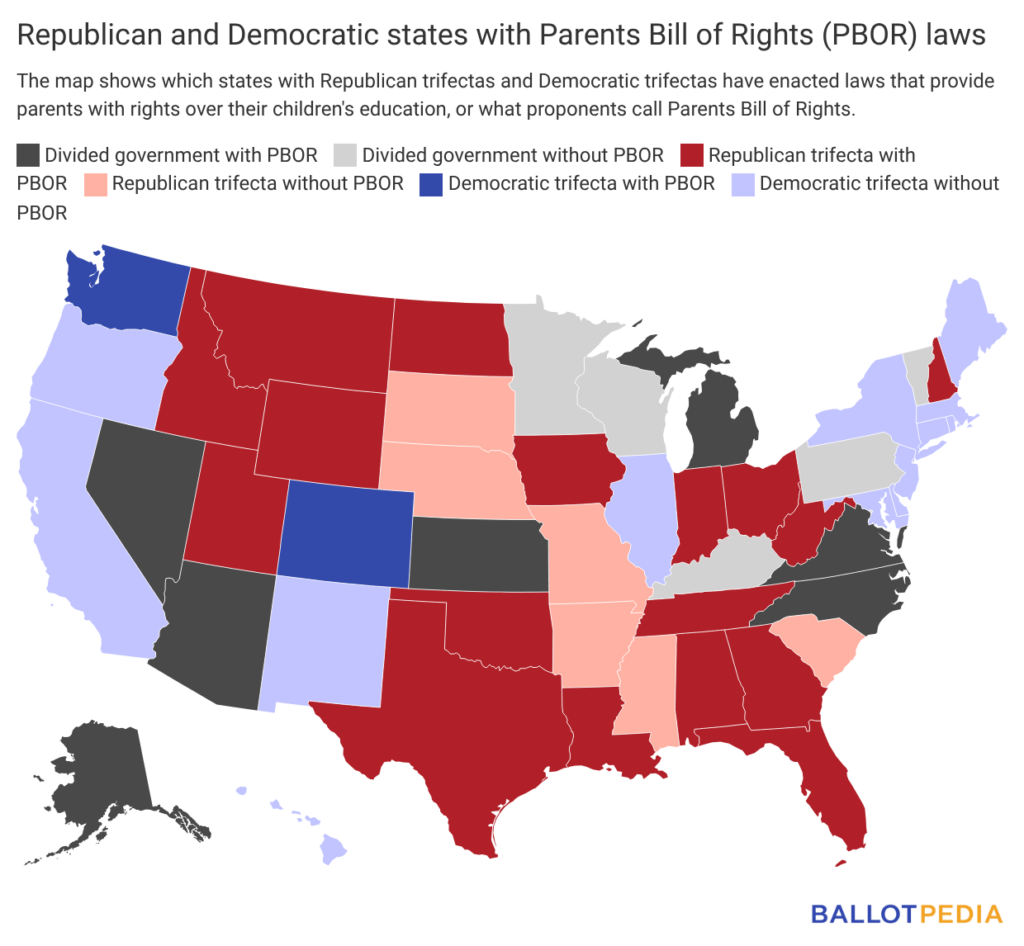
As of January 2026, 26 states, including Washington, have enacted a statewide Parents' Bill of Rights. These laws vary from state to state but generally grant parents specific rights as they pertain to their children's education. States with Republican trifectas are more likely than those with divided governments or Democratic trifectas to have enacted Parents’ Bill of Rights laws. Currently, 17 of 23 states with Republican trifectas have a Parents’ Bill of Rights law, whereas two of the 14 states with Democratic trifectas have done so. Washington and Colorado are the only two Democratic trifecta states with a Parents’ Bill of Rights law.
The sports eligibility initiative
IL26-638, would prohibit students the measure “defines as ‘biologically male’ from competing in certain school athletic activities intended for female students only.”
The initiative would require student athletes’ healthcare providers to verify their sex by "relying only on one or more of the following: The student's reproductive anatomy, genetic makeup, or normal endogenously produced testosterone levels."
Two student high school athletes in Washington who’ve been involved in the campaign for the initiative, Ahnaleigh Wilson and Frances Staudt, said: “Biological men are competing in girls’ sports in Washington State, and it’s destroying fairness in girls’ sports. Title 9 created opportunities for women and girls to compete in sports, and those opportunities are being erased. As [two] female athletes who have been directly impacted by boys competing in girls’ sports, we are standing up for all 110,000 girls playing sports in Washington state middle and high schools.”
Washington Families for Freedom, an organization that opposes IL26-638 and the parental rights initiative, said, “[T]his poorly designed initiative ultimately could put some girls at greater risk by subjecting them to invasive genital exams just to play on an after-school team. We should not impose a blanket ban that eliminates case-by-case solutions and distracts from affordability, housing, and other real problems facing Washingtonians.”
According to the Movement Advancement Project, a nonpartisan think tank that opposes blanket prohibitions on transgender youth participation in sports, 27 states have laws that require student athletes to compete in the category that matches their sex. While all 27 states have Republican-controlled legislatures, four have Democratic governors—Arizona, Kansas, Kentucky, and North Carolina. Republicans hold veto-proof majorities in Kansas and Kentucky.
Two of the blockbuster cases before the country’s highest court this year center on laws regulating high school and college sports eligibility.
On Jan. 13, the U.S. Supreme Court heard oral arguments in cases from Idaho and West Virginia, two of the 27 states with laws requiring athletes to compete in the category that matches their sex. The cases are about girls' and women's sports and whether transgender boys and men can compete in them. In Little v. Hecox, the Idaho case, plaintiffs presented the following question: "Whether laws that seek to protect women's and girls' sports by limiting participation to women and girls based on sex violate the Equal Protection Clause of the Fourteenth Amendment." In West Virginia v. B.P.J., the question is: “1. Whether Title IX prevents a state from consistently designating girls' and boys' sports teams based on biological sex determined at birth. 2. Whether the Equal Protection Clause prevents a state from offering separate boys' and girls' sports teams based on biological sex determined at birth.”
Decisions in both cases are expected in late spring or summer.
In 2024, Let's Go Washington gathered and submitted signatures for six measures—covering topics ranging fromprohibiting the state from implementing an income tax to removing restrictions on when a police officer can engage in a vehicular pursuit. Lawmakers approved three of the measures and voters rejected three.
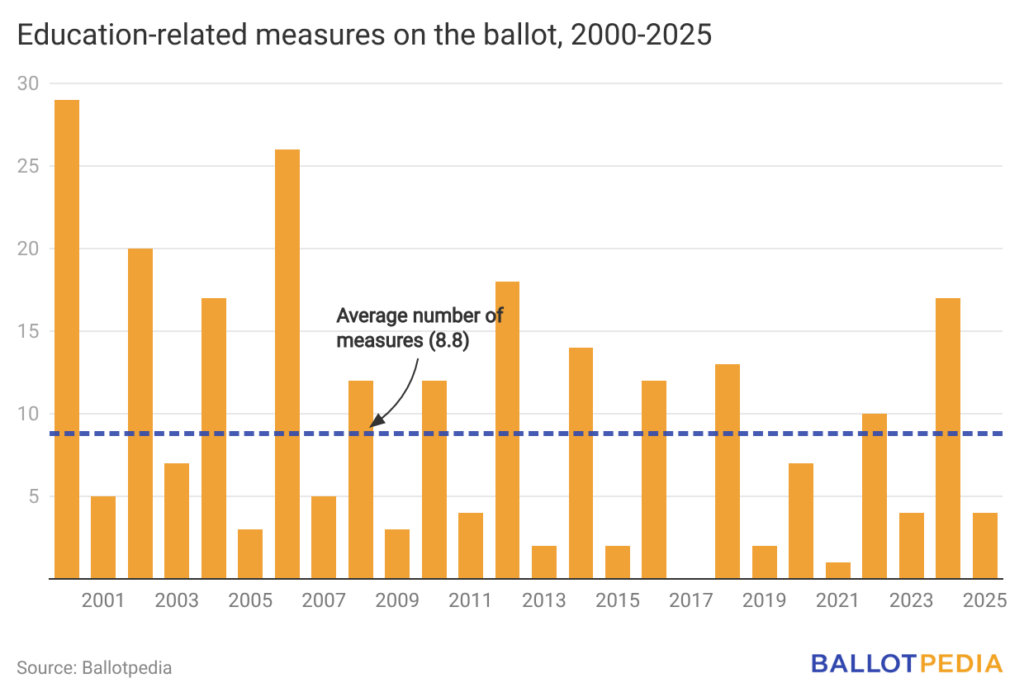
On average, voters decide about nine statewide measures related to education, though the numbers tend to be much higher during even-numbered years. As of January, Ballotpedia is tracking 18 education-related measures, including the two in Washington, that could potentially reach the ballot this year.
Extracurricular: education news from around the web
This section contains links to recent education-related articles from around the internet. If you know of a story we should be reading, reply to this email to share it with us!
- Why Florida charter schools are at capacity while district seats sit empty | Miami Times Online
- How Mississippi Transformed Its Schools From Worst to Best | The New York Times
- Trump’s next plan for the US education system: Lots and lots of rules | Politico
- Designing AI-Resistant Assignments in Educational Leadership Courses | Faculty Focus
- Why should voters care about school board elections? | Arkadelphian
- School board supports non-partisan board elections, Board supports full funding for Early on Michigan | Lake Orion Review
- Texas School District Could Fight State Over Cellphone Policy | Center for Digital Education
- Newsom California Education Plan Would Shift More Power to Governor | The 74
Take our Candidate Connection survey to reach voters in your district
Today, we’re looking at our first batch of 2026 school board candidate surveys.
As a reminder, if you're a school board candidate or incumbent planning to run this year, click here to take the survey. The survey contains more than 30 questions, and you can choose the ones you feel will best represent your views to voters. If you complete the survey, a box with your answers will appear in your Ballotpedia profile. Your responses will also appear in our sample ballot. If there is an election in your community, share the link with your candidates and urge them to take the survey!
Susan Lamkin is a member of the Tulsa Public Schools Board of Education District 7 in Oklahoma, where she has served since 2022. Lamkin is running against Michael Phillips in the April 7 general election. The Feb. 10 primary was cancelled because Lamkin and Phillips were the only candidates to run.
Lamkin's career experience includes working as a homemaker, part-time office assistant, Salvation Army Family Center executive director, small business owner, and as a case manager and behavior intervention specialist with Mental Health Services - MHMR of Tarrant County.
Tulsa Public Schools, with roughly 33,500 students, is the largest district in Oklahoma. Two of the seven seats on the school board are up for election this year.
Ballotpedia is covering all school board elections in Oklahoma in 2026.
Here’s how Lamkin answered the question, “What areas of public policy are you personally passionate about?”

“I believe in local control and that TPS has been a leader in developing needed policies and procedures without having to be governed by our State. One of our challenges is the ongoing teacher shortage in our state and nationwide. I appreciate the policies that support our teachers and encourage them in their careers, such as by providing incentives for teachers to mentor new teachers. I do not agree with policies that limit the autonomy of qualified, professional teachers and restrict or require that they teach specific points of view. We need better policies to limit and support the number of and the ways that we are putting new and alternative teachers in the classroom, where they are often not prepared or supported enough to succeed!”
Click here to read the rest of Lamkin’s responses.
Brent Luyet is running in the March 3 general election to represent Zone 3 on the Conway School District school board in Arkansas. Shannan Knudsen, Tyler W. Moses, and Emily Railsback are also running. Luyet’s career experience includes more than 20 years in the IT industry.
Conway School District is the eighth largest in Arkansas, with roughly 10,000 students. Two of seven seats are on the ballot this year.
Here’s how Luyet answered the question, “Who are you? Tell us about yourself.”

“I believe teachers deserve higher compensation to better support their critical role in educating our future leaders. Our students need teachers who are well-equipped and capable of developing strong leadership skills in young people. Increased teacher salaries would attract more qualified candidates to the profession and help retain experienced educators. Currently, teacher salaries are insufficient to support a comfortable living in today's economy, causing many talented individuals to pursue higher-paying careers in other fields. I'm concerned about the direction some schools are taking, particularly regarding curriculum not appropriate or holds no educational values or scientific consensus. I have conservative values, meaning I am against boys in the girls bathrooms, and encouraging bad behaviors like, enabling a child to think they are an animal.”
Click here to read the rest of Luyet’s responses.