


Welcome to the Friday, Jan. 16, 2026, Brew.
By: Lara Bonatesta
Here’s what’s in store for you as you start your day:
- Signatures filed for two Washington ballot initiatives on school sports eligibility based on biological sex and certain parental rights in public schools
- Emerging ballot measures to watch in 2026, by Leslie Graves, Ballotpedia Founder and CEO
- Six statewide candidate filing deadlines scheduled for January
Signatures filed for two Washington ballot initiatives on school sports eligibility based on biological sex and certain parental rights in public schools
Let's Go Washington, a political action committee (PAC) that hedge fund executive and Republican donor Brian Heywood founded, submitted signatures for two Initiatives to the Legislature on Jan. 2 that address school sports eligibility requirements based on biological sex and certain parental rights in public schools.
At least 308,911 signatures must be verified for each initiative. Let's Go Washington said they submitted 416,201 signatures for the parental rights initiative (IL26-001) and 445,187 for the sports eligibility initiative (IL26-638).
Both measures are Initiatives to the Legislature, where, if enough valid signatures are gathered, the Legislature can choose to:
- Adopt the initiative as written,
- Reject or not act on the initiative, thereby placing it on the ballot for voter approval, or
- Approve an alternative to the proposed initiative, in which case both the original proposal and the legislative alternative are put on the ballot.
An Initiative to the Legislature is an indirect initiated state statute. Nine states have indirect initiatives. Washington citizens can also initiate direct statutes, which are called Initiatives to the People.
The parental rights initiative
IL26-001 would reenact Initiative 2081, which the Legislature approved in 2024 and then partially repealed in May 2025. Initiative 2081 provided parents with a right to review educational materials, receive certain notifications, and opt out of sexual health education.
On May 20, Gov. Bob Ferguson (D) signed House Bill 1296 (HB1296), which amended parts of Initiative 2081. HB 1296 passed in the Legislature along party lines, with Democrats in favor and Republicans opposed. It eliminated the parents’ rights to receive prior notification when medical services are offered to their child, except for emergency medical treatment, when medical services or medications are given that could result in a financial impact to the parent or guardian, or when the school has arranged for medical treatment resulting in follow-up care after school hours.
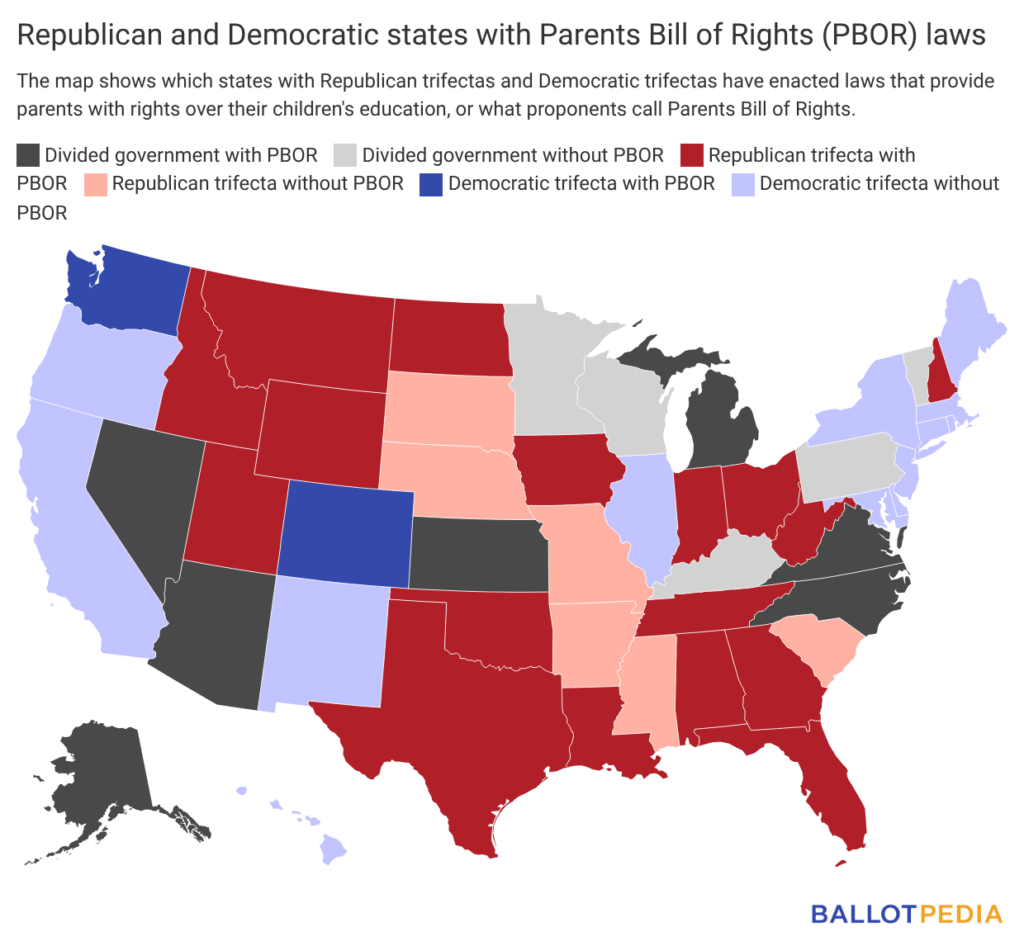
Twenty-six states, including Washington, have enacted what supporters call a statewide Parents' Bill of Rights. These laws vary from state to state, but generally grant parents specific rights regarding their children's education. States with Republican trifectas are more likely than those with divided governments or Democratic trifectas to have enacted Parents' Bill of Rights laws.
The sports eligibility initiative
IL26-638 would require school and voluntary nonprofit athletics to “prohibit students it defines as ‘biologically male’ from competing in certain school athletic activities intended for female students only.”
The initiative would require student athletes' healthcare providers to verify their biological sex by "relying only on one or more of the following: The student's reproductive anatomy, genetic makeup, or normal endogenously produced testosterone levels."
According to the Movement Advanced Project, a nonpartisan think tank that opposes blanket prohibitions on transgender youth participation in sports, 27 states have laws that ban transgender students from playing on sports teams that match their gender identity. While all 27 states have Republican-controlled legislatures, four have Democratic governors —Arizona, Kansas, Kentucky, and North Carolina. Republicans hold veto-proof majorities in Kansas and Kentucky.
On Jan. 13, the U.S. Supreme Court heard oral arguments in cases from Idaho (Little v. Hecox) and West Virginia (West Virginia v. B.P.J.), two of the 27 states with laws regulating the participation of transgender student athletes in sports. Decisions in both cases are expected in late spring or summer.
In 2024, Let's Go Washington gathered and submitted signatures for six measures—covering topics ranging from prohibiting the state from implementing an income tax to removing restrictions on when a police officer can engage in a vehicular pursuit. Lawmakers approved three of the measures, and voters rejected three.
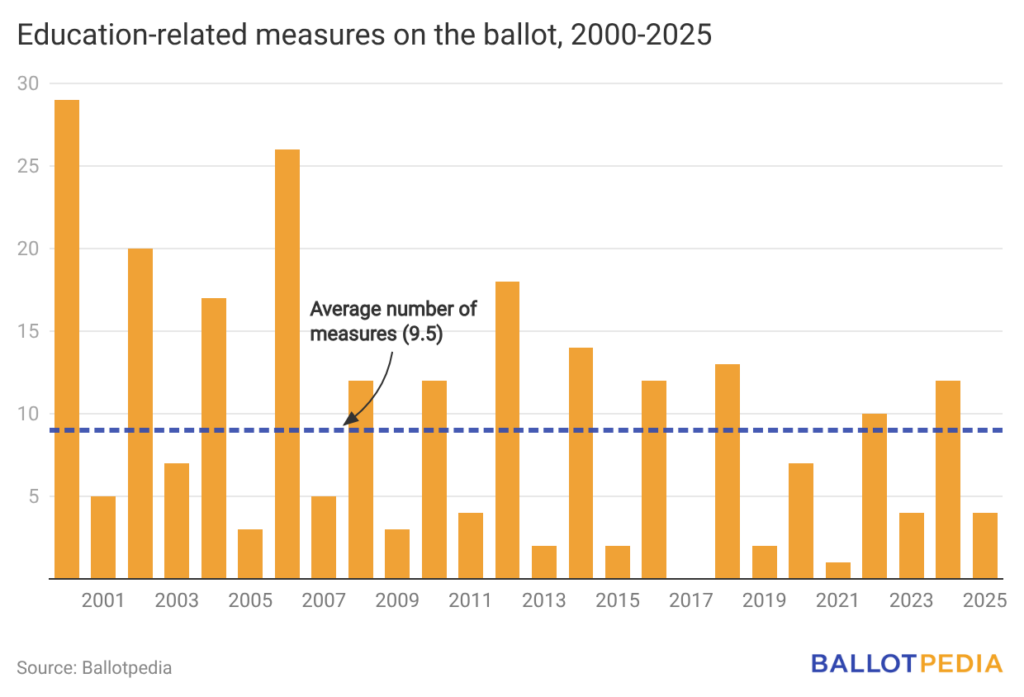
On average, voters nationwide decide about nine statewide measures related to education per year, though the numbers tend to be much higher in even-numbered years. As of January, we have identified 18 education-related measures, including the two in Washington, that could potentially reach the ballot this year.
A version of this story appeared in the Jan. 14 Hall Pass, our weekly newsletter on school board politics and education policy. You can subscribe here.
Click here to read more about IL26-001 and IL26-638.
Emerging ballot measures to watch in 2026

One of Ballotpedia’s earliest projects was gathering and sharing information on ballot measures with voters. We did this because ballot measures not only reflect the public’s mood on certain issues, they also have the power to shape the national political landscape.
That might be the case with several measures our Ballot Measures Team is currently monitoring. One group of measures deals with artificial intelligence and data centers.
Ballotpedia’s Victoria Antram reported that AI-related measures have already been proposed in California. AI company OpenAI and Common Sense Media are sponsoring one measure that would create state-level regulations on children’s use of AI chatbots. There are also several local governments considering referendums tied to data‑center ordinances.
These proposals reflect both the private-sector interest in shaping AI regulation and public concern about AI’s uses and potential costs. These measures fit against a broader national backdrop that was recently identified in a note to clients from the investment firm Jefferies (and as reported in the Financial Times’ Alphaville substack): “We expect effectively every political candidate running for office in 2026 to be forced to take a position, whether they are pro or con data centers/AI.”
It’s not just technology that has activists’ attention. Ballotpedia’s Ryan Byrne noted that the 2026 elections appear to be “the first in which transgender‑related policies are being brought to voters at scale.”
Missouri voters will decide on a proposed constitutional amendment that, in addition to seeking to overturn an abortion-related measure voters approved in 2024, would also ban gender transition surgeries and prohibit cross‑sex hormones and puberty blockers for minors.
Colorado voters could decide on a similar measure. Several states — Colorado, Maine, and Washington — could have ballot measures that propose requiring male and female athletes to compete in the category that matches their sex. In Nevada, Gov. Joe Lombardo (R) announced plans to lead the Protect Girls' Sports initiative, a campaign to place a constitutional amendment on the 2026 ballot “to keep transgender athletes out of girls’ and women’s sports.”
Beyond the policy specifics, the ballot approach signals a strategic shift: groups are taking culturally salient, high‑stakes school issues to voters rather than confining them to legislatures or courts.
It isn’t the first time this has occurred. Ballot measures have been used in various forms in the United States for roughly 200 years. Throughout this long history, and especially following the advent of citizen initiatives during the Progressive Era, ballot measures have addressed significant issues such as taxation, voting rights, healthcare, and education reform.
Our Historical Ballot Measures Factbooks project is intended to offer everyone who’s curious about direct democracy in America a way to understand how ballot measures have evolved, what they’ve addressed, and perhaps most importantly, what they reveal about American voters at any particular point in history.
The certified and proposed measures for the 2026 ballot are the newest chapters in the constantly evolving story of direct democracy in America. And whatever the next big issues heading for the ballot may be, you can count on Ballotpedia to cover them all.
Six statewide candidate filing deadlines scheduled for January
As we enter 2026, midterm races are beginning to take shape. Six states have candidate filing deadlines in January.
Two states have upcoming candidate filing deadlines in the next two weeks. The map and bulleted list below show which states have candidate filing deadlines scheduled between Jan. 17 and Jan. 31.
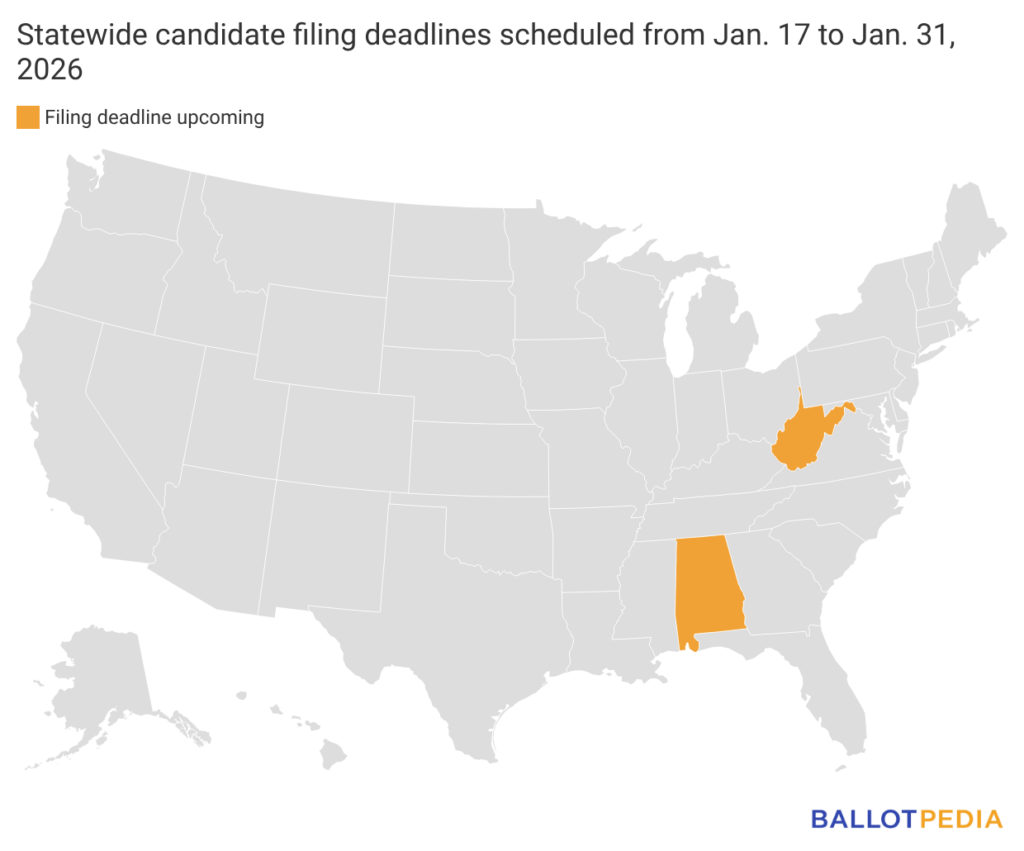
- Alabama: Jan. 23 (statewide filing deadline for primary candidates)
- West Virginia: Jan. 31 (statewide filing deadline for primary candidates)
Looking back
The four states listed below had candidate filing deadlines in the past two weeks:
- Illinois: Jan. 15 (statewide filing deadline for write-in primary candidates)
- Kentucky: Jan. 9 (statewide filing deadline for primary candidates)
- Utah: Jan. 8 (statewide filing deadline for primary candidates, excluding U.S. House)
- Wisconsin (Spring elections): Jan. 6 (statewide candidate filing deadline)
Candidates must meet various state-specific filing requirements and deadlines to appear on primary and general election ballots. These regulations, known as ballot access laws, determine whether and how candidates can make it onto the ballot. These laws are set at the state level and apply to candidates running for state and federal offices.
Upcoming primaries
Looking ahead, here are the five states with statewide primaries coming up in March, and some dates voters in those states should be aware of.
- Voter registration deadline: Feb. 2
- Early voting start date: Feb. 16
- Primary date: March 3
- Voter registration deadline: Feb. 17 by mail (March 1 online, March 17 in person.)
- Early voting start date: Feb. 5
- Primary date: March 17
- Voter registration deadline: Feb. 9
- Mississippi does not permit non-excuse early voting.
- Primary date: March 10
- Voter registration deadline: Feb. 6
- Early voting start date: Feb. 12
- Primary date: March 3
- Voter registration deadline: Feb. 2
- Early voting start date: Feb. 17
- Primary date: March 3
Click here to see a full list of statewide primaries. To read more about candidate filing deadlines for the upcoming midterm elections,click here.