


Welcome to the Tuesday, Jan. 20, 2025, Brew.
By: Lara Bonatesta
Here’s what’s in store for you as you start your day:
- First year of Trump's second term by the numbers
- Wyoming Supreme Court rules abortion is a protected healthcare decision under 2012 constitutional amendment
- Ten candidates are running in the Democratic primary for U.S. Senate in Illinois on March 17
First year of Trump's second term by the numbers
One year ago today, Donald Trump (R) assumed office as the 47th president of the United States, making him one of only two U.S. presidents to serve two non-consecutive terms. Here’s a look at the first year of his second term, by the numbers.
Executive actions:
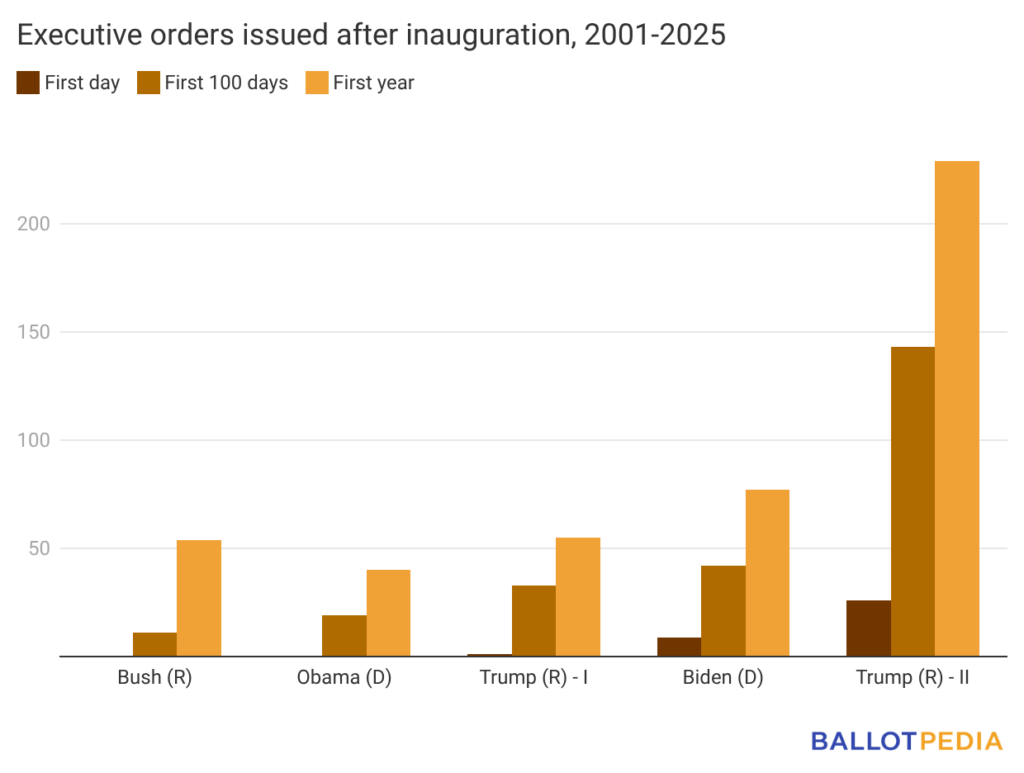
As of Jan. 16, Trump issued 229 executive orders, 57 presidential memoranda, and 118 proclamations in the first year of his second term. Trump’s executive order total was the highest first-year executive order total since Franklin Delano Roosevelt (D), who issued 568 executive orders in 1933. Looking at his second term executive orders by topic, Trump has issued the most executive orders on foreign policy at 61 orders, 35 of which were related to trade and tariffs.
Federal judges
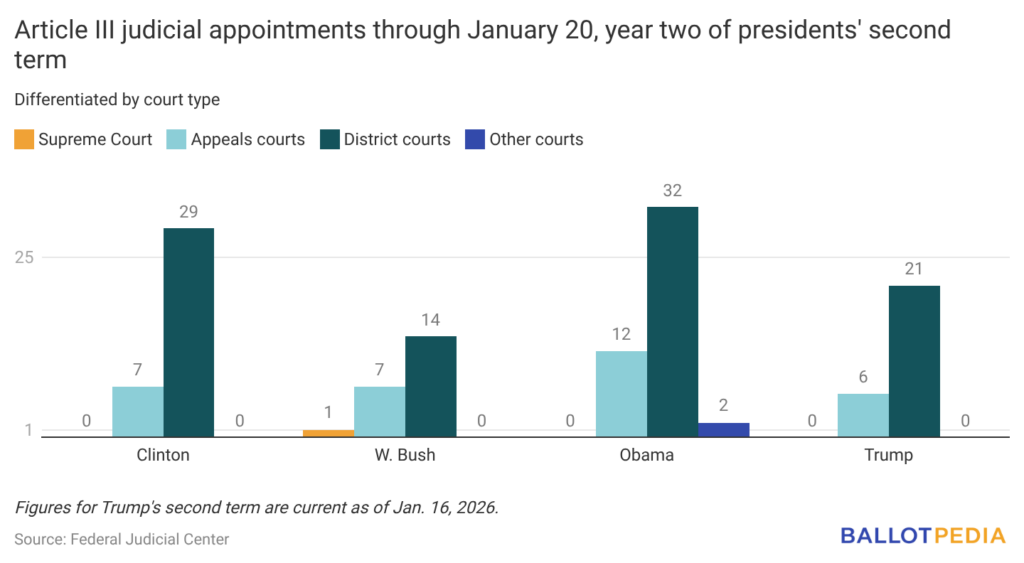
As of Jan. 16, Trump has nominated, and the Senate has confirmed 27 Article III federal judges, including 21 to U.S. District Courts and six to the U.S. Courts of Appeals. During the first year of his first term, Trump nominated, and the Senate confirmed 23 Article III judges, including one Supreme Court Justice, 12 to the U.S. Courts of Appeals, and 10 to the U.S. District Courts.
Supreme Court emergency applications
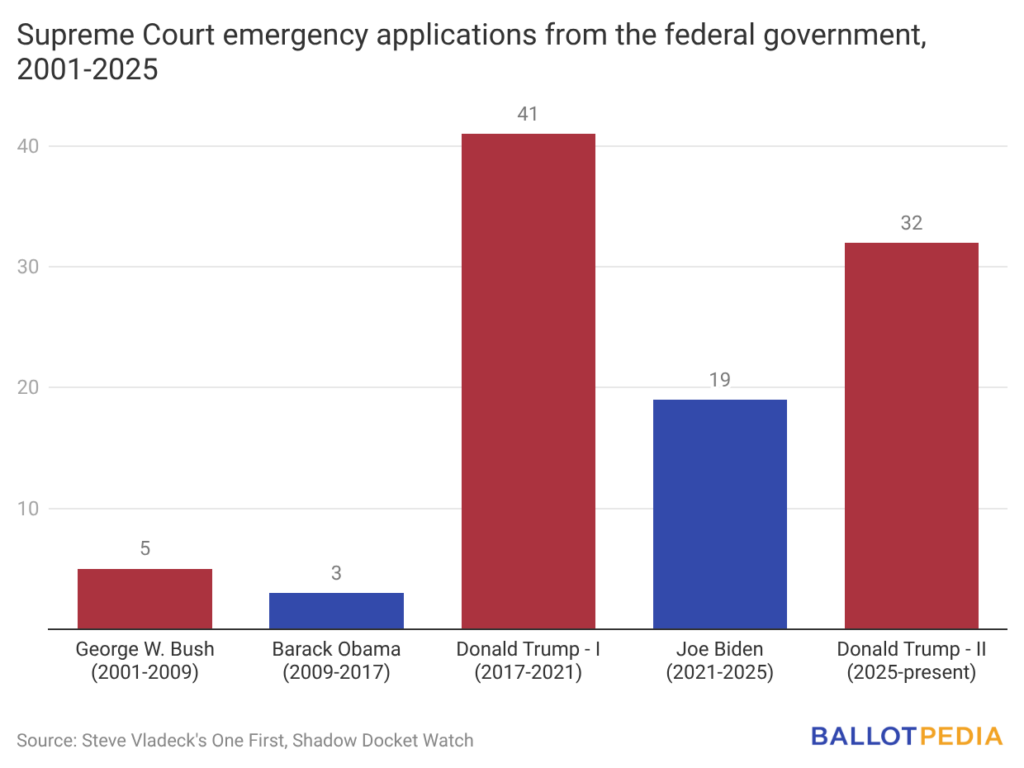
The Trump administration filed 32 emergency applications with the Supreme Court. An emergency application asks the Court for immediate intervention in a case that has not fully progressed through the ordinary procedures required for the Court to issue a regular opinion. The Court granted the Trump administration’s request for intervention in 21 cases, granted the request in part and denied it in part in two cases, and denied the request in four cases. Three requests were withdrawn, and two are pending.
Presidential pardons
Trump issued 181 presidential pardons and commutations (This figure only includes pardons that have been published on the U.S. Department of Justice’s website. As of Jan. 16, the website was last updated on Dec. 15, 2025.) This figure also does not include instances of mass pardons. According to the Department of Justice, during fiscal year 2017, Trump issued one pardon and no commutations. Joe Biden (D), Barack Obama (D), and George W. Bush (R) issued no pardons or commutations during their first fiscal year in office.
Tie-breaking votes in the Senate
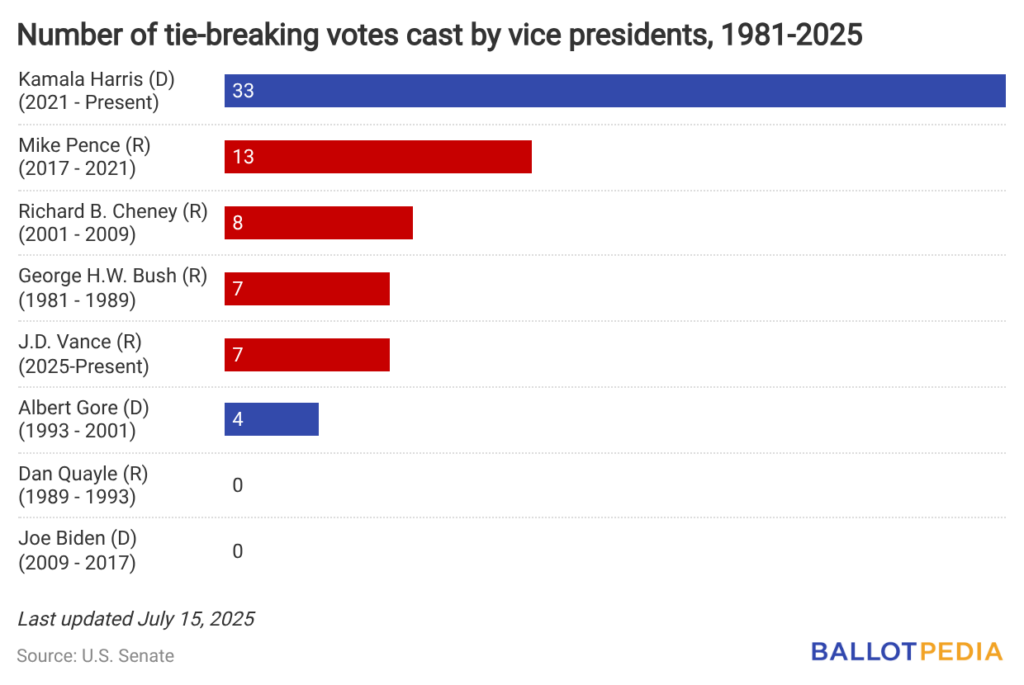
Under Article I, Section 3, Clause 4 of the U.S. Constitution, the vice president also serves as the president of the Senate and may cast the deciding vote when there is a tie in the Senate. Vice President J.D. Vance (R) cast seven tie-breaking votes in the Senate. Three votes were related to the One Big Beautiful Bill Act, two votes were related to the Rescissions Act of 2025, one vote was to table a joint resolution to terminate the national emergency related to global tariffs, and one vote was in favor of the nomination of Secretary of Defense Pete Hegseth.
Click here to read more about Trump’s second term.
Wyoming Supreme Court rules abortion is a protected healthcare decision under 2012 constitutional amendment
On Jan. 6, the Wyoming Supreme Court ruled that the state constitution protects abortion as a healthcare decision and that a 2012 constitutional amendment preempts two 2023 state laws restricting it. The ruling, which means that abortion will stay legal up until fetal viability in Wyoming, was 4-1. Chief Justice Lynne Boomgaarden wrote the majority's opinion and Justice Kari Gray dissented. Republican governors appointed all five members of the Wyoming Supreme Court.
The ruling cited Article 1, Section 38 of the state constitution, which says, "Each competent adult shall have the right to make his or her own health care decisions." Voters added this language to the state constitution when they approved Amendment A 77%-23% in 2012.
In the discussion of the case, the state said that the Legislature put Amendment A on the 2012 ballot in response to the Affordable Care Act, also known as Obamacare, and that it did not mention abortion.
The majority's opinion stated, "The State points out the amendment was put to the voters in response to the Affordable Care Act, with no discussion of abortion care. The record supports this assertion, and we do not disagree. However, that does not change the fact that the plain language of the amendment the voters ratified went beyond addressing concerns with the Affordable Care Act and granted '[e]ach competent adult' 'the right to make his or her own health care decisions.'"
Amendment A was one of seven ballot measures on state ballots between 2010 and 2012 that supporters referred to as Healthcare Freedom Amendments. Voters in Alabama, Arizona, Ohio, and Oklahoma approved these measures, while voters in Colorado and Florida rejected them. Those amendments were designed to prohibit requiring a person to participate in a healthcare system, such as a health insurance mandate. Amendment A in Wyoming also established a constitutional right for adults to make their own healthcare decisions.
Background of the case and how the justices ruled
Currently, Wyoming permits abortion up until fetal viability. In 2023, the Wyoming Legislature passed, and Gov. Mark Gordon (R) signed two laws– House Bill 152 (HB 152) and Senate File 109 (SF 109) – prohibiting abortion and abortion pills with certain exceptions.
- HB 152 held that abortion “is not health care. Instead of being health care, abortion is the intentional termination of the life of an unborn baby.” HB 152 also prohibited persons from performing abortions, with exceptions.
- SF 109 stated that ”it shall be unlawful to prescribe, dispense, distribute, sell or use any drug for the purpose of procuring or performing an abortion on any person.”
A state judge temporarily blocked HB 152 and SF 109 in April 2024. In November 2024, Wyoming Ninth District Court Judge Melissa Owens ruled both laws unconstitutional. After Owens’ ruling, the state appealed, and the case made its way to the state supreme court. The Supreme Court’s Jan. 6 decision upholds Owens’ ruling.
Chief Justice Lynne Boomgaarden wrote the majority's opinion, which said, "The State did not meet its burden of proving the Abortion Laws are necessary to achieve a compelling government interest or are narrowly tailored to avoid unduly infringing on a woman’s right to make her own health care decisions." Justice Kari Gray dissented. She agreed that abortion is healthcare under Amendment A but wrote that when Wyoming voters approved Amendment A, "they simultaneously allowed the legislature to ‘determine reasonable and necessary restrictions’ on that right…” and that “the abortion statutes constitute a ‘reasonable and necessary’ restriction by the legislature on the right of a pregnant woman to make her own health care decisions for the purpose of preserving prenatal life at all stages of development."
A two-thirds vote is required during one legislative session for the Wyoming Legislature to put a constitutional amendment on the ballot. That amounts to a minimum of 42 votes in the Wyoming House of Representatives and 21 votes in the Wyoming Senate, assuming no vacancies. Republicans hold 56 of 60 seats in the House, and 29 of 31 seats in the Senate. The Legislature is expected to convene on Feb. 9.
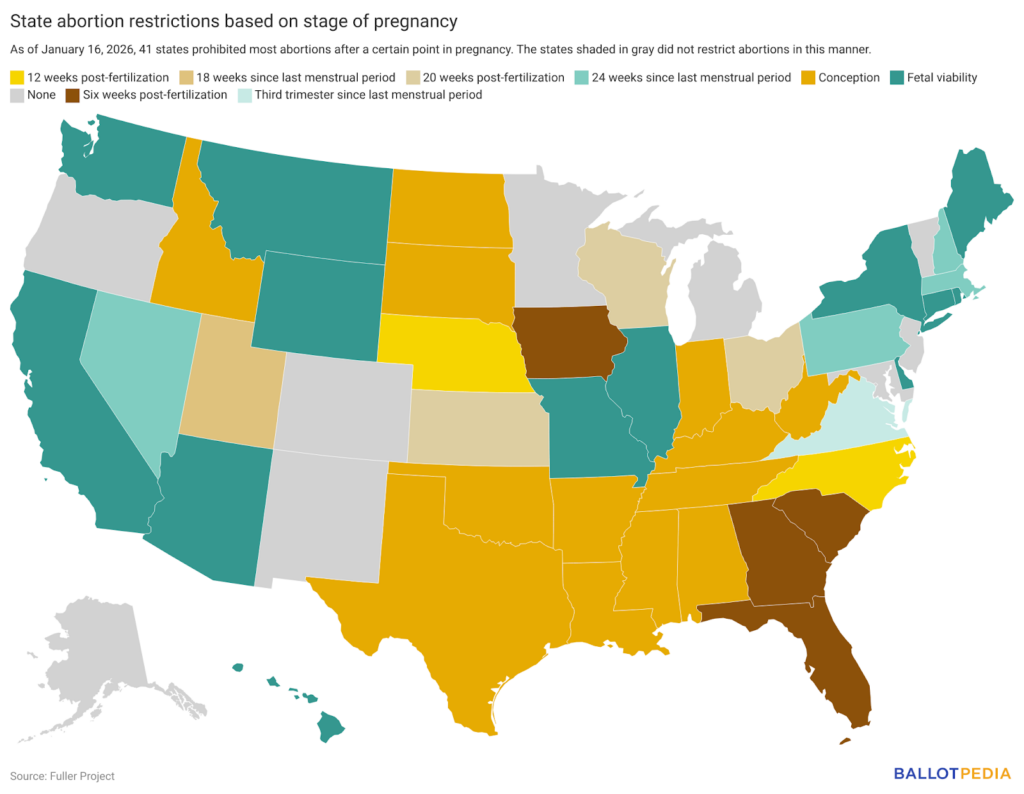
Click here to learn more about Amendment A and how it relates to the Wyoming Supreme Court’s recent abortion decision.
Ten candidates are running in the Democratic primary for U.S. Senate in Illinois on March 17
Ten candidates are running for Illinois’ Democratic U.S. Senate nomination on March 17. Three candidates have led in fundraising, media attention, and polling: Robin Kelly (D), Raja Krishnamoorthi (D), and Juliana Stratton (D). Incumbent Dick Durbin (D), who was first elected in 1996, announced his retirement on April 23, 2025.
The Chicago Crusader wrote that the race "[features] three distinct candidacies that offer starkly different visions for the state’s political future and the national Democratic agenda."
Kelly has represented Illinois' 2nd Congressional District since 2013. She is campaigning on her record, saying, "I'm the only one federally that has a district like mine, urban, suburban, and rural, where I personally have delivered for each of those districts. I've been able to pass meaningful pieces of legislation around health care, saving lives." On her website, Kelly details a plan called "People over Profits," which includes proposals to pass a minimum tax on individuals earning $100 million a year, raise the minimum wage to $17, and pass Medicare for All.
Krishnamoorthi has represented Illinois' 8th Congressional District since 2017. He said he would support a nationwide free school lunch program for kids, repealing cuts to SNAP and Medicare, and a tax credit for new homeowners in the first five years they own a home. Krishnamoorthi has also focused on his experience in business and government, saying, "You need to convince people that you can... stand up for their economics interests and address their economic pain points... as a former small business person and as someone who's worked on these issues in Congress, I feel uniquely positioned to deal with them."
Stratton has been Illinois’ lieutenant governor since 2019. She is campaigning on her record, saying, "To me, Illinois is the blueprint. What Governor Pritzker and I have done here in Illinois is the blueprint that I want to take to Washington, D.C., and I want to fight for Illinoisans just like I've done for seven years." Stratton said she supports Medicare for All, expanding the Earned Income Tax Credit, and passing a federal version of Illinois’ Birth Equity Initiative to reduce maternal mortality.
The Wall Street Journal's John McCormick wrote, "The election is a test of [Governor J.B. Pritzker's (D)] clout." Pritzker endorsed Stratton shortly after her campaign announcement. Sen. Tammy Duckworth (D-Ill.) and Illinois House Speaker Chris Welch (D) also endorsed Stratton. Several labor unions, including the Teamsters and the American Federation of Government Employees, and former Lt. Gov. Sheila Simon (D), endorsed Krishnamoorthi. The Congressional Black Caucus Political Action Committee, BradyPAC, and Sen. Chris Murphy (D-Conn.) endorsed Kelly.
As of the most recent financial reports filed with the Federal Election Commission, Kelly raised $2.7 million and spent $2.2 million, Krishnamoorthi raised $24.9 million and spent $6.8 million, and Stratton raised $2.1 million and spent $1.2 million.
Steve Botsford Jr. (D), Sean Brown (D), Awisi Bustos (D), Jonathan Dean (D), Bryan Maxwell (D), Kevin Ryan (D), and Christopher Swann (D) are also running.
Click here to see our full coverage of the primary for Illinois’ Democratic U.S. Senate nomination.