



The Virginia General Assembly passed a constitutional amendment that would allow legislators to adopt a new congressional district map. Voters must approve the amendment.
House Joint Resolution 4 (HJR 4), the constitutional amendment, would allow the Virginia General Assembly to redraw congressional districts between 2025 and 2030 if other states have conducted mid-decade congressional redistricting.
The Virginia Constitution does not currently allow the Virginia General Assembly to draw or implement new congressional district maps. In 2020, voters approved Question 1, a constitutional amendment that transferred the power to draw the state's congressional and legislative districts from the Virginia General Assembly to a 16-member redistricting commission composed of eight legislators and eight citizens. HJR 4 would allow the General Assembly to exercise that power between Jan. 1, 2025, and Oct. 31, 2030.
Because California, Missouri, North Carolina, and Texas have already conducted voluntary redistricting in 2025, the amendment would allow the general assembly to conduct congressional redistricting before the next scheduled redistricting process, planned for 2031.
While HJR 4 authorizes the adoption of a new map, it does not specify one. According to the New York Times, Democratic legislators said they intend to publish a proposed map before the end of January.
House Joint Resolution 4
On Jan. 14, the state House approved the amendment, titled House Joint Resolution 4, in a vote of 62-33, with five members absent or not voting. On Jan. 16, the state Senate approved HJR 4 in a vote of 21-18, with one senator absent or not voting. Both votes fell along party lines, with Democrats supporting and Republicans opposing.
This was the second time the redistricting amendment was approved by the General Assembly. The general assembly first approved the constitutional amendment at a special legislative session on Oct. 31, 2025. In Virginia, a potential constitutional amendment must be approved by the General Assembly in two successive legislative sessions before being placed on the ballot for voters to decide at an election.
Timing of the referendum election
In Virginia, the default referendum election date is the general election: Nov. 3, 2026. If the constitutional amendment is to be passed and new maps are to be created and enacted for the 2026 congressional election, a special election would need to be scheduled. Additionally, the congressional filing deadline, scheduled for April 2, would need to be postponed.
The state constitution states that the earliest a special election could be scheduled is 90 days after the measure is approved by the legislature. April 16 is 90 days after Jan. 16.
According to Code of Virginia § 24.2-682, no special election can be held less than 55 days before a general or primary election, or at the same time as a primary election. The primary election for Virginia is scheduled on June 16, 2026. April 22 is 55 days before June 16.
Considering those two restrictions, a special election would need to be held between April 16 and April 22, unless the primary election date is moved.
On Jan. 16, The Hill reported that Democratic legislators are looking to hold the special election for the ballot measure sometime in April.
The last special election for a state ballot measure in Virginia was on Jan. 9, 1956, when voters approved a limited constitutional convention to revise Section 141 of the Virginia Constitution, allowing the General Assembly and local governments to use public funds to provide tuition grants for students attending nonsectarian private schools.
Support and opposition to the amendment
Virginia For Fair Elections is leading the campaign in support of the constitutional amendment. On Jan. 15, they published their social media campaign and released a video advertisement in support of the amendment.
Some opponents of the amendment have argued that Virginia should not make decisions based on other states' actions. U.S. Rep. Morgan Griffith (R-9) said, "To conflate and say ‘We ought to be like Texas’ or ‘We ought to be like California’ is just wrong. We’re Virginians and we ought to be proud to be Virginians and the Virginia voter, not the California voter, not the Texas voter, the Virginia voter said they wanted a nonpartisan process."
Virginia Senate Majority Leader Scott Surovell (D-34) disagreed. He said, “This isn’t about payback. It’s about restoring and preserving balance to our system. When other states manipulate their maps to gain an unfair advantage … they don’t just harm their own voters, they also harm Virginia’s ability to have its fair representation in Congress.”
U.S. House Minority Leader Hakeem Jeffries (D-8) agreed with Surovell. After the state Senate approved the measure he said, “the people are now empowered to decide what the congressional map should look like, not Donald Trump and his partisan Republican hacks.”
Some opponents of the measure state that the constitutional amendment opposes the will of the people of Virginia. State Sen. Christopher Head (R-3) said the redistricting measure, “is a dumb thing to be doing. The citizens of the commonwealth voted overwhelmingly in a presidential election year referendum — 66.1% voted to eliminate the ability to do exactly what they are trying to do, and people should be outraged at this overreach power grab that they turn out to vote in droves to vote every one of these rascals out."
Congressional redistricting in other states
If HJR 4 is approved by voters and the legislature enacts new congressional maps, Virginia would join six other states that have participated in congressional redistricting between 2024 and 2026.
As of January 2026, six states—California, Missouri, North Carolina, Ohio, Texas, and Utah—had implemented new congressional maps. Five states—Florida, Georgia, Louisiana, Maryland, and Virginia—had congressional district maps that were subject to change, either through litigation or a voluntary process, before the 2026 elections.
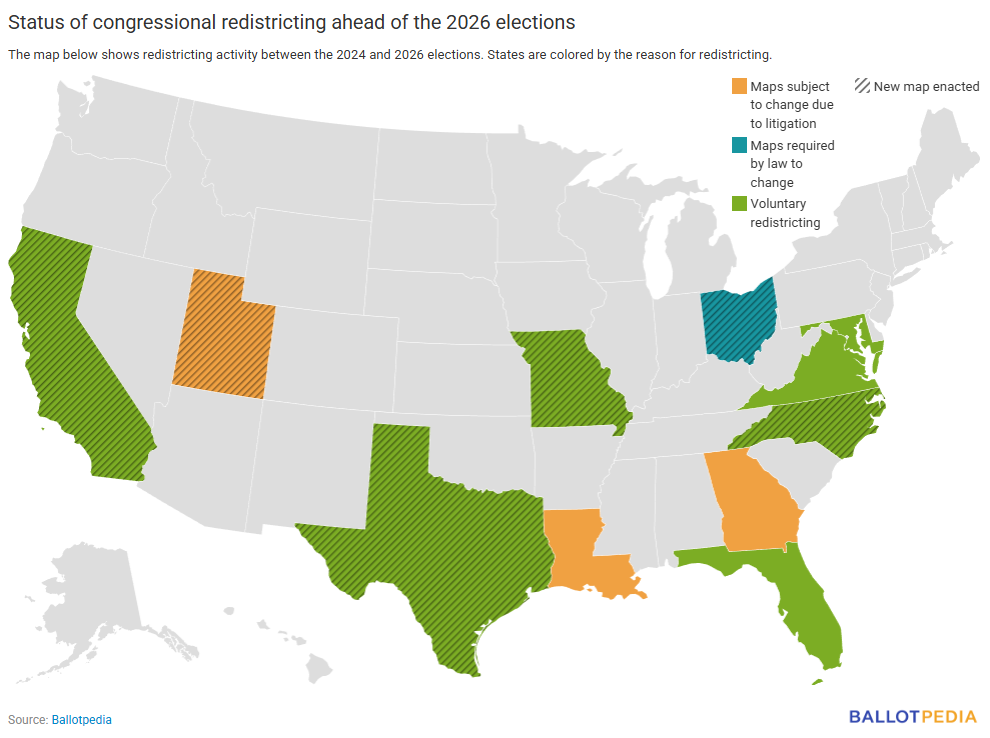
California is the only state that has implemented a new congressional district map by ballot measure between 2024 and 2026. On Nov. 4, 2025, voters approved Proposition 50, with 64.4% voting yes. The measure amended the state constitution to allow the state to use a legislature-drawn congressional district map for elections between 2026 and 2030. Donors to campaigns in support and opposition of Proposition 50 contributed a combined $167 million, making the measure the fourth-most expensive ballot measure in the state’s history.
Other 2026 Virginia constitutional amendments
The Virginia legislature also approved three other constitutional amendments on Jan. 16 that will be placed on the ballot in 2026.
Thefirst would remove the state’s constitutional ban on same-sex marriage. Due to the ruling ofObergefell v. Hodges, the ban has been inoperative since 2015. Thesecond would add a right to reproductive freedom to the state constitution. The amendment defines this as "the right to make and effectuate one's own decisions about all matters related to one's pregnancy." Thethird would provide that persons convicted of felonies will be entitled to vote following release from incarceration. As of 2026, the governor can restore voting rights to a previously incarcerated felon on an individual basis.
Additional reading: