



The 2025 budget reconciliation bill, the One Big Beautiful Bill Act (OBBBA), established mandatory work requirements for certain able-bodied Medicaid recipients beginning in 2027. By creating a federal mandate, the OBBBA significantly changed the national landscape of Medicaid work requirements and states must respond by designing and implementing systems to comply, or risk losing federal funding. Previously, states could apply for a waiver to implement work requirements. As of January 2026, only two states had ever implemented work requirements for Medicaid.
History of Medicaid work requirements
Since 2016, states have used or attempted to use waivers under Section 1115 of the Social Security Act to implement Medicaid work requirements. Section 1115 gives the secretary of Health and Human Services (HHS) authority to approve any "experimental, pilot, or demonstration project which, in the judgment of the Secretary, is likely to assist in promoting the objectives of public assistance programs in a State or States." Section 1115 waivers give states flexibility to implement state-specific Medicaid policies. Work requirement policies are among the many different types of policies states have implemented using these waivers.
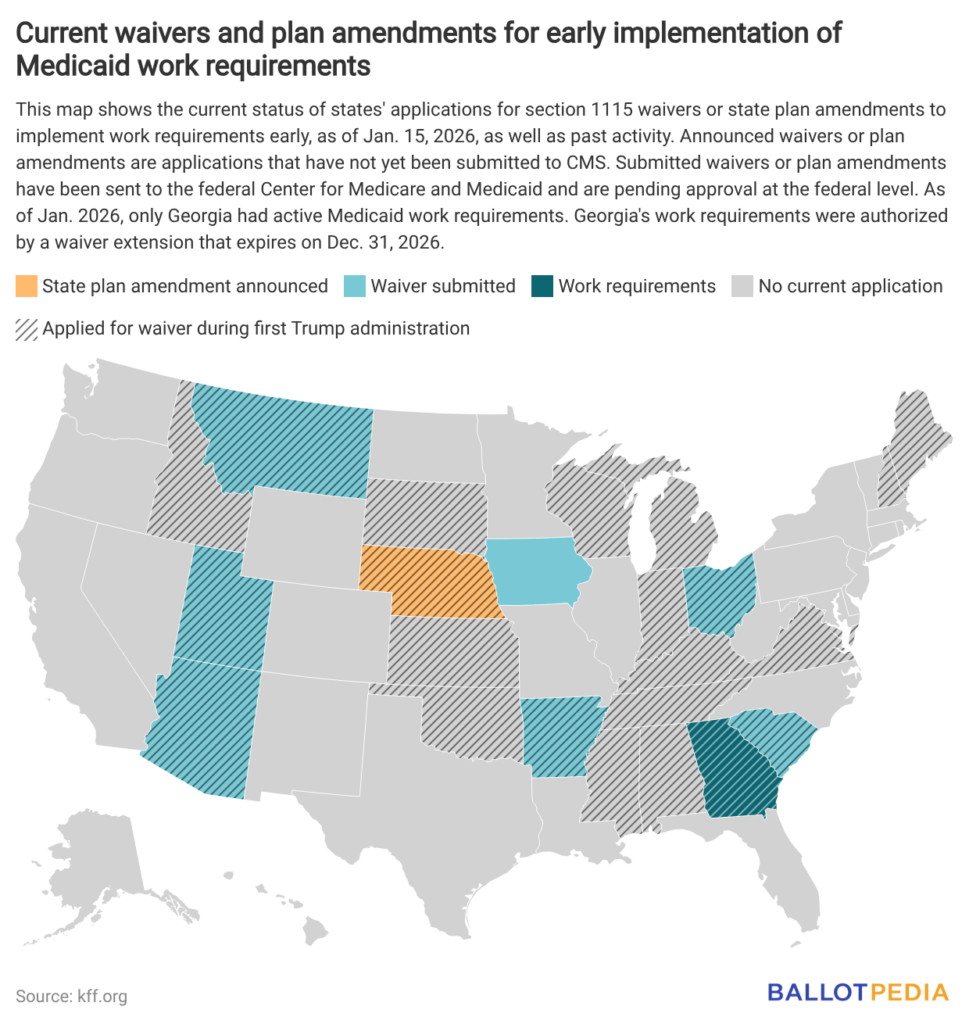
During the first Trump administration, the Centers for Medicare and Medicaid Services (CMS) approved state-level work requirement policies for 13 states through Section 1115 waivers. The Biden administration revoked all of these waivers. Only two states, Arkansas and Georgia, have ever implemented work requirement policies for Medicaid, both using this type of waiver. Arkansas implemented its work requirements before the Biden administration revoked its waiver in 2021. Georgia successfully defended its Section 1115 waiver in court and implemented work requirements for the program on July 1, 2023, which are still in effect.
The OBBBA mandate
The OBBBA requires all states to implement a work requirement of 80 hours per month for able-bodied Medicaid recipients in the Affordable Care Act (ACA) expansion group by Jan. 1, 2027. The ACA expanded Medicaid eligibility to include childless adults under age 65 whose income is up to 138 percent of the poverty level, known as the expansion group.
The OBBBA allows states to apply for Section 1115 waivers to implement work requirements for Medicaid ahead of the January 2027 deadline, but explicitly prohibits states from using these waivers to waive the work requirements.
Pending state actions
Seven states have active applications for Section 1115 waivers that would implement work requirements before the Dec. 31, 2026 deadline to do so. As of Jan. 23, each of these waivers was still pending at CMS. One state, Nebraska, had announced its intention to implement Medicaid work requirements ahead of schedule without a waiver, using a state plan amendment instead. The seven states with pending waivers are: Arizona, Arkansas, Iowa, Montana, Ohio, South Carolina, and Utah. Some states submitted waiver requests before President Donald Trump (R) signed the OBBBA into law on July 4, while others submitted requests afterwards. All seven waivers would enact some form of Medicaid work requirements ahead of the OBBBA deadline, but not all would establish work requirements that meet the new federal standards.
The OBBBA requires able-bodied Medicaid recipients ages 19-64 in the ACA expansion group to work 80 hours per month in order to maintain eligibility for benefits, with some exemptions. Here's how each waiver compares to those requirements, which begin Jan. 1, 2027:
- Arizona applied to CMS for a waiver to require expansion adults ages 19 - 54 to work 80 hours per month before the passage of the OBBBA.
- Arkansas applied to CMS for a waiver to require expansion adults ages 19 - 64 to work 80 hours per month after the passage of the OBBBA. Arkansas’ waiver also requested permission to use certain compliance tracking methods.
- Iowa applied to CMS for a waiver to require expansion adults ages 19 - 64 to work 100 hours per month before the passage of the OBBBA. Iowa’s policy wouldn’t require individuals to comply with work requirements to begin receiving Medicaid benefits, but would enforce work requirements beginning 6 months after certification and every six months thereafter.
- Montana applied to CMS for a waiver to require expansion adults ages 19 - 64 to work 80 hours per month after the passage of the OBBBA. Montana is requesting additional exemptions.
- Ohio applied to CMS for a waiver that conditions Medicaid expansion on meeting work requirements before the passage of the OBBBA.
- South Carolina applied to CMS for a waiver that would expand Medicaid to cover parents and caretakers earning 67% - 100% of the federal poverty level. The waiver would also require parents and caretakers aged 19 to 64 to work 80 hours per month.
- Utah requested a work requirement waiver, but the state has since indicated that it will no longer be moving ahead with the waiver process. The waiver is still technically pending at CMS.
Additional reading: