On Jan. 21, 2026, New York state judge Jeffrey Pearlman ruled that New York’s 11th Congressional District unconstitutionally diluted Black and Latino voting power. Pearlman ordered the New York State Independent Redistricting Commission to redraw the congressional map by Feb. 6. On Jan. 26, Republicans appealed the decision.
The lawsuit, filed in October 2025, argued that the district's boundaries “confine Staten Island’s growing Black and Latino communities in a district where they are routinely and systematically unable to influence elections.” The district, which U.S. Rep. Nicole Malliotakis (R) represents, is New York City’s only congressional district with a Republican representative.
New York is one of 11 states that use redistricting commissions to draw congressional district lines. The Associated Press' Anthony Izaguirre wrote that New York's "redistricting panel has the primary power to draw congressional maps, and is supposed to do so without gerrymandering the boundaries to give any party a political advantage. But, in the past, that commission has sometimes failed to reach an agreement on the makeup of a district, which has then given the Democrat-controlled state legislature the ability to tweak the lines in their favor."
Ahead of the appeal, Malliotakis said in a statement after the ruling, “We are reviewing the judge's decision and our options to protect the voices of the people of Staten Island and Brooklyn. Nothing changes the fact that this is a frivolous attempt by Washington Democrats to steal this congressional seat from the people and we are very confident that we will prevail at the end of the day.”
House Democratic Leader Rep. Hakeem Jeffries (D-N.Y.) said, "This ruling is the first step toward ensuring communities of interest remain intact from Staten Island to Lower Manhattan. The voters of New York deserve the fairest congressional map possible."
According to City & State New York’s Rebecca C. Lewis, the ruling could affect this year's race for U.S. Rep. Dan Goldman’s (D) 10th District seat as well: “[Goldman] faces a left-wing primary challenge from former New York City Comptroller Brad Lander. But the court ruling could place Goldman into a newly drawn, more moderate 11th District to face off against Malliotakis. It could leave Lander the 10th District, which would likely remain fairly progressive.”
Democrats currently represent 19 of New York’s 26 U.S. House districts. Because mid-decade redistricting would require a state constitutional amendment that could not take effect until the 2028 election cycle, the lawsuit may create the state’s only opportunity to influence the national redistricting effort ahead of this year’s midterms.
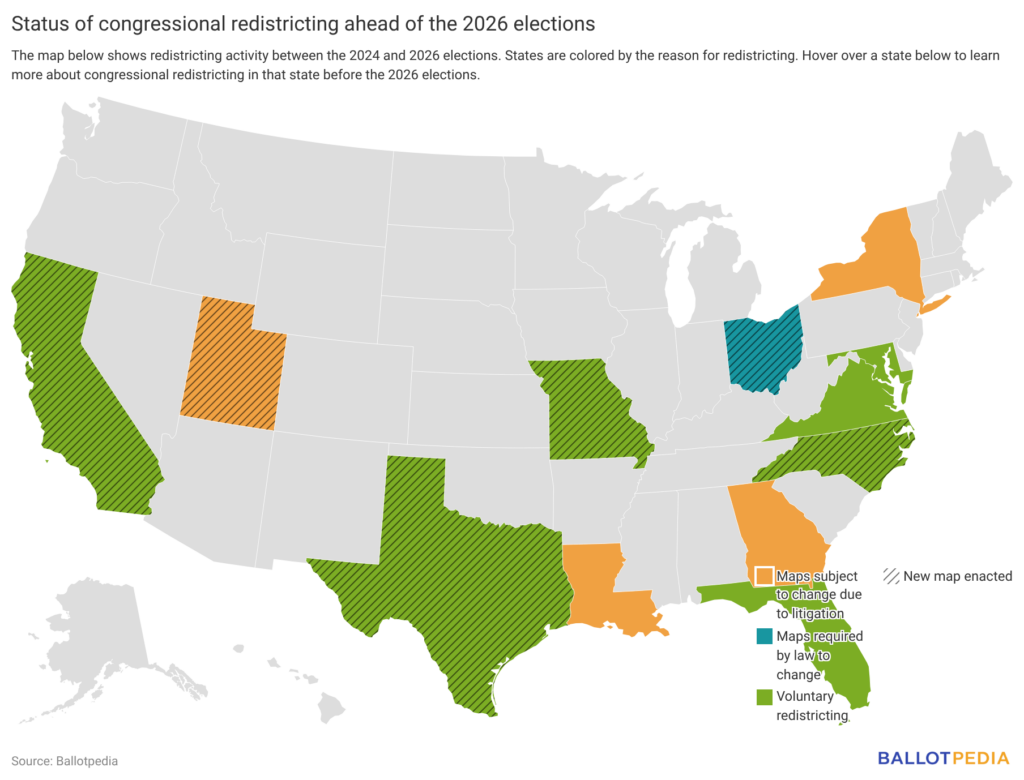
Six states have already revised their congressional maps ahead of the 2026 elections. Four states—California, Missouri, North Carolina, and Texas—voluntarily passed new congressional maps. Ohio was required by law to adopt a new map. New York would join Utah as the second state to have litigation lead to a new map. The redraw could create an additional Democratic district ahead of the 2026 elections, bringing Republicans' net gain from redistricting nationwide to two districts.
One Republican-led state and two Democratic-led states are also considering congressional redistricting in time for the elections this year.
The Florida Legislature will meet in April for a special legislative session on redistricting. Maryland Gov. Wes Moore’s (D) redistricting advisory commission approved a congressional map that would shift the state’s only Republican district toward Democrats. That proposal awaits the Maryland General Assembly’s consideration. Virginia Democrats plan to appeal a state court ruling that blocked an April 21, 2026, special election for a constitutional amendment that would allow the Virginia General Assembly to conduct mid-decade redistricting.