


Welcome to Hall Pass, a newsletter written to keep you plugged into the conversations driving school board governance, the politics surrounding it, and education policy.
In today’s edition, you’ll find:
- On the issues: The debate over whether the states or Congress should be the primary AI regulator
- School board filing deadlines, election results, and recall certifications
- A look at some of the K-12 education-related ballot measures voters could decide in 2026
- Extracurricular: education news from around the web
- Candidate Connection survey
Reply to this email to share reactions or story ideas!
On the issues: The debate over whether the states or Congress should be the primary AI regulator
In this section, we curate reporting, analysis, and commentary on the issues school board members deliberate when they set out to offer the best education possible in their district. Missed an issue? Click here to see the previous education debates we’ve covered.
States are debating how to regulate artificial intelligence (AI), including in K-12 public schools. According to the Center for Democracy and Education (CDT), in 2025, lawmakers in 21 states proposed 53 bills addressing AI in education. Such bills became law in Illinois, Louisiana, Nevada, and New Mexico. In total, state legislatures considered more than 1,000 AI bills last year.
At the same time, President Donald Trump (R) has called for limiting the regulations states can place on the use of AI. On Dec. 11, 2025, Trump issued an executive order titled “Ensuring a national policy framework for artificial intelligence.” The order says that differing state AI policies risk hampering the country’s technological innovation and competitiveness. The order calls for Congress to pass legislation creating a national AI policy and directs cabinet officials to identify what it considers to be burdensome and unconstitutional state-level AI regulations. Although the order says certain state-level regulations are permissible, such as those addressing child safety protections, it does seek to condition some federal funding on compliance with the proposed national framework.
The federal-state conflict over AI regulations has implications for how state lawmakers and education leaders approach AI restrictions in schools in the coming years.
Let’s look at arguments from experts who come down on different sides of the debate over which level of government should chiefly regulate AI.
Adam Thierer, a senior fellow for technology and innovation at the R Street Institute, and Kevin Frazier, director of the University of Texas School of Law’s AI Innovation and Law Program, say that responsibility for regulating AI should fall most heavily on Congress. They argue a patchwork of state laws will make it harder for the U.S. to compete with China and other countries. Thierer and Frazier say AI is unlike technologies from previous eras, and that the diffuse nature of data means that state regulations risk violating federalism and speech provisions in the U.S. Constitution.
Aalok Mehta, the director of the Center for Strategic and International Studies’ Wadhwani AI Center, says fears of state-level AI regulations are overblown. Mehta argues that AI poses numerous challenges that state lawmakers are trying to address through legislation. Mehta says surveys show citizens want AI to be regulated, even at the risk of slowing innovation, and that there’s no evidence state-level policies are inhibiting the pace of technological progress.
Congress Should Lead On AI Policy, Not The States | Adam Thierer and Kevin Frazier, R Street Institute
“An ‘AI Articles of Confederation’ approach would reverse the past 30 years of digital technology policy and undermine the nation’s efforts to create a coherent national AI policy framework that can help boost the many potential life-enriching benefits of advanced algorithmic systems, while also ensuring the nation stays ahead of China and other nations in the race for technological supremacy in advanced computational technology.
“Such a regulatory model will be particularly problematic for smaller innovators without the legal compliance teams needed to deal with the mountains of confusing and costly compliance requirements.
“Moreover, the fact that AI is also an information technology means that there are often important speech-related considerations at stake that necessitate greater scrutiny and protection. For this reason, state efforts to legislate in AI policy may be problematic not only because they create a confusing patchwork that runs contrary to the constitutional federalism principles, but also because some laws impose speech restrictions and obligations that violate the First Amendment.”
Targeting State AI Laws Undermines, Rather than Advances, U.S. Technology Leadership | Aalok Mehta, Center for Strategic & International Studies
“First, the EO’s approach is not aligned with what U.S. citizens and many lawmakers want when it comes to AI. Americans remain highly skeptical about the benefits of AI, as well as about the technology industry in general, and they are keen not to repeat the mistakes of the social media era. By preempting state laws before a federal framework exists, the EO stands to further increase concerns about AI technology and to slow down the pace of AI adoption, at a time when China is investing significantly in and seeing promising results from its own push on adoption.
…
“Third, the EO takes an unnecessarily antagonistic approach to the efforts of state lawmakers. AI is a revolutionary technology that stands to impact every sector of the economy at an unprecedented pace, but those same features make it particularly difficult to regulate well. As former U.S. Supreme Court Justice Louis Brandeis noted in 1932, ‘a single courageous State may, if its citizens choose, serve as a laboratory; and try novel social and economic experiments without risk to the rest of the country.’ State lawmakers are making genuine attempts to grapple with world-changing technology; the administration would benefit from learning from and incorporating their efforts rather than villainizing and dismissing them.”
School board update: filing deadlines, election results, and recall certifications
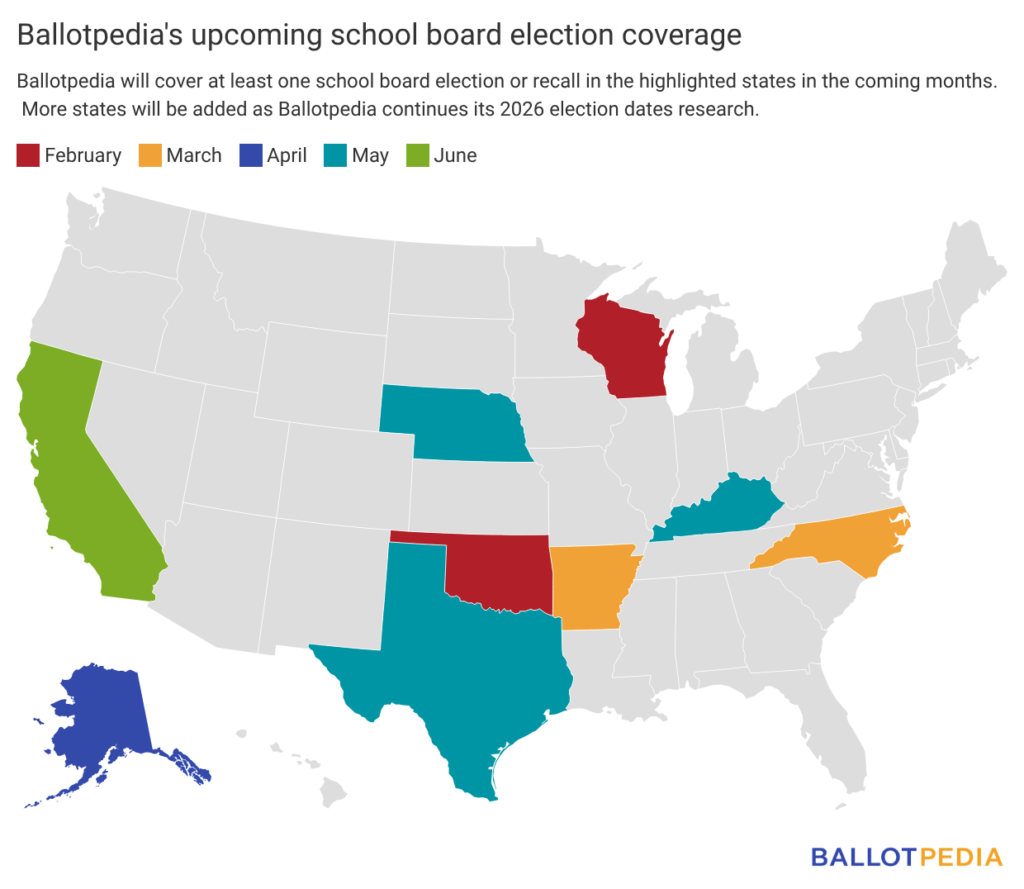
In 2026, Ballotpedia will cover elections for more than 30,000 school board seats. We’re expanding our coverage each year with our eye on covering the country’s more than 80,000 school board seats.
Below is a look at the upcoming elections in the first part of this year.
Upcoming school board elections
Wisconsin
On Feb. 17, voters in 17 districts will decide school board primaries. Eighty-three candidates are running.
Ballotpedia is covering all school board elections in Wisconsin this year. In Wisconsin, school board primaries are only held if there are more than two candidates running for a single seat or if the number of candidates running in multi-seat races is more than twice the number of seats up for election.
If those criteria are not met, the primary is canceled and candidates automatically advance to a general election on April 7.
Click here to learn more about 2026 school board elections.
A look at some of the K-12 education-related ballot measures voters could decide in 2026
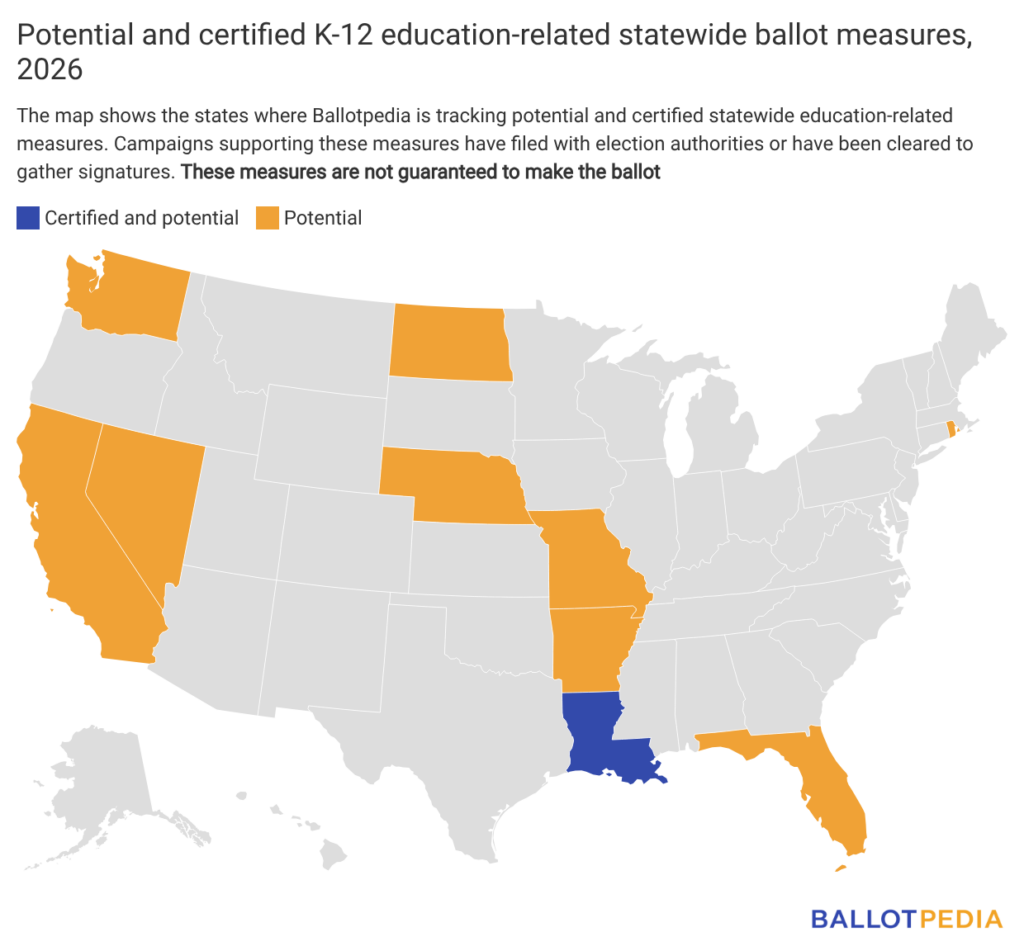
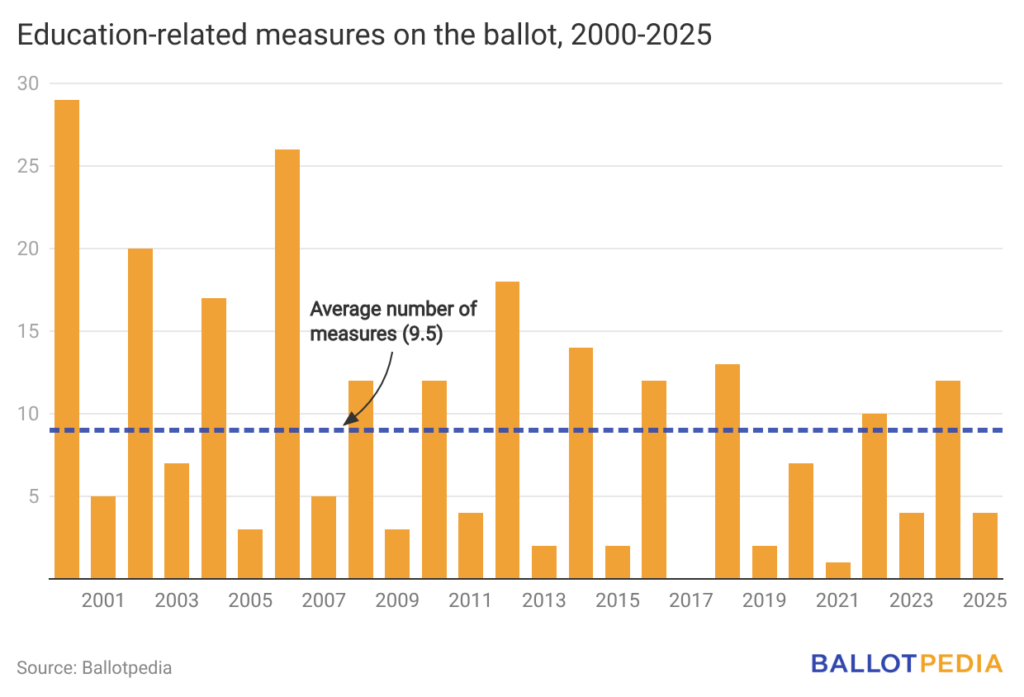
Voters this year will decide a bevy of statewide ballot measures, at least one of which will directly address K-12 education. Currently, Ballotpedia is following 14 potential education-related measures and one that is certified for the November ballot.
We could still see more potential education-related measures cleared to gather signatures in the coming months. Campaigns are still collecting signatures to place their respective measures on the ballot, and there’s no guarantee they will succeed.
The measures touch on some of the biggest concerns around K-12 education today. They address funding, school choice, religion, teacher pay, school meals, transgender participation in sports, and more.
Here’s a look at some of the education-related measures that could make the ballot (so far!). Click here to see the full list.
Private school choice
Voters in Arkansas and Missouri could decide measures addressing private school choice.
These programs, which proponents say give students a chance to find schools that fit their needs, differ in their particulars but generally give families government money for private school tuition, tutoring services, and sometimes homeschooling expenses. Critics say the programs disproportionately benefit wealthier families and drain funding from public schools.
Since 2022, 18 states have enacted or expanded programs to cover all students, without regard for family income, or would eventually do so.
In Arkansas, the For AR Kids campaign is collecting signatures for the Establish Educational Standards for Schools Receiving Public Funding Initiative, which would, among other things, require identical academic and accreditation standards for all schools receiving state or local funding, including private schools that receive such funding.
Arkansas enacted the Children’s Educational Freedom Account Program in 2023. The program, open to all students, provides participants with roughly $7,000 for educational expenses outside the public school system.
For AR Kids is a coalition of groups that includes the Arkansas Education Association (AEA). The AEA is the state-level affiliate of the National Education Association (NEA), the country’s largest teachers union. The AEA opposed the Children’s Educational Freedom Account Program.
The campaign has until July 3 to collect 90,704 valid signatures.
In Missouri, attorney Duane Martin filed the Prohibit Public Funding of Nonpublic Schools Amendment. The measure would amend the state constitution to say “No person or organization shall receive public aid, directly or indirectly, for educational services provided by a nonpublic school.” The measure allows exceptions for students with disabilities.
In 2021, Missouri enacted the MOScholars program, which provides tax credits for donations to scholarship-granting organizations. Those organizations then provide scholarships for private educational expenses to low-income students and those with Individualized Education Plans (IEPs). In 2024, Gov. Mike Parson (R) signed legislation increasing the program’s funding cap.
The smallest possible requirement to place the Prohibit Public Funding of Nonpublic Schools Amendment on the ballot is 170,215 valid signatures. The actual requirement depends on the congressional districts in which signatures are collected. The deadline to submit signatures is May 3.
Private school choice programs have been on the ballot in the past. Voters in Nebraska (1972), Michigan (2000), California (2000), Utah (2007), Arizona (2018), Colorado (2024), Kentucky (2024), Nebraska (2024) and elsewhere have defeated private school choice measures.
Funding
In California, the California Teachers Association (CTA), the state’s largest teachers union, is leading the campaign to place the Renew State Income Tax Increase for Education Funding Initiative on the ballot.
The initiative would indefinitely extend the additional income tax enacted with the approval of Proposition 30 in 2012 that helps fund education and early childhood programs. Proposition 30 created four new income tax brackets and tax rates for incomes exceeding $250,000, $300,000, $500,000 and $1,000,000 (for single payers) for seven years and raised the state’s sales tax for four years. In 2016, voters approved an extension of Proposition 38’s income tax provisions through 2030.
The income tax provisions have brought in roughly $10 billion on average each year.
Right to public education
Campaigns in Missouri and Rhode Island are collecting signatures for measures that would amend their respective state constitutions to affirm a right to public education.
In Missouri, entrepreneur Spencer Toder’s petition would amend the constitution to say that education is a fundamental right, and that it is the duty of the state to establish and maintain adequate, thorough, and uniform high quality free public schools.
Toder said the petition was not aimed at the MOScholars program, the state’s private school choice program: “It is to ensure that no matter if vouchers exist, it doesn’t come at the expense of public school students’ quality of education.”
Like the Prohibit Public Funding of Nonpublic Schools Amendment, Toder’s campaign has until May 3 to submit signatures.
In Rhode Island, state Sen. Jonathon Acosta (D-16) introduced the Right to Public Education Amendment as SJR 177 in 2025. A simple majority vote is required during one legislative session for the Rhode Island Legislature to place a constitutional amendment on the ballot.
SJR 177 would, among other things, require the General Assembly and the state government to "guarantee an equitable, adequate and meaningful education for each child." On April 8, 2025, the state Senate approved the amendment 35-0, with three senators absent or not voting. SJR 177 was then referred to the House State Government & Elections committee, where it now sits.
Teacher pay
In Nebraska, Advocates for All Nebraskans is collecting signatures for the Minimum Base Salary for Certified Public School Teachers Initiative, which would establish a minimum base salary of $50,000 for certified public school teachers beginning with the 2027-2028 school year.
According to the NEA, the starting salary for teachers in Nebraska was $38,811 in 2025.
The campaign has until July 3 to submit signatures equal to 7% of registered voters at the time of the petition filing deadline (signatures must also come from at least 5% of the registered voters in 38 of Nebraska's 93 counties).
Transgender participation in sports
In Washington, Let's Go Washington submitted 445,187 signatures on Jan. 2 for L26-638, an Initiative to the Legislature that would prohibit students the measure “defines as ‘biologically male’ from competing in certain school athletic activities intended for female students only.” It would also require student athletes’ healthcare providers to verify their sex by "relying only on one or more of the following: The student's reproductive anatomy, genetic makeup, or normal endogenously produced testosterone levels."
On Jan. 22, Secretary of State Steve Hobbs (D) announced that a sufficient number of signatures were deemed valid after examining a 3% random sample of the submitted signatures.
Click here to read our January deep dive into L26-638.
An Initiative to the Legislature is a type of indirect initiated state statute where, if enough valid signatures are gathered, the state legislature can choose to: 1) adopt the initiative as written; 2) reject or not act on the initiative, thereby placing it on the ballot for voter approval; or 3) approve an alternative to the proposed initiative, in which case both the original proposal and the legislative alternative are placed on the ballot.
In Nevada, the Protect Girls Sports Nevada PAC is collecting signatures for the Biological Sex Requirements for School Sports Programs Amendment. Nevada Gov. Joe Lombardo (R) serves on the board of the PAC.
The amendment would require that eligibility for sports or athletic competitions in public schools and colleges is based upon the sex of the athlete recorded at birth rather than gender identity or gender expression, and that males are not permitted to participate in a sport or competition designated for females.
The campaign has until June 24 to submit 148,789 valid signatures.
Extracurricular: education news from around the web
This section contains links to recent education-related articles from around the internet. If you know of a story we should be reading, reply to this email to share it with us!
- Kindergarten readiness varies widely by income, new data shows. Cities are stepping in to help | Associated Press
- State lawmakers introduce Chicago Teachers Union-backed bills to increase state education funding | Chalkbeat Chicago
- California’s public school funding should be based on students actually enrolled | Reason Foundation
- Oklahoma rejects application for Jewish public charter school | K-12 Dive
Take our Candidate Connection survey to reach voters in your district
Last week, we looked at survey responses from two of the 10 candidates running in the March 3 Republican primary to represent District 2 on the Winston-Salem Forsyth County Schools school board, in North Carolina.
Today, we’re looking at survey responses from candidates running on the other side of the aisle. Frank James and Linda Winikoff are two of 10 candidates running in the March 3 Democratic primary for three at-large seats on the Winston-Salem Forsyth County Schools school board. Incumbent Richard Watts is also running in the primary.
The general election is Nov. 3.
Winston-Salem/Forsyth County Schools is the fourth largest district in the state, with approximately 52,100 students. North Carolina is one of five states where, depending on the district, candidates run in partisan or nonpartisan elections.
James earned a bachelor's degree from Swarthmore College in 1992 and a graduate degree from Wake Forest University in 2001. His career experience includes working as a teacher. Here’s an excerpt from his answer to the question, “What are the main points you want voters to remember about your goals for your time in office?”

“As an educator, I have seen firsthand how a small number of chronic disruptions can derail instruction for an entire class. When learning environments are not protected, students disengage, teachers burn out, and families lose confidence in the school system. That is not fair to students who come to school ready to learn, nor to the educators tasked with teaching them.As a member of the Board of Education, I will advocate for policies that prioritize instructional time, support teachers when they address disruptive behavior, and ensure that discipline practices are both fair and effective. Accountability and compassion are not opposites, and both are necessary for a safe, orderly environment where learning can thrive.”
Click here to read the rest of James’ answer to this question, along with his other responses.
Winikoff earned a bachelor's degree from Duke University and a graduate degree and Ph.D. from the University of Pittsburgh. Her career experience includes working as an educator. Here’s an excerpt from Winikoff’s answer to the question, “What are the main points you want voters to remember about your goals for your time in office?”

“I hold a Ph.D. and M.Ed. from the University of Pittsburgh and a bachelor’s degree from Duke University. I have spent my career teaching in public schools and university laboratory settings, working directly with students across a wide range of learning environments.One of the most impactful chapters of my career was teaching for 14 years in a public school where nearly all students qualified for free or reduced lunch. That experience gave me a clear understanding of how poverty, access to resources, and policy decisions affect student outcomes—and why one-size-fits-all approaches don’t work. There are solutions. We need the vision and will to look for and apply them. I can provide that leadership. Our entire community depends on it.”
As a reminder, if you're a school board candidate or incumbent planning to run this year, click here to take the survey. If you complete the survey, your answers will appear in your Ballotpedia profile. Your responses will also appear in our sample ballot. If there is an election in your community, share the link with your candidates and urge them to take the survey!