


Welcome to the Feb. 16 edition of Robe & Gavel, Ballotpedia’s newsletter about the Supreme Court of the United States (SCOTUS) and other judicial happenings around the U.S.
“I hold that while man exists, it is his duty to improve not only his own condition, but to assist in ameliorating mankind.”
-Abraham Lincoln
Follow Ballotpedia on X and Bluesky or subscribe to the Daily Brew for the latest news and analysis.
We #SCOTUS and you can, too!
Grants
SCOTUS has accepted six new cases to its merits docket since our Jan. 19 edition. To date, the court has agreed to hear 60 cases for the 2025-2026 term. SCOTUS dismissed one case after accepting it. Ten cases have yet to be scheduled for arguments.
Click the links below to learn more about these cases:
- Hikma Pharmaceuticals USA Inc. v. Amarin Pharma, Inc. originated from the U.S. Court of Appeals for the Federal Circuit.
- Monsanto Company v. Durnell originated from the Missouri Court of Appeals.
- Chatrie v. United States originated from the U.S. Court of Appeals for the Fourth Circuit.
- Anderson v. Intel Corporation Investment Policy Committee originated from the U.S. Court of Appeals for the Ninth Circuit.
- Klein v. Martin originated from the U.S. Court of Appeals for the Fourth Circuit.
- Salazar v. Paramount Global originated from the U.S. Court of Appeals for the Sixth Circuit.
Arguments
The Supreme Court will not hear any arguments this week. Click here to read more about SCOTUS' current term.
Click the links below to learn more about these cases:
In its October 2024 term, SCOTUS heard arguments in 65 cases. Click here to read more about SCOTUS's previous term.
Opinions
SCOTUS has ruled on four cases since our Jan. 19 edition. The court has issued rulings in 11 cases so far this term. Fifty-three cases are still under deliberation. SCOTUS had released seven opinions at this point in its 2024-2025 term.
Click the links below to read more about the specific cases SCOTUS ruled on since Jan. 19:
Jan. 20
Coney Island Auto Parts Unlimited, Inc. v. Burton was argued before the court on Nov. 4, 2025.
The case concerns Federal Rule of Civil Procedure 60(c)(1).
The outcome: In a 9-0 opinion, the Court affirmed the judgment of the U.S. Court of Appeals for the Sixth Circuit. The Supreme Court held that litigants seeking relief under Rule 60(b)(4) have to comply with Rule 60(c)(1) and file a motion within a reasonable time. Because Coney Island Auto Parts Unlimited, Inc. did not argue that it complied with this requirement, the Court concluded that SCOTUS does not need to discuss whether its timing was reasonable.
Ellingburg v. United States was argued before the court on Oct. 14, 2025.
The case concerns the Mandatory Victim Restitution Act.
The outcome: In a 9-0 opinion, the Court reversed and remanded the judgment of the U.S. Court of Appeals for the Eighth Circuit, holding that restitution under the Mandatory Victim Restitution Act is plainly criminal punishment for the purposes of the Ex Post Facto Clause.
Berk v. Choy was argued before the court on Oct. 6, 2025.
The case concerns whether an affidavit of merit (AOM) is required to bring a complaint of medical malpractice against a practitioner, according to Delaware state law.
The outcome: Delaware law states that a plaintiff cannot sue for medical malpractice unless an affidavit of merit “accompanie[s]” the complaint. The affidavit must state that there are “reasonable grounds to believe that there has been health-care medical negligence committed by each defendant,” and it must be signed by a medical professional. In a 9-0 opinion, the court reversed and remanded the judgment of the U.S. Court of Appeals for the Third Circuit, holding that Delaware’s affidavit law does not apply in federal court.
Jan. 26
Klein v. Martin was decided without argument.
The case concerns the Antiterrorism and Effective Death Penalty Act of 1996 (AEDPA).
The outcome: In an 8-1 per curiam opinion, SCOTUS reversed and remanded the decision of the U.S. Court of Appeals for the Fourth Circuit.
The Federal Vacancy Count
The Federal Vacancy Count tracks vacancies, nominations, and confirmations to all U.S. Article III federal courts in a one-month period. This month’s edition includes nominations, confirmations, and vacancies from Jan. 2 to Feb. 1.
Highlights
- Vacancies: There were two new judicial vacancies since the Jan. 1 report. There are 41 vacancies out of 870 active Article III judicial positions on courts covered in this report. Including the U.S. Court of Federal Claims and the U.S. territorial courts, 42 of 890 active federal judicial positions are vacant.
- Nominations: There were four new nominations since the Jan. 1 report.
- Confirmations: There was one new confirmation since the Jan. 1 report.
Vacancy count for Feb. 1, 2026
A breakdown of the vacancies at each level can be found in the table below. For a more detailed look at the vacancies in the federal courts, click here.
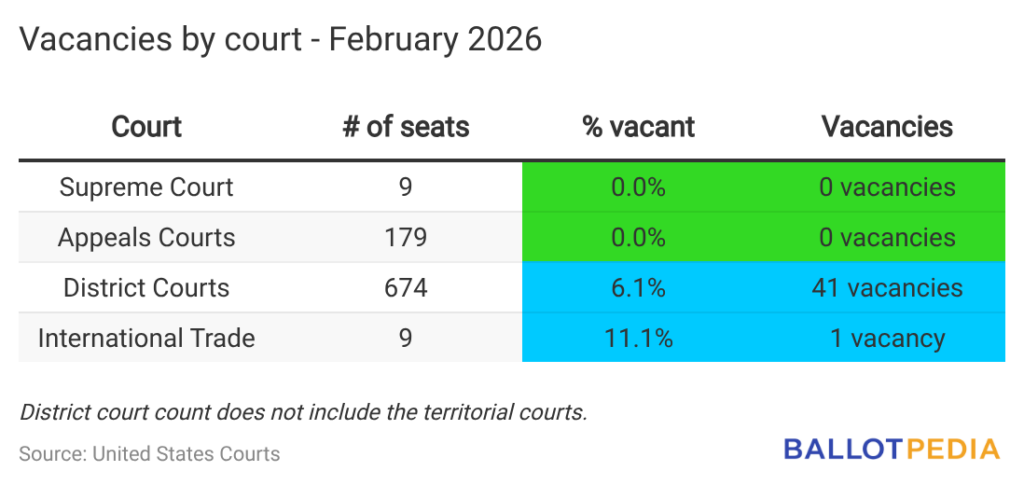
*Though the U.S. territorial courts are named as district courts, they are not Article III courts. They are created in accordance with the power granted under Article IV of the U.S. Constitution. Click here for more information.
New vacancies
Two judges have left active status since the previous vacancy count, creating Article III life-term judicial vacancies. The president nominates individuals to fill Article III judicial position vacancies. Nominations are subject to U.S. Senate confirmation.
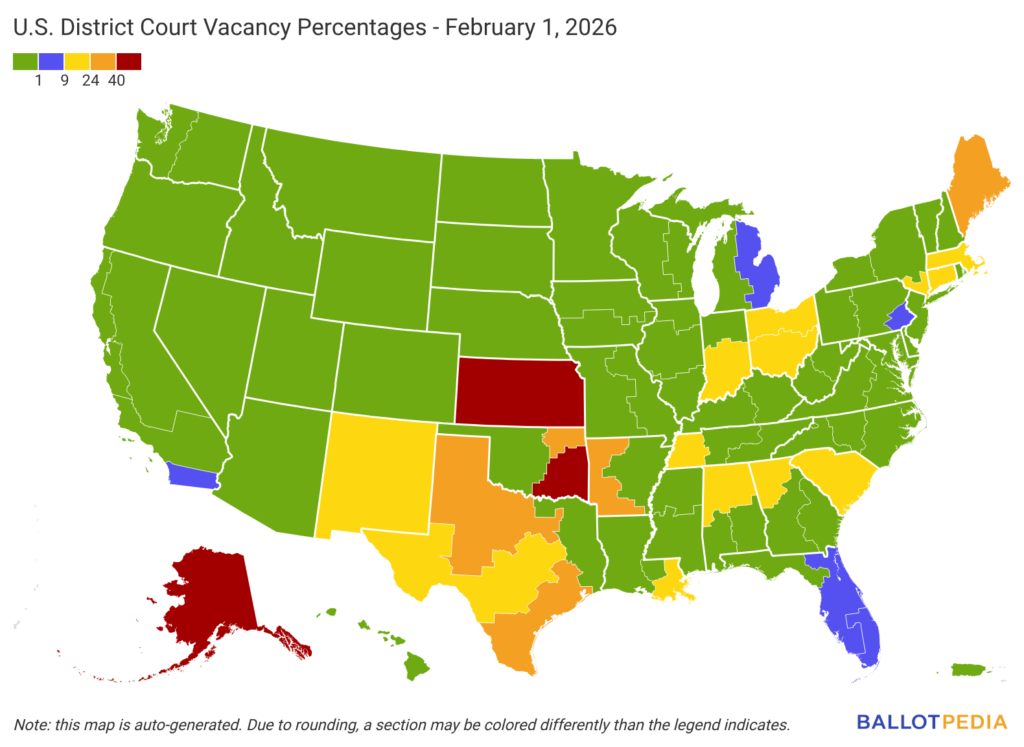
- Judge James O. Browning assumed senior status on the U.S. District Court for the District of New Mexico.
- Judge Ronald White assumed senior status on the U.S. District Court for the Eastern District of Oklahoma.
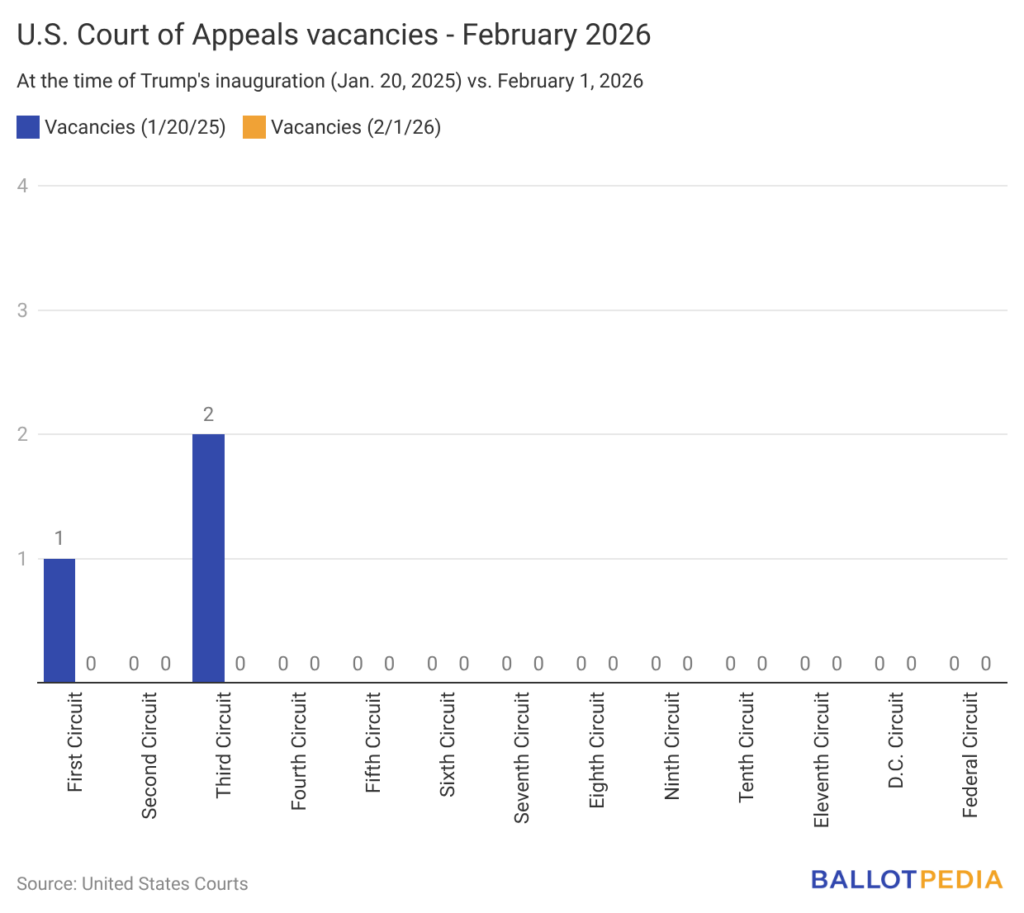
The following chart tracks the number of vacancies in the U.S. Courts of Appeals from President Donald Trump's (R) inauguration to the date indicated on the chart.
U.S. District Court vacancies
The following map shows the number of vacancies in the U.S. District Courts as of Feb. 1.
New nominations
President Trump announced four new nominations since the Jan. 1 report:
- Anna St. John, to the U.S. District Court for the Eastern District of Louisiana
- Chris Wolfe, to the U.S. District Court for the Western District of Texas
- Andrew Davis, to the U.S. District Court for the Western District of Texas
- John Shepherd, to the U.S. District Court for the Western District of Arkansas
The president has announced 39 Article III judicial nominations since taking office on Jan. 20, 2025. For more information on the president’s judicial nominees, click here.
New confirmations
As of Feb. 1, the Senate has confirmed 27 of President Trump’s judicial nominees—Twenty-one district court judges and six appeals court judges—since January 2025
Comparison of Article III judicial appointments over time by president (1981-Present)
- Presidents have made an average of 34 judicial appointments through February 1 of their second year in office. President Barack Obama (D) had the most appointees confirmed with 46, and President George W. Bush (R) had the fewest confirmations with 23.
- President Bill Clinton (D) made the most appointments through four years with 174. President W. Bush made the fewest through four years with 122.
- President Obama made the most appointments through two years with 134. President W. Bush made the fewest with 54.
- President Obama made the most appointments through one year in office with 45. President W. Bush made the fewest with 22.
Need a daily fix of judicial nomination, confirmation, and vacancy information? Click here for continuing updates on the status of all federal judicial nominees.
Or, keep an eye on this list for updates on federal judicial nominations.
Looking ahead
We’ll be back on Feb. 23 with a new edition of Robe & Gavel. Until then, gaveling out!
Contributions
Myj Saintyl compiled and edited this newsletter, with contributions from Sam Post and Ellie Mikus.