


Welcome to the Tuesday, Feb. 17, 2026, Brew.
By: Lara Bonatesta
Here’s what’s in store for you as you start your day:
- Nebraska Legislature alters 2022 minimum wage initiative, the second time the Legislature has altered an initiative in two years
- Arizona moves its primary from August to July
- A comprehensive look at 161 years of ballot measures in Nevada
Nebraska Legislature alters 2022 minimum wage initiative, the second time the Legislature has altered an initiative in two years
On Feb. 10, Gov. Jim Pillen (R) signed Legislative Bill 258 (LB 258), enacting changes the Legislature made to a 2022 minimum wage initiative. This is the second year in a row that the Legislature has altered voter-approved ballot measures.
Nebraska Initiative 433 and 2026 alteration
Nebraska voters approved the minimum wage initiative, known as Initiative 433, 59% to 41% in 2022. The initiative incrementally increased the state’s minimum wage from $9 to $15 between 2023 and 2026. In 2027 and beyond, the minimum wage would have been adjusted annually to reflect increases in the Consumer Price Index for All Urban Consumers (CPI-U) for the Midwest Region.
LB 258 removed the CPI increase and replaced it with an annual increase of 1.75%. The bill also authorized employers to pay employees between the ages of 14 and 16 a minimum wage of $13.50, adjusted annually by 1.5%.
A two-thirds supermajority vote in Nebraska’s unicameral Legislature is required to alter or repeal an initiated state statute. This amounts to 33 votes in the 49-member Nebraska Senate. The Legislature passed LB 258 in a 33-16 party-line vote. The Republican majority supported the bill, and the two nonpartisan members joined the Democratic opposition. (There are no formal party alignments or groups within the Nebraska Senate. Click here to learn how we determined the partisan affiliation for Nebraska senators.) The law goes into effect in July, three months after the session adjourns.
Legislative alteration context
In 2025, Nebraska legislators also amended a 2024 initiative that required Nebraska businesses to offer earned paid sick leave. The alteration excluded individual owner-operators, independent contractors, individuals working fewer than 80 hours in one calendar year, agricultural seasonal workers, workers under the age of 16, and employees subject to the federal Railroad Unemployment Insurance Act from the list of employees eligible for paid sick leave. The bill passed 33-16.
Before 2025, the last time the Nebraska Legislature altered or repealed an initiative was in 2007, when lawmakers repealed a 2004 initiative that established a gambling tax. Voters approved the initiative 51% to 49%.
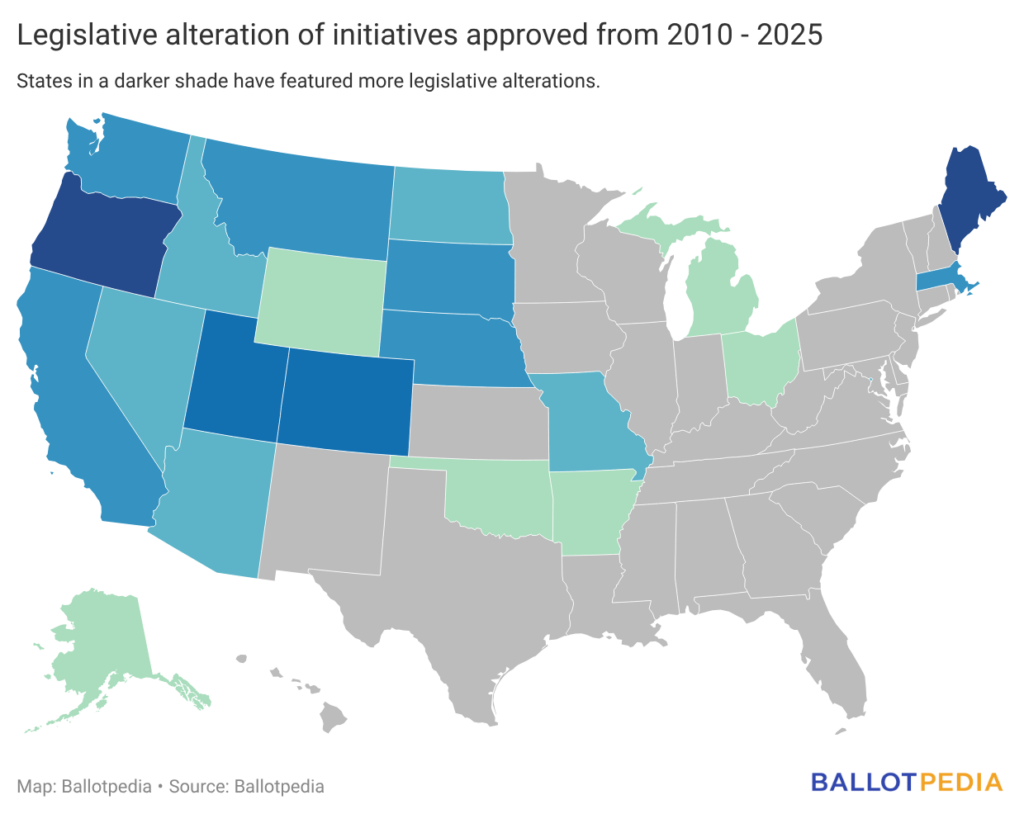
Since 2010, voters approved 282 initiated state statutes nationwide, and five initiated ordinances in D.C. Thirty-three of these measures were legislatively altered. The states with the most legislative alterations are Oregon and Maine, with four each. Among initiatives approved from 2010 through 2024, marijuana was the topic that drew the most legislative alterations, with eight.
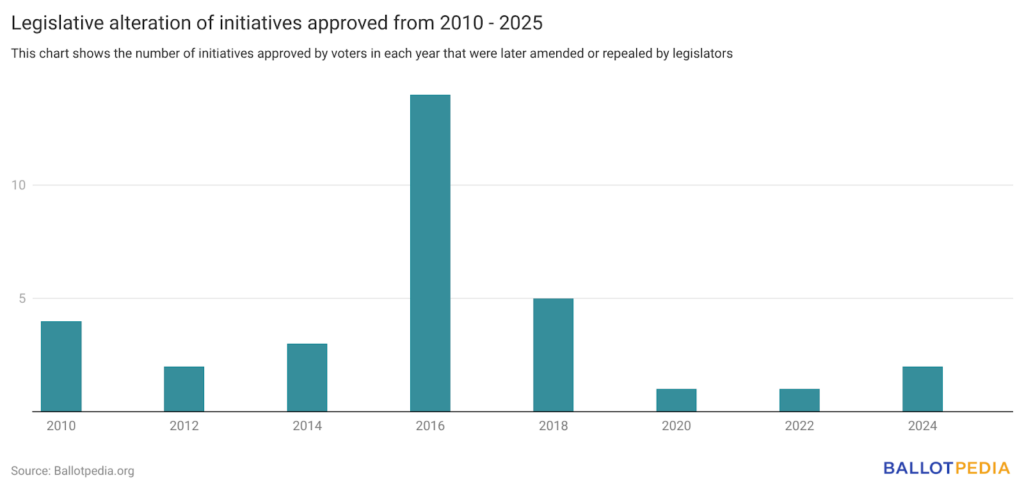
The year with the most initiatives that were later amended or repealed was 2016. Click here to see a list of altered measures by year and state.
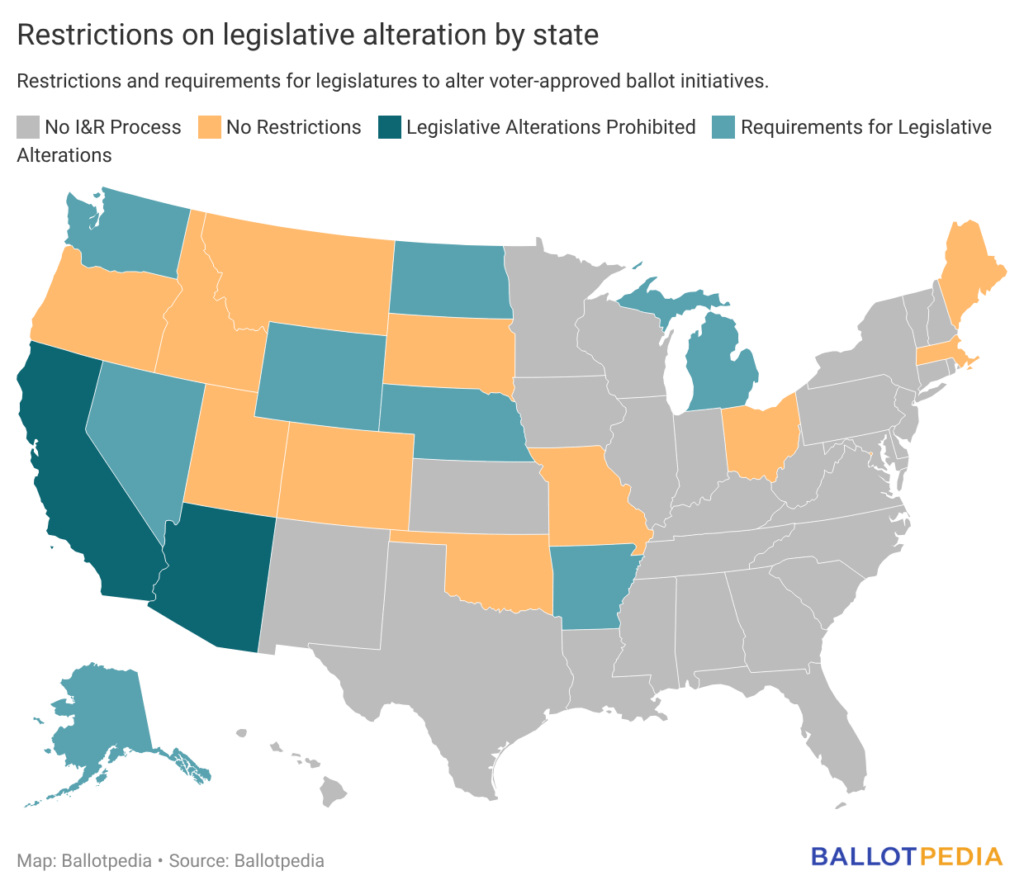
Twenty-one states have initiated state statutes. Eleven of these states have no restrictions on legislative alteration. Arizona and California require voter approval of substantive alteration. The remaining eight states have either time restrictions, supermajority vote requirements, or a combination of the two.
Minimum wage context
From 1996 to 2025, there were 32 ballot measures to increase state minimum wages. Voters approved 28 and rejected four. In 2024, California and Massachusetts became the first states to reject minimum wage increase ballot measures since 1996. The other two defeated measures were on the ballot in 1996 in Missouri and Montana.
Since 2010, three state minimum wage ballot measures, including the one in Nebraska, were legislatively altered. In 2013, the Arizona Legislature amended a 2006 initiative. In 2017, the Maine Legislature amended a 2016 initiative. The D.C. City Council also altered two minimum wage initiatives during this time period. In 2018, the Council repealed an initiative that voters approved earlier that year. In 2025, the Council amended a measure that voters approved in 2022.
Click here to learn more about minimum wage ballot measures and here to learn more about the Nebraska Legislature’s alteration of Initiative 433.
To learn more about legislative alternation, click here and here.
Arizona moves its primary from August to July
On Feb. 6, Arizona Gov. Katie Hobbs (D) signed HB 2022, a bill that moves Arizona’s primary election from the first Tuesday in August to the second-to-last Tuesday in July, starting this year. As a result, Arizona’s 2026 primary will be held on July 21 instead of Aug. 4.
The Arizona House approved HB 2022 unanimously, and the state Senate approved it 27-1.
A statement from the Arizona Senate Republicans said the move was needed to address timing conflicts affecting military and overseas voters, giving them more time to return their ballots before the general election.
The legislation allows signatures gathered on petition forms with the old primary date to be valid. It also:
- Changes the time for officials to compare a provisional ballot with a list of early voters from five business days to five calendar days.
- Changes the time for officials to compare a provisional ballot with the polling place roster from 10 calendar days to seven calendar days.
- Allows county party chairs to appoint election observers for ballot replacement locations.
- Allows county party chairs to appoint challengers at polling places and early-voting centers.
This is the second time in recent years that Arizona has moved its primary election date. In 2024, Hobbs signed a law moving up that year’s primary by a week to July 30.
In 2025, 23 states enacted 49 laws on election dates. Arkansas, Louisiana, and Mississippi passed legislation adjusting their primary election dates for at least some elections. In 2024, 18 states, including Arizona, passed 33 laws on election dates.
So far this year, legislators in 32 states have introduced or carried over from the 2025 session 147 bills that would adjust election dates. Sixteen of those bills have passed at least one state legislative chamber, including SB 8604 in New York, which changes the date of the state’s presidential primary.
Click here to learn more about 2026 election dates.
A comprehensive look at 161 years of ballot measures in Nevada
Ballotpedia's Historical Ballot Measure Factbook will document nearly 200 years of direct democracy in the United States. This ongoing research effort will provide an unparalleled resource for researchers, reporters, and the public on how ballot measures have evolved, the issues they have covered, and their role in our civic life.
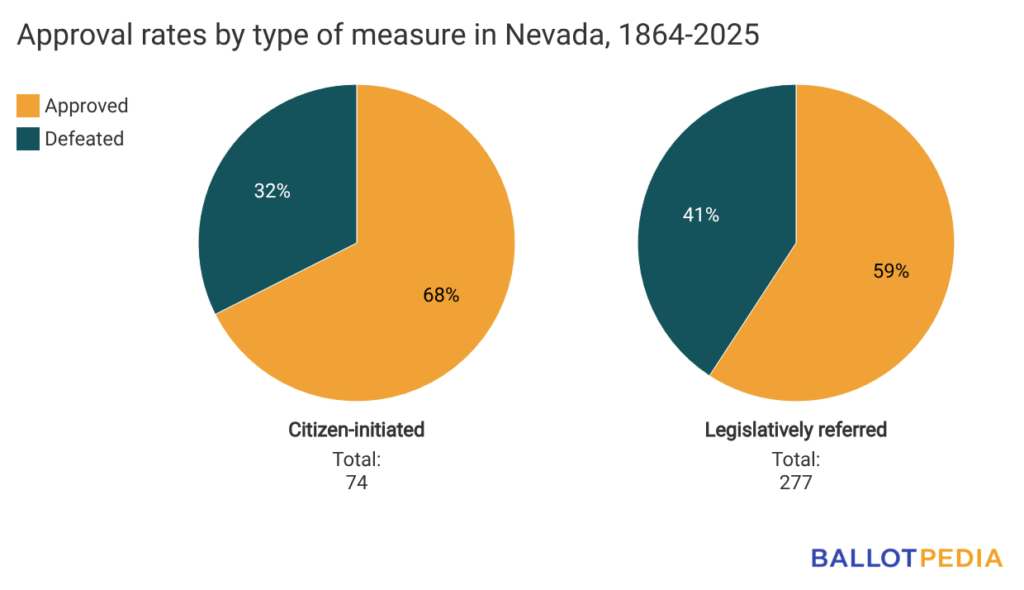
Today, let’s look at historical ballot measures in Nevada. Our comprehensive inventory of Nevada ballot measures spans from 1864 to 2025. In that time, Nevada voters approved 215 measures and defeated 138 — a 60.9% approval rate.
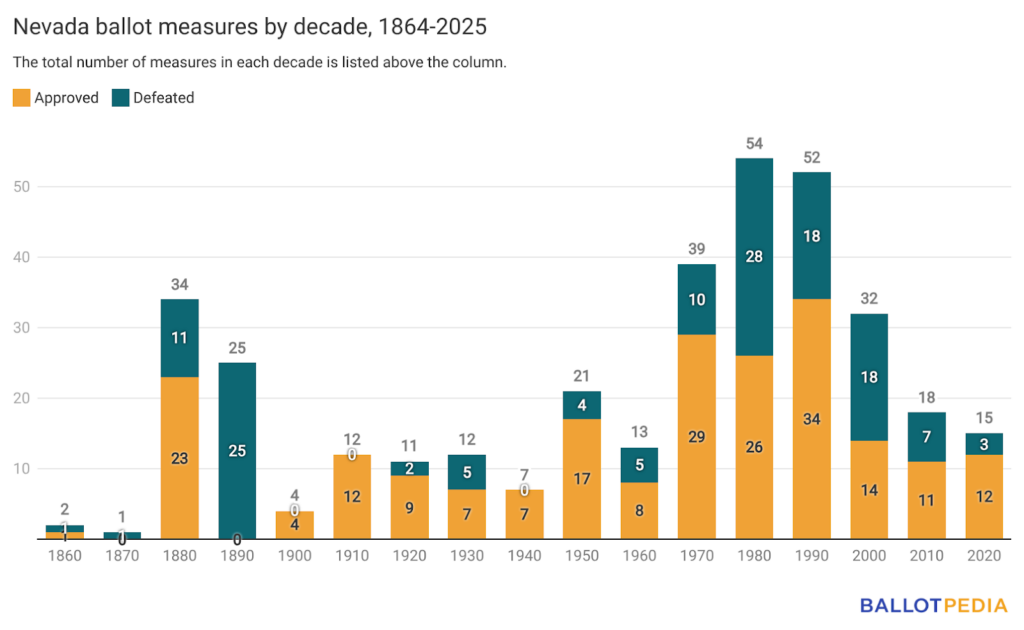
In Nevada, the Legislature can refer measures to the ballot, or citizens can do so through a citizen initiative. The Legislature put 277 measures on the ballot, and there were 74 citizen initiatives. Voters approved 164 (59.2%) of the measures the Legislature put on the ballot and defeated 113. Voters approved 50 (67.6%) citizen initiatives and defeated 24.
Additionally, two state constitution ratification questions were referred to voters from two state constitutional conventions—one in 1863, and one in 1864. In January 1864, voters rejected the proposed 1863 constitution, and in September 1864, voters approved the constitution proposed at the 1864 convention.
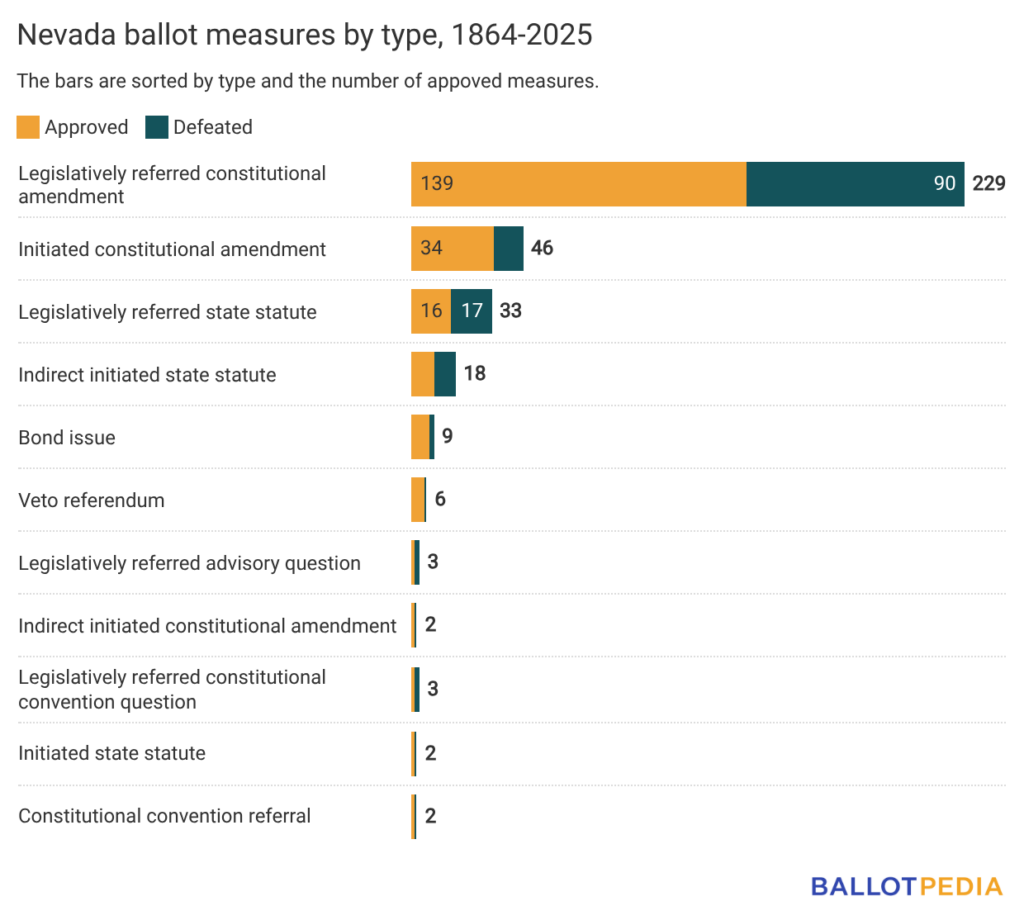
There are 11 different types of ballot measures in Nevada. Legislatively referred constitutional amendments appeared on the ballot the most (229 times). Veto referendums had the highest approval rating, with voters approving five of six (83.3%) referendums. Constitutional convention questions had the lowest success rate, with two out of three measures defeated.
Nevada ballot measures addressed 122 unique topics. The most common topic was state legislative authority (56 measures). Other common topics included sales taxes (36 measures), state legislative processes and sessions (24 measures), and property taxes (17 measures).
Below is a selection of notable and unique ballot measures in Nevada’s history. For a more detailed list, see here.
- In 1912, voters approved a constitutional amendment to establish an initiative and referendum process.
- In 1914, voters approved a constitutional amendment to provide women with the right to vote—six years before the 19th Amendment was ratified.
- In 1988 and 1990, voters approved an initiated constitutional amendment to prohibit a state tax on personal income.
- Voters decided on five marijuana-related ballot measures. In 1998 and 2000, voters approved an initiated constitutional amendment legalizing medical marijuana. In 2002 and 2006, voters rejected ballot initiatives to decriminalize or legalize marijuana. In 2016, voters approved a ballot initiative legalizing recreational marijuana in the state.
- In 2020, voters approved Question 2, making Nevada the first state to repeal a constitutional same-sex marriage ban. Earlier, in 2000 and 2002, voters approved a citizen initiative constitutional amendment to define marriage as between one man and one woman.
Of the 353 measures in Nevada, five were decided by less than one percentage point. The measure with the smallest margin was State Question 2 in 1930. It would have created a state rabies commission to control rabies and predatory animals. The measure was defeated 50.04%-49.96%, a margin of 0.08 percentage points.
The measure with the largest margin was State Question 4 in 1880, which was an advisory question asking voters if they supported continuing to permit Chinese immigration. The measure was defeated, 98.95%- 1.05%, a margin of 97.9 percentage points.Click here to see our comprehensive coverage of Nevada ballot measures, and here to find a list of our other completed factbooks.