Highlights from this edition of Checks and Balances include a bill barring political appointees from serving as inspectors general, and disparate state bills affecting their relationship with ICE
In Washington
Bill barring political appointees from serving as inspectors general introduced in Senate
On Jan. 15 Sen. Tammy Duckworth (D) and four other Democratic senators introduced S 3687, a bill that would prohibit current or former politically appointed officials from being appointed an agency inspector general by the same president. In 2025, President Trump (R) dismissed 19 inspectors general, and appointed six former Trump administration officials to inspector general positions.
The Senate bill’s proposed ban includes currently-serving political appointees, as well as anyone who “has previously served as a political appointee under such President.” The bill makes an exception for someone who served in a different inspector general position (which is considered a political appointment).
Duckworth said that “inspectors general are supposed to be calling balls and strikes and be independent and say, 'Hey, you can't do that,' but if you put a political appointee in that position they are going to lean in favor of who put them there." She specifically criticized the appointment of Department of Veterans’ Affairs Inspector General Cheryl Mason, who was serving as a senior advisor to Veterans Affairs Secretary Doug Collins when she was appointed. Mason said in her June 4 Senate confirmation hearing that "I consider myself to be an impartial, independent aid to the department because that's my role… I am loyal to the veterans. That's who I am loyal to."
Inspectors general and the Trump administration
On Jan. 24, 2025 President Trump dismissed 17 inspectors general, including those for the Department of Defense, the State Department, and the Department of Housing and Urban Development. Eight of these officials sued to challenge their dismissal, leading to a Sept. 24 U.S. district court ruling that the dismissals violated the 1978 Inspector General Act because they did not involve a 30-day notice to Congress. The court did not reinstate the officials, stating that Trump could dismiss them again after providing appropriate notice to Congress.
Trump also dismissed the inspector general of the U.S. Agency for International Development on Feb. 11, and the inspector general of the Export-Import Bank on Oct. 15. In addition, Trump has dismissed at least five acting inspectors general since taking office, including those of the Departments of Justice, Commerce, and Housing and Urban Development.
Senator Chuck Grassley (R) criticized the dismissal of Export-Import Bank Inspector General Parisa Salehi, writing on X that Trump “hasnt told Congress he was firing the Ex-Im Inspector General The law says POTUS has to specifically inform Congress abt IG firings and unless the courts say otherwise thats still the law.” White House representative Kush Desai said that “The administration remains committed to finding the best, most qualified individuals who are aligned with the president’s vision to make America great again.”
The Senate has confirmed at least eight Trump administration nominees to inspector general positions as of Feb. 11. Six of these nominees had served as politically appointed officials in the first or second Trump administration. Inspectors General Chris Fox of the Intelligence Community, Cheryl Mason of the Department of Veterans’ Affairs, John Walk of the Department of Agriculture, Thomas Bell of the Department of Health and Human Services, and Platte Moring of the Department of Defense had each served as appointed officials in the departments they oversee. Small Business Administration Inspector General William Kirk served as an official in the Department of Education in the first Trump administration.
What do inspectors general do?
The Inspector General Act of 1978 created the first 12 statutory inspector general positions. There are currently 72 members of the Council of the Inspectors General on Integrity and Efficiency (CIGIE). The 2008 Inspector General Reform Act created CIGIE, which is an organization of the statutory inspectors general. According to CIGIE, each inspector general office is “responsible for conducting audits and investigations relating to the programs and operations of its agency… and recommending policies… for the purpose of promoting economy, efficiency, and effectiveness,” as well as keeping “the agency head and the Congress ‘fully and currently informed’ about problems and deficiencies relating to the administration of agency programs and operations.” CIGIE also notes that “the IG Act contains a variety of statutory guarantees of Office of Inspector General (OIG) independence, designed to ensure the objectivity of OIG work to safeguard against efforts to compromise that objectivity or hinder OIG operations. It is these guarantees of independence that make statutory IGs unique.”
On Sept. 26, the Office of Management and Budget (OMB) informed CIGIE that it would not be apportioned operational funding for 2026. Senators Grassley Susan Collins (R) challenged this move, writing in a letter to the OMB that “effectively defunding CIGIE — contrary to congressional intent — will disrupt numerous important oversight functions, including the Oversight.gov website, whistleblower reporting portals and activities designed to ensure the inspectors general community is held accountable.” An OMB representative defended the move, saying that “inspectors general are meant to be impartial watchdogs identifying waste and corruption on behalf of the American people. Unfortunately, they have become corrupt, partisan and in some cases, have lied to the public.” On Nov. 18, the OMB partially reversed course, announcing that CIGIE would be funded through Jan. 30. On Dec. 17, a number of government oversight groups filed a lawsuit to stop the administration from defunding CIGIE after that date. This litigation is ongoing as of Feb. 11.
Want to learn more?
In the states
States consider disparate bills on their relationships with ICE
As the 2026 legislative session begins, at least 42 states are considering bills that would affect their relationships with Immigrations and Customs Enforcement (ICE), with some seeking to curtail ICE activities while others seek to deepen their cooperation with the agency. These bills come in the wake of a surge of deportations under the Trump administration, and a federal-level dispute over funding for the Department of Homeland Security, ICE’s parent department, after two US citizens were shot by ICE agents in Minnesota.
How many states are considering bills?
At least 42 states are or have considered bills affecting ICE in the 2026 legislative session. Twenty-nine states — California, Colorado, Connecticut, Delaware, Florida, Georgia, Hawaii, Illinois, Kansas, Maine, Maryland, Massachusetts, Michigan, Minnesota, Missouri, Montana, Nebraska, Nevada, New Hampshire, New Jersey, New Mexico, New York, Oregon, Rhode Island, Utah, Vermont, Virginia, Washington, and Wisconsin — are or have considered bills which would curtail ICE activities.
Eleven states — Alabama, Arizona, Idaho, Indiana, Iowa, Kentucky, Mississippi, Oklahoma, Pennsylvania, South Carolina, and West Virginia — are or have considered bills which support ICE activities. Ohio and Tennessee are both considering bills which would support ICE, as well as bills which would curtail the agency.
What would the state bills do?
Some major topics in bills that would curtail ICE include bans on wearing face masks, bans on ICE operations in the vicinity of particular geographic locations (such as schools, churches, or courthouses), and bills which would make it easier to sue the federal government in state courts. For example, Maryland’s SB 1 (which passed the Maryland Senate Feb. 3) would require the Maryland Police Training and Standards Commission to develop professional standards for law enforcement officers (including ICE officers) which bans them from wearing face-covering masks. California passed a similar bill (SB 627) in the 2025 session, which required most law enforcement agencies operating in the state to adopt policies prohibiting officers from wearing face coverings. On Feb. 9, a U.S. district court judge blocked the ban on the grounds that the bill discriminates against the federal government because it does not apply to state law enforcement officers. State Sen. Scott Wiener (D), who sponsored SB 627, said that he would introduce a new bill which removes this exception.
Bills that would support ICE are mainly focused on mandating that local law enforcement cooperate with ICE operations, including requirements that local law enforcement share information with ICE or enter into 287(g) agreements with the agency. Section 287(g) of the Illegal Immigration Reform and Immigrant Responsibility Act of 1996 provides a mechanism for local law enforcement agencies to enter into agreements with federal immigration officials, allowing local law enforcement to engage in immigration enforcement activities. For example, Oklahoma’s SB 2013 would require local law enforcement to enter into 287(g) agreements with ICE by Sept. 1, 2026, and to train at least 25% of officers to engage in immigration enforcement operations. As of Feb. 13, ICE has signed 1,415 of these 287(g) agreements with law enforcement agencies in 40 states.
Want to learn more?
- Immigration and Customs Enforcement
- Illegal Immigration Reform and Immigrant Responsibility Act of 1996
- Department of Homeland Security
- Federalism
Featured commentary
A Regulatory Review debate on the duty of reasoned decision-making. This month, the University of Pennsylvania Law School’s Regulatory Review published four opinion pieces debating the future of the duty of reasoned decision-making in administrative law. George Washington University Law School professor Richard J. Pierce, Jr. argues that courts should act to strengthen this standard. His GWU colleague Robert L. Glicksman argues that scholars should distinguish between substantive and procedural duties in agency decision-making. George Mason University Law School professor Eric R. Claeys argues that the 1983 case of Motor Vehicles Manufacturers Association v. State Farm, an important precedent for agency reasoned decision-making, should be overturned. Georgetown Law School professor William W. Buzbee argues that Roberts court decisions have been consistent with reasoned decision-making principles.
Regulatory highlight
Congressional Review Act
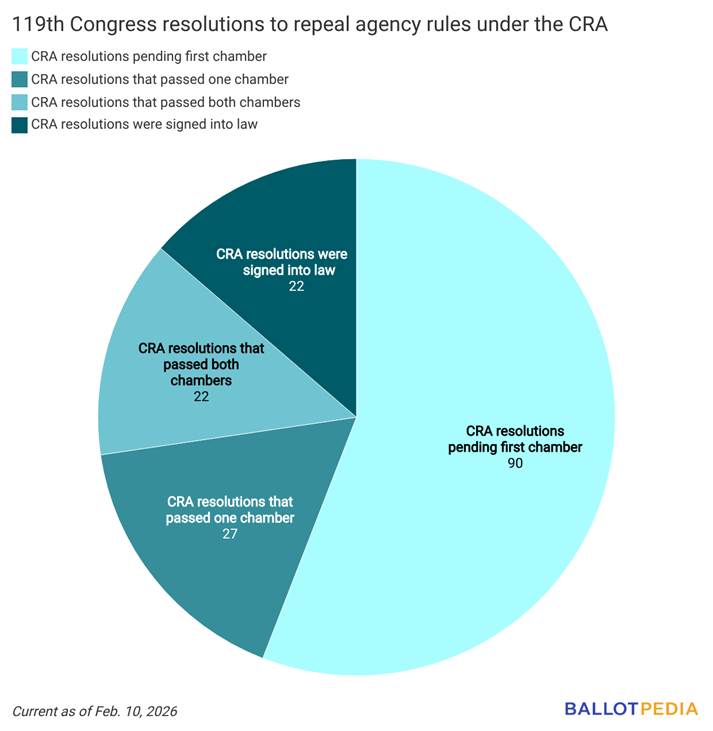
The Congressional Review Act (CRA) allows Congress to repeal rules with joint resolutions of disapproval. Congress repealed more regulations under the CRA in 2025 (22) than in any other year. In his two terms, President Trump has signed 38 of the 42 total CRA resolutions ever adopted.
The CRA defines a rule as “the whole or a part of an agency statement of general or particular applicability and future effect designed to implement, interpret, or prescribe law or policy.” Congress’s 60-day window to review a rule begins when an agency submits it for review, even if the agency action took place some time before this.
Congressmen have introduced 114 resolutions of disapproval so far this session.
Notable regulation
- The Office of Information and Regulatory Affairs (OIRA) completed its review of three State Department final rules that update award terms for foreign assistance grants to prohibit support and funding for abortion, social, psychological, or medical services for transgender individuals, and diversity, equity, and inclusion initiatives.
- Want to learn more?
Pick of the news
Federal
Judge orders OBM to publish additional federal spending info. A U.S. district judge ordered the Office of Management and Budget to include information on agency spending in a publicly available online database. This ruling comes amid ongoing litigation on the database, which was removed from the internet in March 2025 and restored by court order in August. Government Executive
Supreme Court to hear case on FCC power to issue fines. The U.S. Supreme Court agreed to hear a case on the Federal Communications Commission’s power to issue fines for alleged violations before those violations were litigated in court. Reuters
OPM releases guidance documents for “rule of many” hiring. The Office of Personnel Management issued guidance documents for agencies to implement “rule of many” hiring, a hiring practice which has been in development since 2019. Federal News Network
Bill to create new critical minerals agency receives bipartisan sponsorship. Senator Jeanne Shaheen (D) and Sen. Todd Young (R) introduced a bill which would create a new agency with a mandate to oversee the extraction of rare earths and other critical minerals. Representative Rob Wittman (R) introduced a companion bill in the House. Associated Press
Judge rules against restricting members of Congress from visiting detention facilities. A U.S. district court judge has ruled that the creation of a Department of Homeland Security policy requiring members of Congress to provide a week’s notice when visiting immigration detention facilities was likely an unlawful use of appropriated funds. Politico
The Supreme Court appears likely to rule for Fed Governor. The Supreme Court heard oral arguments in Trump v. Cook, a case on presidential power to dismiss a Federal Reserve Governor, on Jan. 21. Court observers say it is likely that the Court will rule in favor of Fed Governor Lisa Cook. Washington Post
State
Trump executive order asserts federal control of Los Angeles disaster recovery. President Trump signed an executive order on Jan. 27 which asserted federal control over permitting for wildfire recovery in Los Angeles. The executive order would preempt state and local permitting power. Politico
Judge issues injunction against stopping SNAP funding to Minnesota. On Jan. 14, a U.S. district court judge issued a preliminary injunction against US Department of Agriculture plans to stop SNAP funding for Minnesota. The USDA issued a directive Dec. 16 that Minnesota must interview SNAP recipients to determine their eligibility by Jan. 16 or have its SNAP funding stopped. MPR News
OMB memo requests review of federal funding for 14 states. The Office of Management and Budget issued a memo directing federal agencies to review and report on funding to 14 states and the District of Columbia. 13 of the 14 states have Democratic governors. CNN
Oregon Gov. announces Data Center Advisory Committee. Oregon Gov. Tina Kotek announced the creation of a Data Center Advisory Committee on Jan. 20, with a directive to provide policy recommendations on data center permitting by October. News From the States
Legislative Tracking Update
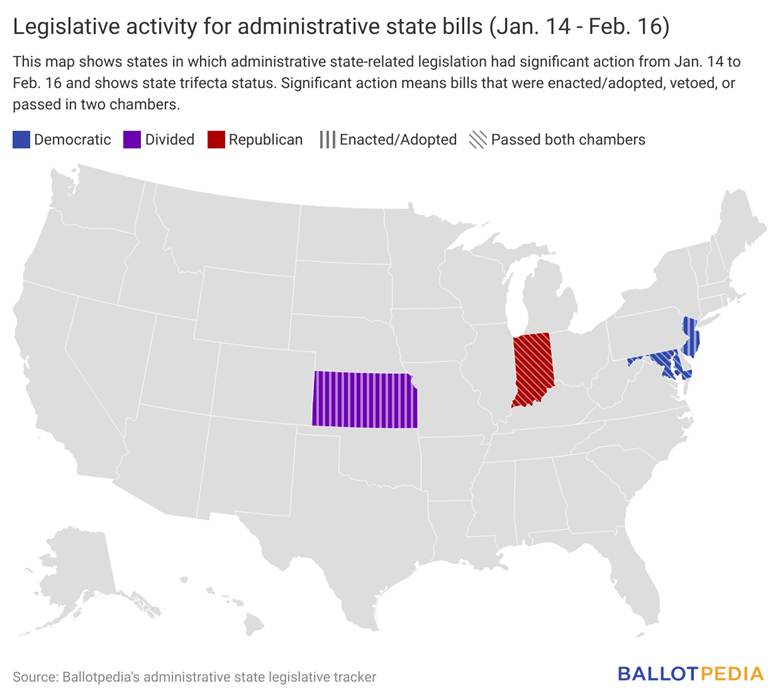
Since our last newsletter edition, Ballotpedia tracked significant legislative action (enactments, vetoes, and passage through both chambers) in four states on 13 bills related to the administrative state, as of Feb. 17. New Jersey Gov. Mikie Sherrill (D) signed eight bills, and Kansas Gov. Laura Kelly (D) signed one bill. Both houses of the Maryland legislature passed two bills and both houses of the Indiana legislature passed two bills.
Ballotpedia tracked a total of 1,461 bills related to the administrative state in 2026, as of Feb. 17.