Welcome to The Ballot Bulletin: Ballotpedia’s Weekly Digest on Election Administration. Every Friday, we deliver the latest updates on election policy around the country, including nationwide trends and recent legislative activity.
In this week’s Ballot Bulletin, we cover 239 bills state legislatures acted on in the past week.
Note: Starting on March 3, we’ll be sending Ballot Bulletin on Tuesdays instead of Fridays. The newsletter will continue to provide the same in-depth data on election legislation, alongside more analysis and news from around the states. There will be no newsletter next Friday, Feb. 27, as we move to the new schedule, with Ballotpedia staff writer Drew McNair taking the helm. Thank you for joining us as we follow election policy developments around the U.S.!
Weekly highlights
The big takeaways from the past week's legislative actions.
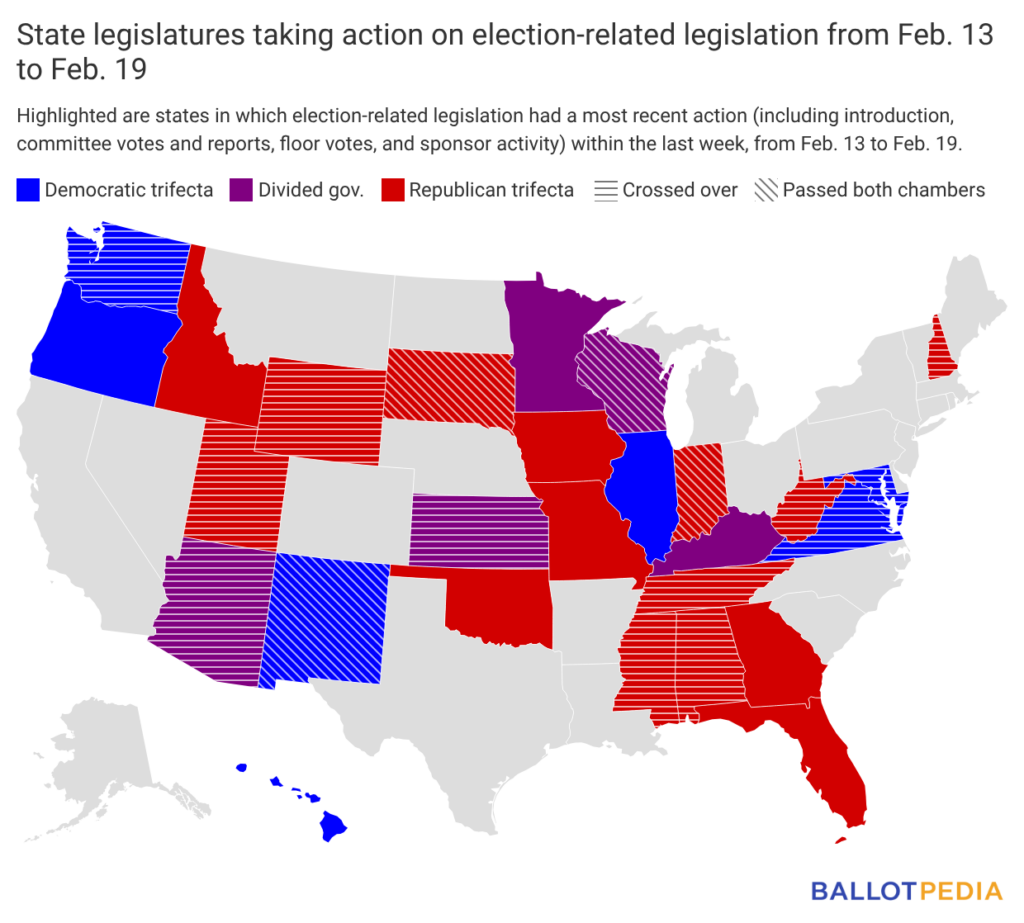
Lawmakers in 27 states acted on 239 bills over the past week. Forty-three state legislatures are in regular or special sessions.
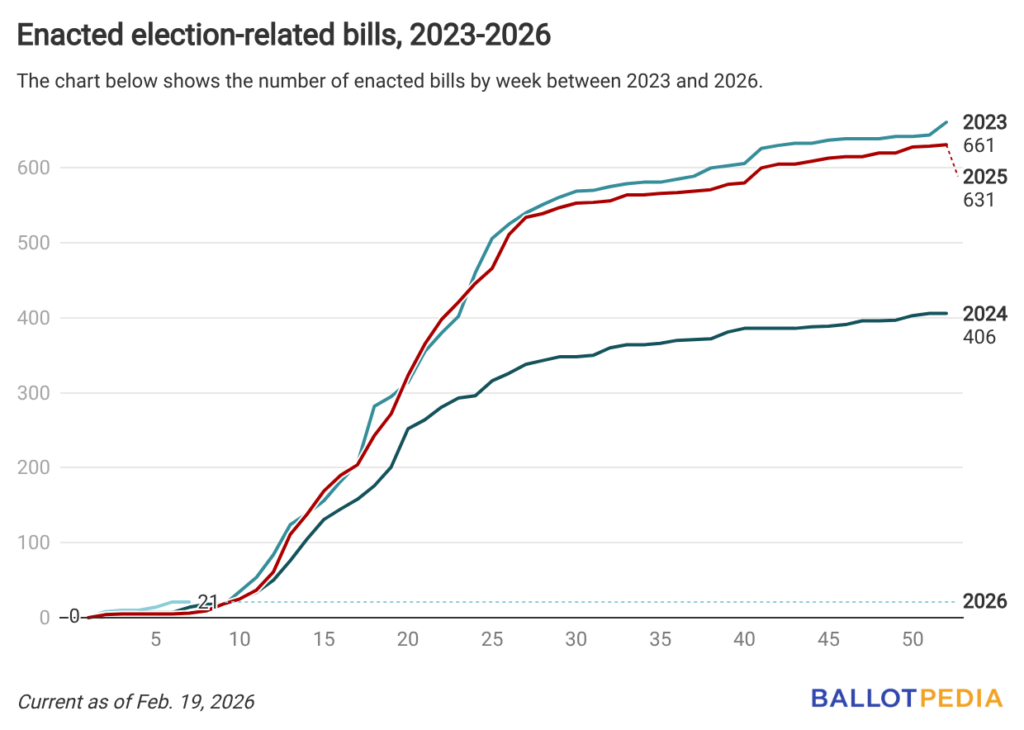
- No bills were enacted this week. One bill was enacted during the same week in 2025, seven bills were enacted during the same week in 2024, and two bills were enacted during the same week in 2023.
- Legislators acted on 501 bills in 2025 and 404 bills in 2024 during the same week.
- Ninety of the bills acted on this week are in states with Democratic trifectas, 116 are in states with Republican trifectas, and 33 are in states with divided government.
- The most active bill categories this week were election types and contest-specific procedures (107), campaign finance (59), and voter registration and list maintenance (57).
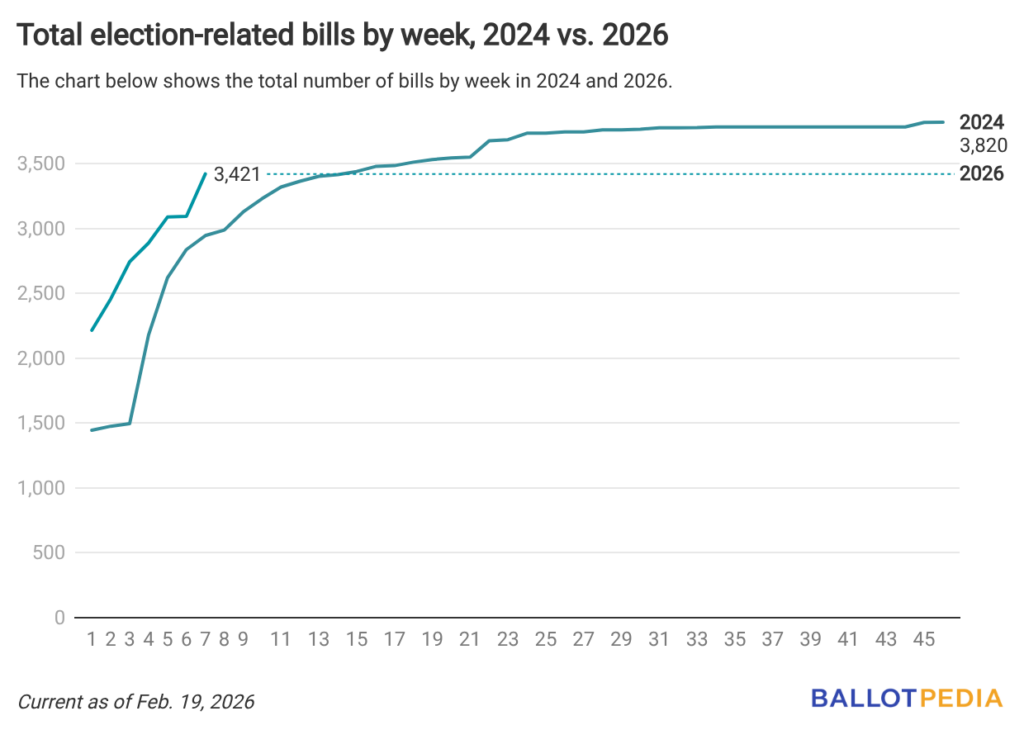
- The numbers in this newsletter include 3,421 bills. We are actively processing bills filed since Feb. 7 as legislative activity increases for 2026.
Note: In some states, legislators can file hundreds of bills per day. We are actively reviewing those bills to determine their relevance to election administration. As a result, during this period of heightened legislative activity, year-to-year comparisons may not yet account for all relevant bills introduced in 2026.
In the news
A glance at what's making headlines in the world of election law.
- On Feb. 19, Tazewell County Circuit Court Judge Jack Hurley Jr. blocked an April vote on a Virginia constitutional amendment that would enact new congressional maps for the 2026 midterm elections. U.S. Reps. Ben Cline (R) and Morgan Griffith (R) and the Republican National Committee filed the lawsuit challenging the legality of the ballot measure language. Attorney General Jay Jones (D) said he would appeal the decision. The Virginia Supreme Court previously ruled on Feb. 13 that it would allow the special election to proceed while it considers a separate lawsuit over the legality of the process used to pass the amendment. Early voting for the April 21 election is scheduled to begin on March 6.
- On Feb. 17, the Indiana House of Representatives approved legislation banning the use of ranked-choice voting in the state on a 58-30 vote, with 58 Republicans voting in favor and 28 Democrats and two Republicans against, with 12 members not voting. The bill now heads to the desk of Gov. Mike Braun (R). If the bill is signed, Indiana would become the 19th state to prohibit the use of ranked-choice voting. Indiana has a Republican trifecta.
- On Feb. 17, the New Mexico House passed SB 264, which makes it a crime to deploy federal troops to a polling place. The legislation was approved on a 41-26 vote along party lines, with 41 Democrats voting in favor, 26 Republicans against, and three members absent. It now heads to the desk of Gov. Michelle Lujan Grisham (D), after passing the state Senate on Feb. 15. New Mexico has a Democratic trifecta.
- On Feb. 13, the Ohio chapters of the League of Women Voters and Council on American-Islamic Relations filed a lawsuit challenging provisions of a 2025 Ohio law that require the secretary of state to conduct monthly checks for noncitizens on the state’s voter rolls. The lawsuit argues the requirements violate the National Voter Registration Act and seeks to permanently block the checks from being implemented.
Key movements
A look at what bills are moving and where.
No bills were enacted in the past week. One bill was enacted during the same week in 2025, seven bills were enacted during the same week in 2024, and two bills were enacted during the same week in 2023. To see all enacted bills, click here.
Four bills passed both chambers of a state legislature. To see the full list of all bills awaiting
gubernatorial action, click here.
- Indiana (Republican trifecta)
- New Mexico (Democratic trifecta)
- South Dakota (Republican trifecta)
- Wisconsin (Divided government)
No bills were vetoed in the past week. No bills have been vetoed so far this year. No bills were vetoed during this period in 2025, 2024, and 2023. To see all vetoed bills, click here.
The big picture
Zooming out to see the macro-level trends in election policy so far this year.
Enacted bills
All bills
We are following 3,421 election-related bills, including bills carried over from the previous year.
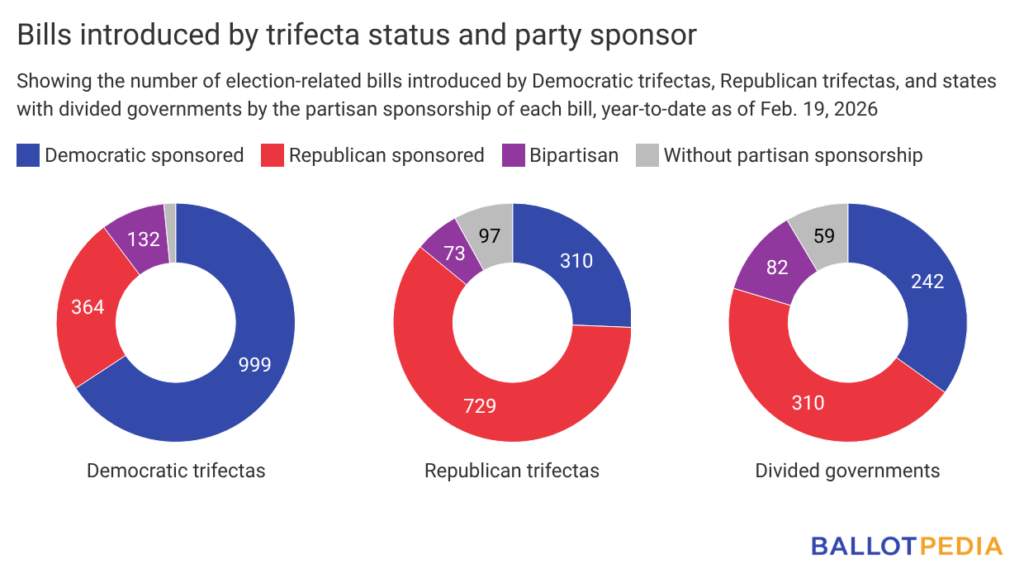
- Trifecta status
- Democratic: 1,519 (44.4%)
- Republican: 1,209 (35.3%)
- Divided: 693 (20.3%)
- Partisan sponsorship
- Democratic: 1,551 (45.3%)
- Republican: 1,403 (41%)
- Bipartisan: 287 (8.4%)
- Other: 180 (5.3%)
We were following 2,988 bills at this point in 2024. Below is a breakdown of those bills by trifecta status and partisan sponsorship.
- Trifecta status
- Democratic: 1,188 (39.8%)
- Republican: 1,228 (41.1%)
- Divided: 572 (19.1%)
- Partisan sponsorship
- Democratic: 1,224 (41%)
- Republican: 1,336 (44.7%)
- Bipartisan: 228 (7.6%)
- Other: 200 (6.7%)
See the charts below for a comparison of total bills between 2024 and 2026 and a breakdown of all 2026 legislation by trifecta status and partisan sponsorship.