


Welcome to the Monday, Feb. 23, 2026, Brew.
By: Lara Bonatesta
Here’s what’s in store for you as you start your day:
- Texas voters to decide on a combined 23 non-binding advisory questions in the March 3 primaries
- Three states have restricted student cellphone use in K-12 public schools so far this year
- Maine legislators weigh expanding state's ranked-choice voting system
Texas voters to decide on a combined 23 non-binding advisory questions in the March 3 primaries
On March 3, Texas voters will decide on a series of non-binding advisory questions that the state's Democratic and Republican parties put on their respective primary ballots. Democratic ballots will have 13 questions. Republican ballots will have 10 questions.
An advisory question is a ballot measure in which citizens vote on a non-binding question. The outcome of an advisory question does not result in a new, changed, or repealed law or constitutional amendment. Instead, advisory questions are used to gauge voter sentiment about party positions.
At least three states — Georgia, South Carolina, and Texas — have allowed political parties to include nonbinding political party advisory questions on statewide primary ballots. All three states have open primaries, meaning voters do not have to formally affiliate with a political party in advance to vote in that party's primary.
The Texas Democratic Party last placed advisory questions on the ballot in 2020, when there were 11. The approval rate ranged from 91.5% for a question on income and corporate taxes to 97.6% for a question on the right to a clean environment.
At the 2020, 2022, and 2024 Republican primaries, the voters decided on 10, 10, and 13 non-binding advisory questions, respectively. Approval rates ranged from 72.7% on a 2024 question that advised adopting a closed primary system to 98.5% on a 2020 question that advised requiring proof of citizenship to vote and removing noncitizens from voter lists.
On the 2026 Democratic and Republican ballots, voters will be able to select either "yes" or "no" on each of the following propositions.
The propositions on the Democratic ballot are:
- “Texas should expand Medicaid and ensure access to affordable healthcare for all.”
- “Texans should support humane and dignified immigration policies and pathways to citizenship.”
- “Texans should have the right to make their own healthcare decisions, including reproductive rights.”
- “Texas should address the state's housing crisis in affordability and access in both urban and rural communities.”
- “Texas should fund all public schools at the same per-pupil rate as the national average.”
- “Secure online voter registration should be accessible to all eligible Texas residents.”
- “Texas should have a clean and healthy environment that includes water, air, and biodiversity. Texas must preserve the state's natural, cultural, scenic, and recreational resources.”
- “Texas should legalize cannabis for adults and automatically expunge criminal records for past low-level cannabis offenses.”
- “Texas should raise salaries to at least the national average and should provide a cost-of-living increase based on the national Consumer Price Index every two years to current/retired school and state employees.”
- “Texas should ban racially motivated redistricting, ban mid-decade redistricting, and create a non-partisan redistricting board to redraw lines every 10 years.”
- “The working class should be eligible for greater federal income tax relief and have their tax burden fairly shifted onto the wealthiest.”
- “Texas should expand accessible public transportation opportunities in rural and urban communities so residents can get to their workplaces, schools, and healthcare.”
- “Texas should prevent individuals with a history of domestic abuse from purchasing firearms by implementing 'red flag' laws.”
The propositions on the Republican ballot are:
- “Texas property taxes should be assessed at the purchase price and phased out entirely over the next six years through spending reductions.”
- “Texas should require any local government budget that raises property taxes to be approved by voters at a November general election.”
- “Texas should prohibit denial of healthcare or any medical service based solely on the patient's vaccination status.”
- “Texas should require its public schools to teach that life begins at fertilization.”
- “Texas should ban gender, sexuality, and reproductive clinics and services in K-12 schools.”
- “Texas should enact term limits on all elected officials.”
- “Texas should ban the large-scale export or sale of our groundwater and surface water to any single private or public entity.”
- “The Texas Legislature should reduce the burden of illegal immigration on taxpayers by ending public services for illegal aliens.”
- “The Republican-controlled Texas Legislature should stop awarding leadership positions, including committee and subcommittee chairmanships and vice chairmanships, to Democrats.”
- ‘Texas should prohibit Sharia Law.”
Click here to see a full list of Texas political party advisory questions on the March 3 ballot.
Three states have restricted student cellphone use in K-12 public schools so far this year
A version of this story appeared in Ballotpedia’s Hall Pass newsletter on Feb. 18. Click here to sign up.
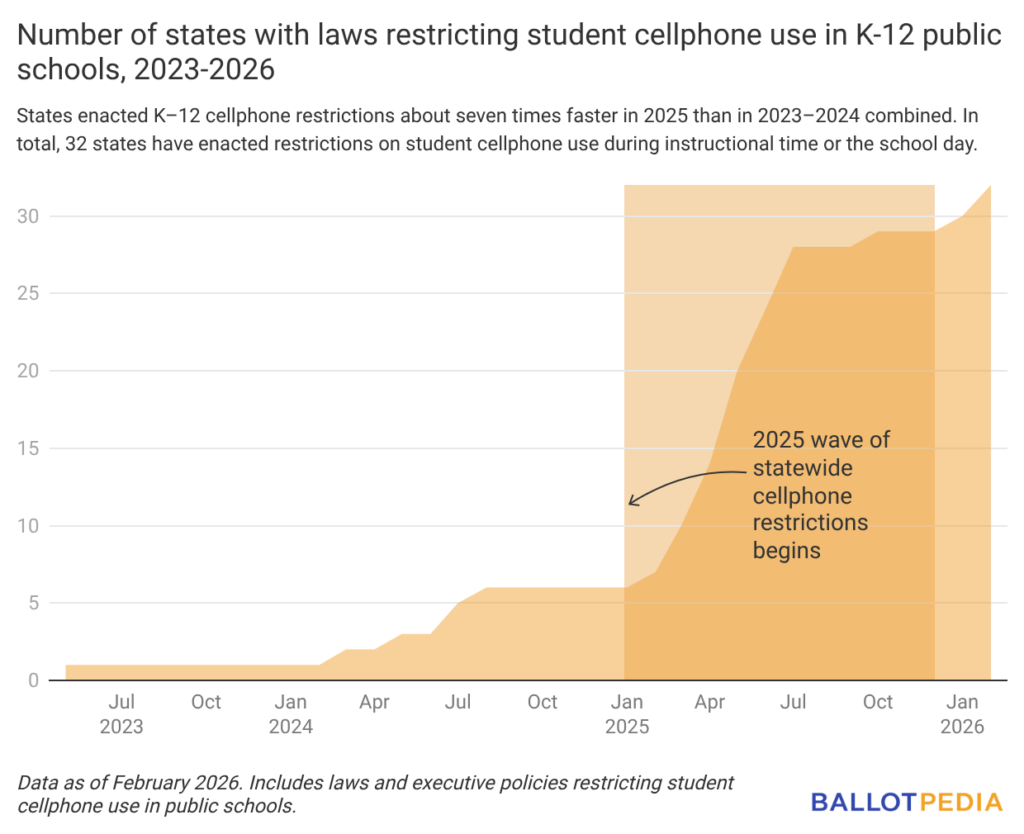
Nearly half of states passed laws restricting cellphone use in K-12 public schools in 2025, and the topic continues to be a priority for many lawmakers this year.
- On Feb. 12, the Hawaii Board of Education, the state’s only school district, prohibited elementary and middle school students from using their phones during the entire school day. The policy bars high school students from using their phones only during instructional time and permits schools to develop their own rules governing technology during recesses, lunches, and other breaks.
- On Feb. 10, Michigan Gov. Gretchen Whitmer (D) signed a bill prohibiting public school students from using their cellphones in class beginning in the 2026-2027 school year.
- On Jan. 8, New Jersey became the first state to enact a ban in 2026, when then-Gov. Phil Murphy (D) signed S3695. The law requires the state Commissioner of Education to develop policies for local school boards that prohibit student cellphone use on school grounds during the school day. It also requires school boards to adopt policies based on the New Jersey Department of Education's guidelines.
Florida was the first state to regulate cellphones in schools when Gov. Ron DeSantis (R) signed HB 379 in 2023. Since then, more than 60% of states have imposed similar requirements on public school districts.
Forty-one states have passed laws addressing phones in school. In nine of those states, laws either encourage districts to limit student cellphone use or require them to adopt classroom technology policies without specifying the form those policies should take.
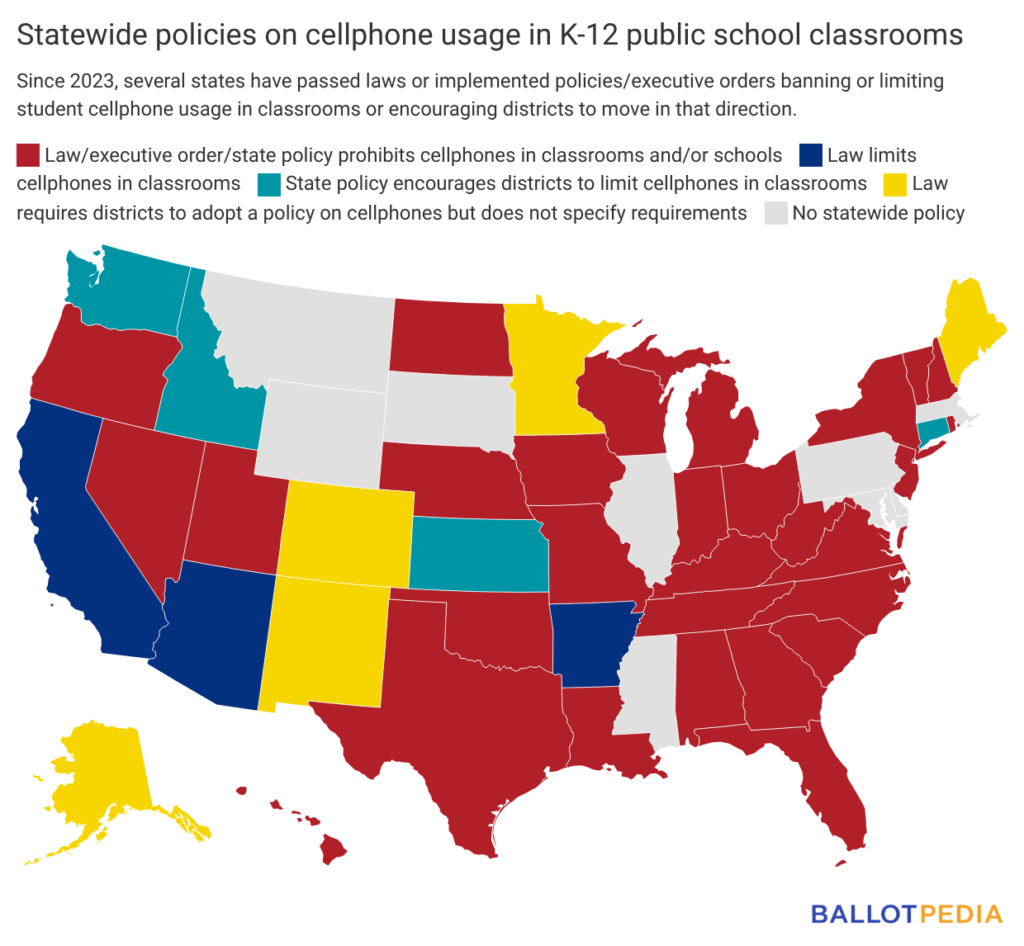
In the states with bans, the laws either bar students from using their cellphones in class or during the entire school day (commonly referred to as a “bell-to-bell” ban).
Of the 32 states that limit student cellphone use, 18 had a Republican trifecta when the laws went into effect, while six had a Democratic trifecta. Eight states had divided governments.
Other states could pass bans in the coming months. Legislators in Kansas and South Dakota have taken action on cellphone ban bills in recent weeks. Kansas does not require districts to regulate student cellphone use, but has taken official actions addressing the topic. In 2024, the Kansas State Board of Education accepted guidelines encouraging districts to limit student cellphone use in schools.
- Kansas: On Feb. 17, the Kansas House voted 75-48 to pass a bill that would prohibit cellphone use during school hours for students attending public and private schools. The bill now goes back to the Senate for a final vote. Kansas has a divided government, with Republicans controlling both chambers of the Legislature.
- South Dakota: On Feb. 17, the South Dakota Senate voted 19-15 to pass SB 198, a bill to prohibit K-12 public school students from using their cellphones during the school day. The bill now goes to the House. South Dakota has a Republican trifecta. South Dakota is one of nine states that currently do not have statewide district cellphone policies in place.
On Feb. 15, the New Mexico Senate voted 32-6 to pass SB 23, which would have required school districts and charter schools to ban student cellphone use during the school day. The bill did not receive a House vote before the legislative session ended on Feb. 19. In 2025, New Mexico passed a law requiring districts to adopt cellphone policies.
Click here to learn more about state-level school cellphone policies.
Maine legislators weigh expanding state's ranked-choice voting system
On Feb. 10, Maine legislators approved a bill requiring the use of ranked-choice voting (RCV) to elect the governor and members of the Legislature. Before sending the bill to Gov. Janet Mills (D), the Legislature is waiting for advice from the Maine Supreme Judicial Court.
Since 2018, Maine has used RCV for congressional races, as well as primary elections for governor and the Legislature. In 2019, the state expanded its use of RCV to include presidential primaries and general elections.
In 2016, voters approved the Maine Ranked Choice Voting Initiative, which authorized the use of RCV for all congressional, state legislative, and gubernatorial elections.
In 2017, the state supreme court issued an advisory opinion holding that using RCV in general elections for governor and the Legislature violated the Maine Constitution: "According to the terms of the Constitution, a candidate who receives a plurality of the votes would be declared the winner in that election. ... In essence, the Act is inapplicable if there are only two candidates, and it is in direct conflict with the Constitution if there are more than two candidates."
In 2025, the Legislature approved a bill to require RCV for gubernatorial and legislative elections, but recalled it from Mills' desk and kept it for consideration in 2026.
This year, the Maine House approved LD 1666 on a 71-52 vote on Feb. 10, with 71 Democrats voting in favor, 51 Republicans and one Democrat voting against. Twenty-five legislators were absent.
Also on Feb. 10, the Maine Senate approved the bill 19-13. But instead of sending the bill to Mills’ desk, the Senate voted to request an advisory opinion from the state supreme court on the measure’s constitutionality. Under the Maine Constitution, the court is required to issue an advisory opinion if the governor or either legislative chamber requests it.
Currently, seven states have laws authorizing or requiring the use of RCV for certain elections, while 18 states have laws prohibiting or restricting the use of RCV.
The legislation in Maine is one of 34 bills that have been introduced this year requiring or allowing at least some state or local elections to use RCV. The Virginia Senate has approved legislation allowing all local governing bodies, rather than just county boards of supervisors and city councils, to use RCV.
Legislators have also introduced 18 bills repealing or prohibiting RCV. Three bills — in Iowa, Michigan, and Ohio — have passed at least one chamber of a state legislature. A fourth bill in Indiana passed both chambers. As of this writing, Gov. Mike Braun (R) had not yet signed or vetoed the bill.
Click here to read more about ranked-choice voting.