


Welcome to the Tuesday, Feb. 24, Brew.
By: Briana Ryan
Here’s what’s in store for you as you start your day:
- New Mexico voters will decide whether to establish salaries for legislators after last deciding on such a measure in 1990
- Indiana becomes the third state to send a bail-related constitutional amendment to voters this year
- New York Senate passes $1 billion emissions reporting bill
New Mexico voters will decide whether to establish salaries for legislators after last deciding on such a measure in 1990
On Nov. 3, New Mexico voters will decide on a constitutional amendment that would establish a salary for state legislators based on the state's annual median household income.
New Mexico is the only U.S. state where legislators receive no salary. Salaries of state legislators vary by state. In 2025, the average annual base salary for a state legislator is $47,904. New York has the highest legislator salary at $142,000 per year, while New Hampshire has the lowest, at $100 a year.
State legislators may also receive a per diem or mileage reimbursement, depending on the state. In New Mexico, state legislators receive a per diem of $202 a day during sessions or interim meetings, intended to cover food and lodging expenses.
This amendment would set the state legislative salary in New Mexico to be equal to the state's median household income. Currently, this is estimated to be $67,800. For the salaries of 112 legislators, this would cost about $7.6 million.
According to the National Conference of State Legislatures, “Legislatures take several different approaches to set legislator salary. Three methods are most frequently used: pay set by legislative measures, pay tied to external factors like rate scales or pay indexes, or pay set by compensation commissions.”
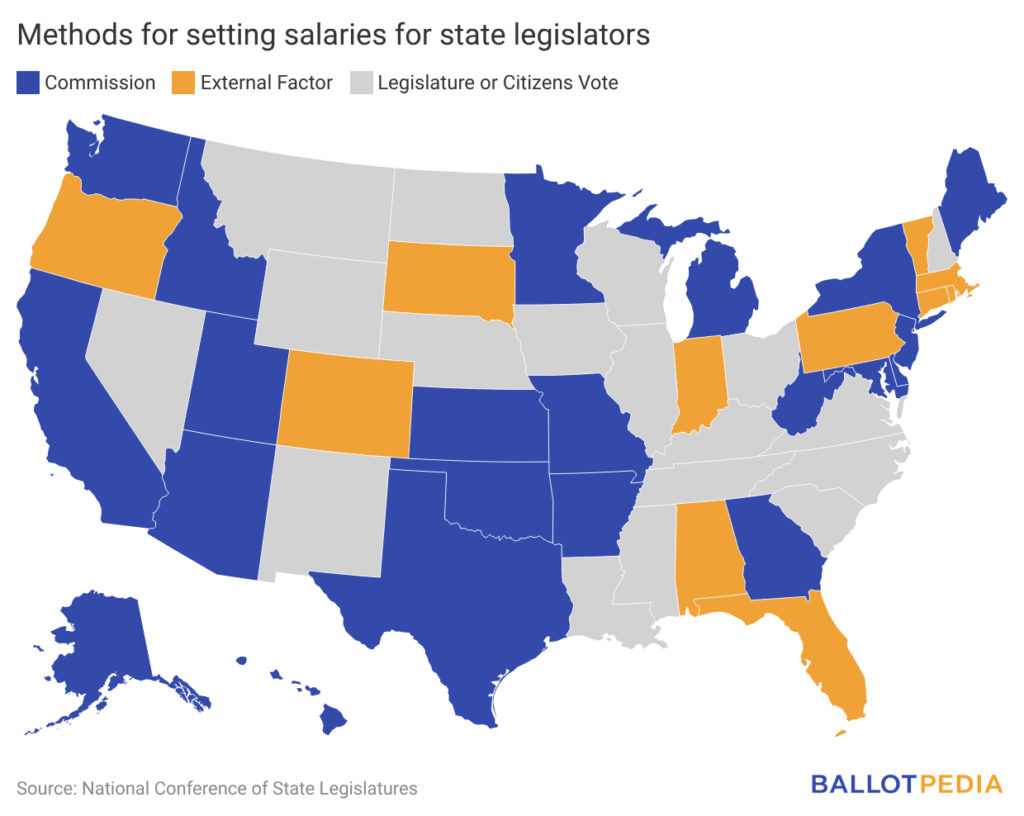
State Rep. Cristina Parajón (D) introduced the amendment, House Joint Resolution 5 (HJR 5), in the New Mexico House of Representatives. On Feb. 13, HJR 5 passed the state House 41-26. On Feb. 17, the New Mexico Senate passed it 23-19. Constitutional amendments do not need the governor's signature to be put on the ballot.
New Mexico voters last decided on an amendment related to legislator salaries in 1990, which would have increased the legislative per diem and provided a monthly salary. Voters defeated the amendment 74.8% to 25.2%.
This amendment will join three other measures on the Nov. 3 ballot — an amendment that would eliminate the gubernatorial pocket veto, an amendment repealing the current requirement that school board elections are held at different times of year from partisan elections, and another that would make changes to appointments to the Board of Regents.
Click here to read more about this year's New Mexico Legislative Salary Amendment.
Indiana becomes the third state to send a bail-related constitutional amendment to voters this year
On Feb. 17, the Indiana General Assembly voted to put a constitutional amendment related to bail on the Nov. 3 ballot.
Introduced as Senate Joint Resolution 1 (SJR 1), the amendment says that offenses, other than murder or treason, are bailable "unless the accused poses a substantial risk to any other person or the community" if the presumption is strong and the state proves that no condition of release will protect the community.
State Rep. Chris Jeter (R), who voted in favor of the amendment, stated that SJR 1 is "a public safety amendment to the Indiana Constitution" and that, currently, "every criminal defendant is authorized to be released on bail, unless it is determined for treason, even if (they are) a substantial risk to the public. This amendment would change that to allow anyone who's deemed a public safety threat to be held indefinitely."
State Sen. Greg Taylor (D), who voted against the amendment, said, "It's not based on the charge — it's based on the person, which makes this even more egregious. If you don't think there are some judges out there that may have bias in their community of certain people, then you haven't been to court in Indiana."
The Indiana Senate passed SJR 1 43-2, with four members not voting. The Indiana House of Representatives passed it 75-11, with 14 members not voting. Republicans, along with 23 Assembly Democrats, supported SJR 1, while the remaining 17 Democrats either opposed it or abstained.
Voters in Alabama and Tennessee will also decide on bail-related amendments.
In Alabama, the amendment would expand the list of crimes for which bail can be denied to include shooting or discharging a firearm, explosive device, or other weapon into an occupied dwelling and solicitation to commit murder.
In Tennessee, the amendment would remove the right to bail in cases where the presumption of guilt is great, and the defendant is accused of terrorism, second-degree murder, aggravated rape of a child, grave torture, and any other offense for which a convicted individual could not be released before the expiration of at least 85% of their sentence.
Since 2023, voters in Colorado, Texas, and Wisconsin have approved amendments adding conditions or exceptions to their state constitutions' right to bail for criminal defendants.
Indiana voters will also decide on another ballot measure on Nov. 3 that would require city and town court judges to reside in either the county where the court is located or the bordering county closest to the court.
Click here for more information about this year's Indiana Bailable Offenses and Substantial Risk Standard Amendment.
New York Senate passes $1 billion emissions reporting bill
On Feb. 10, the New York Senate passed Senate Bill 9072A, the Climate Corporate Data Accountability Act, in a 40-22 vote. Democrats cast all votes in favor of the bill, and Republicans cast all votes against it.
The bill would apply to companies that do business in New York and generate more than $1 billion in annual revenue. It would require annual public disclosure of:
- Scope 1 emissions — direct emissions from company operations, beginning in 2028
- Scope 2 emissions — emissions from purchased electricity, steam, heating, or cooling, beginning in 2028
- Scope 3 emissions — indirect emissions from supply chains and product use, beginning in 2029
The measure now moves to the New York Assembly, where a companion bill has been introduced.
If enacted, the measure would require affected companies to formalize emissions tracking and disclosure practices in one of the country’s largest state economies. Businesses that operate in multiple states would need to coordinate reporting systems across jurisdictions if similar laws are adopted elsewhere.
New York’s proposal mirrors California’s Senate Bill 253 (SB 253), the Climate Corporate Data Accountability Act, which Gov. Gavin Newsom (D) signed in October 2023. SB 253 requires companies doing business in California with more than $1 billion in annual revenue to disclose emissions.
California also enacted Senate Bill 261 (SB 261), the Climate-Related Financial Risk Act, in October 2023. It required companies with more than $500 million in annual revenue doing business in California to disclose climate-related financial risks and mitigation strategies.
Business groups challenged both laws in federal court. In November 2025, the U.S. Court of Appeals for the Ninth Circuit temporarily blocked enforcement of SB 261 while litigation proceeds. The order did not apply to SB 253’s emissions disclosure requirements.
We follow support for and opposition to the environmental, social, and corporate governance (ESG) investing. To learn more about arguments for, against, and about ESG, click here. For more information on ESG policy reform proposals, click here.
Click here to check out enacted state ESG legislation by trifecta status.