


Welcome to the March 2 edition of Robe & Gavel, Ballotpedia’s newsletter about the Supreme Court of the United States (SCOTUS) and other judicial happenings around the U.S.
“What you endure is who you are. I can't change the past. But I can certainly help somebody else in the future, so they don't have to go through what I did.”
- Patsy Mink
The first woman of color elected to Congress
Follow Ballotpedia on X and Bluesky or subscribe to the Daily Brew for the latest news and analysis.
We #SCOTUS and you can, too!
Grants
SCOTUS has not accepted any new cases to its merits docket since our Feb. 23 issue. To date, the Court has agreed to hear 58 cases for argument for the 2025-2026 term and three cases for the 2026-2027 term.
Arguments
The Supreme Court will hear three arguments this week. Click here to read more about SCOTUS' current term.
Click the links below to learn more about these cases:
March 2
- United States v. Hemani concerns 18 U.S.C. § 922(g)(3), a federal law that prohibits the possession of firearms by someone who is an unlawful user of any controlled substance.
- The questions presented: “Whether 18 U.S.C. 922(g)(3), the federal statute that prohibits the possession of firearms by a person who ‘is an unlawful user of or addicted to any controlled substance,’ violates the Second Amendment as applied to respondent.”
March 3
- Hunter v. United States concerns federal defendants’ waivers of their right to appeal.
- The questions presented: “1. Whether the only permissible exceptions to a general appeal waiver are for claims of ineffective assistance of counsel or that the sentence exceeds the statutory maximum.
“2. Whether an appeal waiver applies when the sentencing judge advises the defendant that he has a right to appeal and the government does not object.”
March 4
- Montgomery v. Caribe Transport II, LLC concerns § 14501(c), which describes federal authority over intrastate transportation.
- The questions presented: “Does§ 14501(c) preempt a state common-law claim against a broker for negligently selecting a motor carrier or driver?”
In its October 2024 term, SCOTUS heard arguments in 65 cases. Click here to read more about SCOTUS's previous term.
Opinions
SCOTUS has ruled on four cases since our Feb. 23 edition. The Court has issued rulings in sixteen cases so far this term. This includes four per curiam opinions. Forty-six cases are still under deliberation.
Click the links below to read more about the specific cases SCOTUS ruled on since Feb. 23:
Feb. 24
The Hain Celestial Group, Inc. v. Palmquist was argued before the Court on Nov. 4.
The case concerns a procedural issue in federal courts.
The outcome: In a 9-0 opinion, the Court affirmed and remanded the decision of the U.S. Court of Appeals for the Fifth Circuit. The Court held that the appellate court correctly dismissed the case due to the case's jurisdictional defect when it was removed to federal court.
USPS v. Konan was argued before the Court on Oct. 8.
The case concerns the Federal Tort Claims Act (FTCA).
The outcome: In a 5-4 opinion, the Court vacated and remanded the judgment of the U.S. Court of Appeals for the Fifth Circuit. The Court held that the U.S. Postal Service has sovereign immunity for claims of intentional nondelivery of mail because both miscarriage and loss of mail can occur under the FTCA’s postal exception due to the Postal Service’s intentional failure to deliver the mail.
Feb. 25
The GEO Group, Inc. v. Menocal was argued before the Court on Nov. 10.
The case concerns the collateral-order doctrine.
The outcome: In a unanimous opinion, SCOTUS affirmed and remanded the decision of the U.S. Court of Appeals for the Tenth Circuit. The Court held that because Yearsley v. W. A. Ross Constr. Co. gives federal contractors a potential merits defense rather than immunity from suits, a pretrial order denying Yearsley protection is not immediately appealable.
Villarreal v. Texas was argued before the Court on Oct. 6.
The case concerns the Sixth Amendment.
The outcome: In a unanimous opinion, SCOTUS affirmed the decision of the Texas Court of Criminal Appeals. The Court held that a qualified conferral order that only prohibits discussion of the defendant’s testimony for its own sake during a midtestimony overnight recess does not violate the Constitution.
Federal court action
Nominations
President Donald Trump (R) has not announced any new Article III nominees since our Feb. 23 edition.
The president has announced 47 Article III judicial nominations since taking office on Jan. 20, 2025. For more information on the president’s judicial nominees, click here.
Committee action
The Senate Judiciary Committee has not reported any nominees out of committee since our Feb. 23 edition.
Confirmations
The Senate has not confirmed any nominees since our Feb. 23 issue.
Vacancies
The federal judiciary currently has 37 vacancies, 36 of which are for lifetime Article III judgeships. As of publication, there were four pending nominations.
According to the Administrative Office of U.S. Courts, there were nine upcoming vacancies in the federal judiciary, where judges have announced their intention to leave active judicial status.
For more information on judicial vacancies during President Trump’s term, click here.
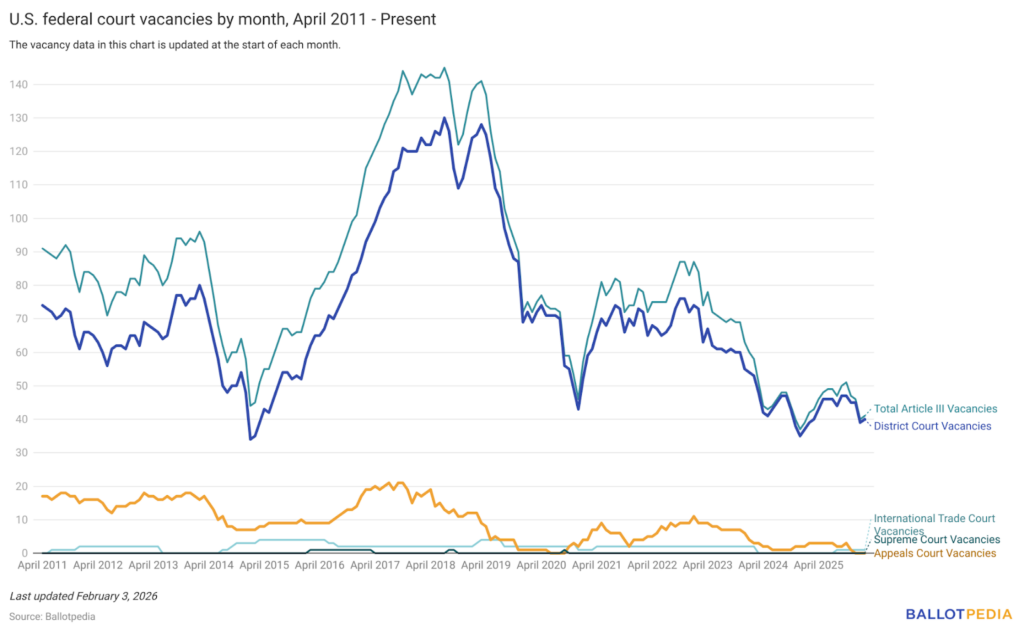
Do you love judicial nomination, confirmation, and vacancy information? We figured you might. Our monthly Federal Vacancy Count monitors all the faces and places moving in, moving out, and moving on in the federal judiciary. Click here for our most current count.
Need a daily fix of judicial nomination, confirmation, and vacancy information? Click here for continuing updates on the status of all federal judicial nominees.
Or, keep an eye on our list for updates on federal judicial nominations.
Spotlight: SCOTUS Justices
Justice Clarence Thomas is an associate justice of the Supreme Court. President George H.W. Bush (R) nominated Thomas to the Court on July 8, 1991, to replace Justice Thurgood Marshall, who assumed senior status on October 1, 1991. Thomas was sworn in on October 23, 1991, becoming the second Black justice in U.S. history to sit on the Court.
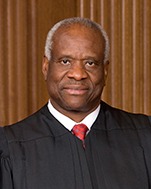
- Justice Thomas is the longest-serving active justice on the Court.
- He considered entering the priesthood at the age of 16 and attended St. John Vianney's Minor Seminary on Isle of Hope, GA.
- He earned a bachelor's degree in English from Holy Cross College, where he was one of the school's first Black students and a founding member of the school's Black Student Union.
Click here to learn more about Justice Thomas.
Looking ahead
We’ll be back on March 9 with a new edition of Robe & Gavel. Until then, gaveling out!
Contributions
Myj Saintyl compiled and edited this newsletter, with contributions from Sam Post and Ellie Mikus.