


Welcome to the Friday, March 6, Brew.
By: Briana Ryan
Here’s what’s in store for you as you start your day:
- Thirty-four states require legislative review of all or some executive agency regulations
- Louisiana and Ohio both have more candidates running for the U.S. House this year than in previous years
- Two new measures have been certified for this year’s statewide ballots
Thirty-four states require legislative review of all or some executive agency regulations
State legislatures oversee executive agency rulemaking through a variety of mechanisms. Legislatures may be tasked with reviewing regulations or explicitly approving them before adoption. They can also disapprove of or nullify regulations and hold hearings about proposed or adopted rules. In some instances, a legislature's roles depend on the nature of the regulation or rule.
In 2025, we did a study of legislative oversight of executive agency rulemaking that identified legislative oversight requirements, designated oversight authorities, and the scope of regulatory oversight in each state. Here's what we found:
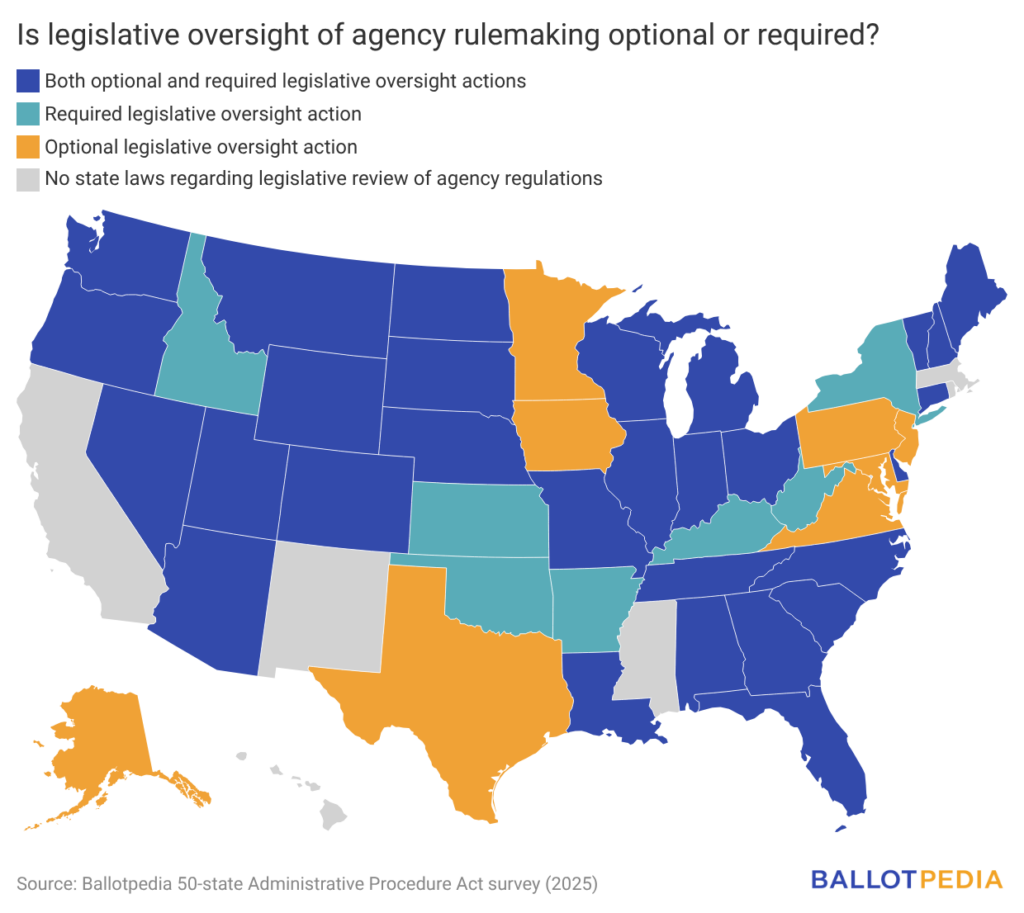
Is legislative oversight optional, required, or both?
- Thirty-four states require legislative review of all or some agency regulations. Seven states include both optional and required legislative oversight mechanisms. Twenty-seven states have required legislative oversight mechanisms.
- Ten states authorize, but do not require, legislative oversight of agency regulations.
- In six states, we could not identify provisions of the law regarding legislative review of agency regulations.
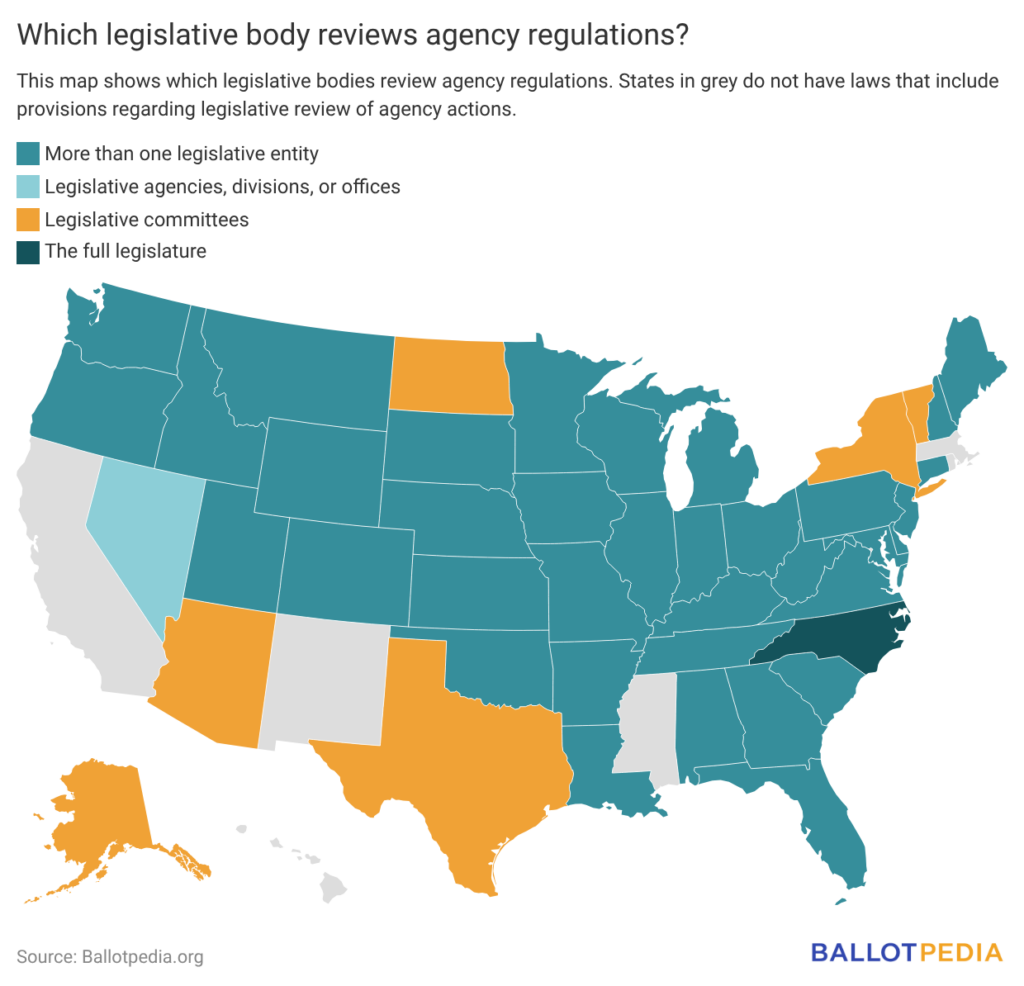
What legislative body is authorized (or required) to oversee agency regulations?
Several states have multiple procedures for legislative review involving different legislative entities with varying levels of authority.
- Thirty-one states authorize or require the full legislature to review agency regulations. Some states require their full legislatures to pass bills authorizing regulations, and others allow full legislatures to vote to disapprove regulations.
- Forty-one states authorize or require legislative committees to review agency regulations. These states authorize committees to either disapprove, delay, approve, or recommend changes to regulations, or any combination of those actions.
- Thirteen states authorize or require legislative agencies, divisions, or offices to review agency regulations. These states authorize agencies, divisions, or offices to review regulations for compliance with procedural requirements, fiscal impact, or correct formatting, among other types of review.
- Thirty-three states authorize or require more than one legislative entity to review agency regulations.
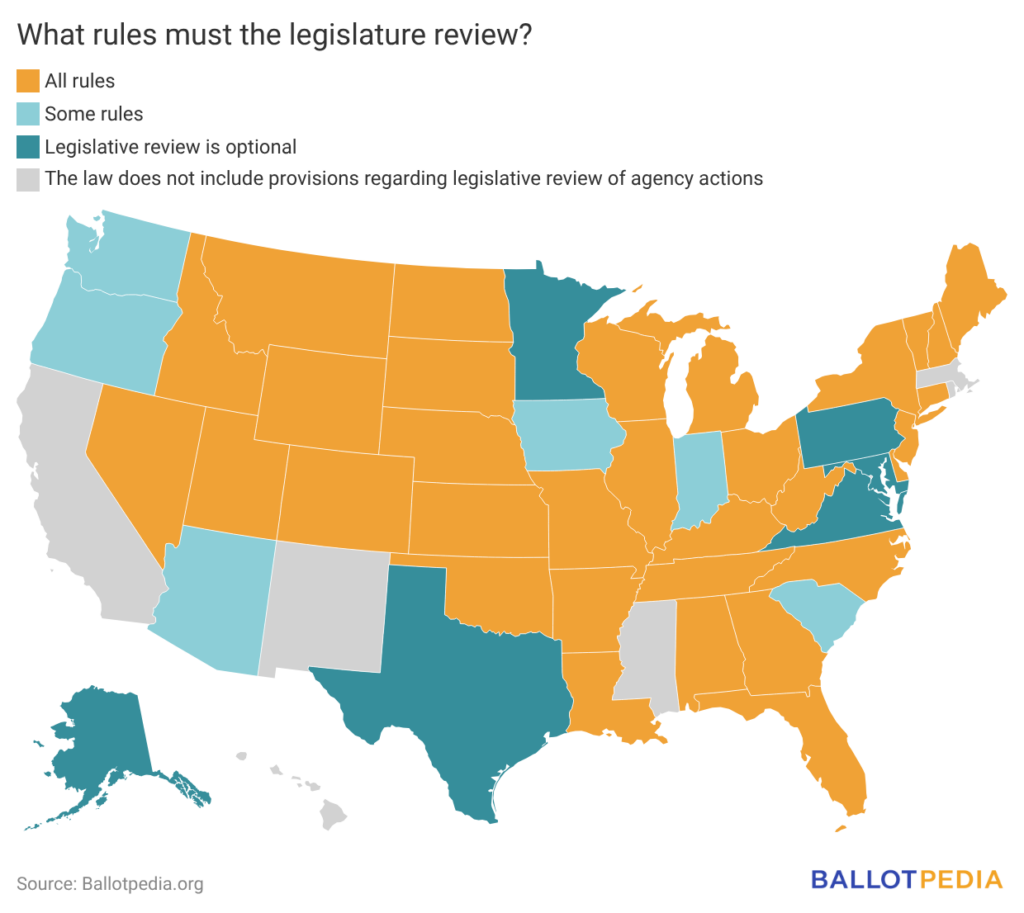
Is oversight required for all rules, some rules, or no rules?
- Thirty-two states require legislative review of all rules. Some states require different levels of review for rules that meet different criteria, such as those with an estimated fiscal impact exceeding a certain threshold.
- Six states require legislative review of some rules. Some states require legislatures to review only rules that meet certain criteria, which are policies similar to REINS-style state laws. Other states require legislative review of rules that receive public complaints.
- Six states do not require legislative review of rules, but explicitly authorize it.
- Six states do not have laws regarding legislative review of agency rules.
Click here to read more about legislative oversight of executive agency rulemaking, including lists of each state's legislative oversight of agency rulemaking requirements.
Louisiana and Ohio both have more candidates running for the U.S. House this year than in previous years
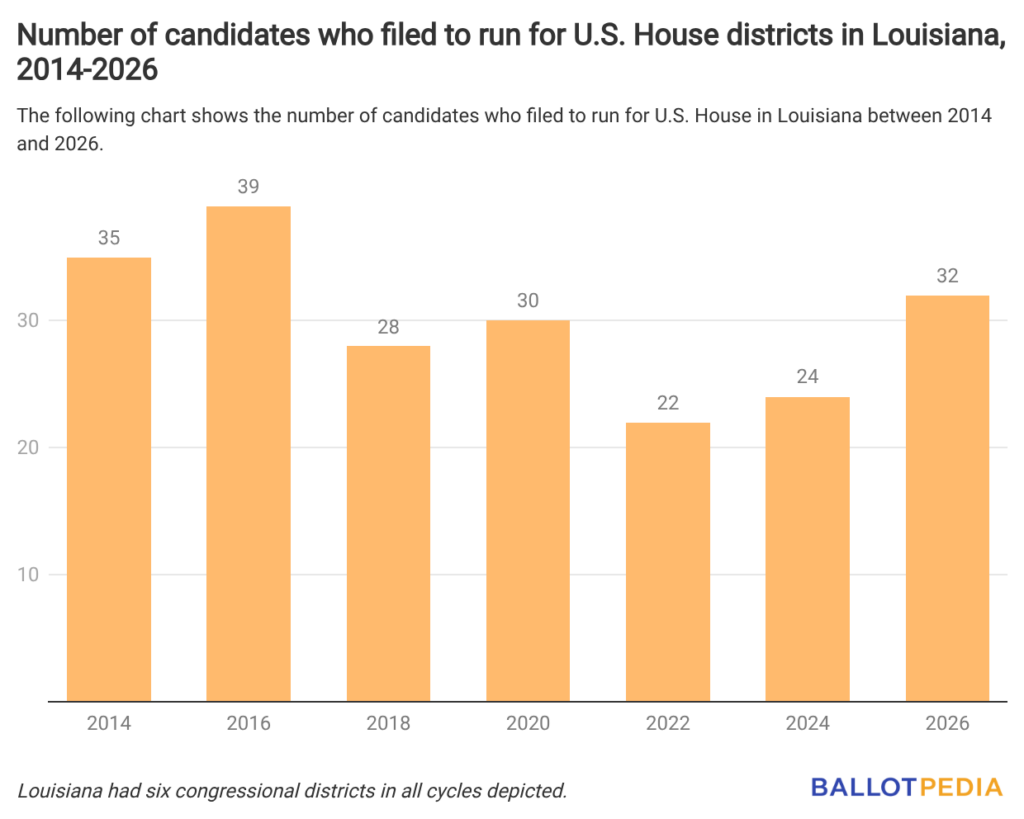
With the U.S. House primaries now in full swing, we’re taking a look at two states with higher numbers of candidates this year: Louisiana and Ohio. The total number of candidates running in Louisiana is the highest since 2016, and in Ohio, it is the highest since 2014.
Here’s a closer look at the U.S. House primaries in both states.
Louisiana
Thirty-two candidates — 15 Democrats and 17 Republicans — are running for Louisiana’s six U.S. House districts on May 16.
Louisiana’s 5th Congressional District is open this year because Rep. Julia Letlow (R) is running for the U.S. Senate. There was one open district in 2024, none in 2022, one in 2020, none in 2018, two in 2016, and one in 2014.
This year marks the first time Democratic and Republican candidates will run in separate U.S. House primaries, under a semi-closed primary system where registered party members and unaffiliated voters are allowed to vote. Additionally, a runoff will take place on June 27 between the top-two finishers if no candidates received a majority of the vote in the primary. The state previously used the Louisiana majority-vote system for Congressional elections. Under that system in even years, candidates from all parties ran on the same ballot in November. If no candidate received a majority of the vote, the top two finishers from any party advanced to a second election in December.
Here are some interesting details about this year’s filings:
- Nine primaries — five Democratic and four Republican — are contested this year.
- Twelve candidates — five Democrats and seven Republicans — are running in the open 5th district, the most in any district this year.
- Three incumbents — one Democrat and two Republicans — are facing primary challengers this year. That ties with 2016 and 2014 for the year with the fewest incumbents in contested primaries in the last seven election cycles.
- The 2nd Congressional District is guaranteed to Democrats because no Republicans will appear on the ballot. Democrats filed to run in all six districts, meaning none are guaranteed to Republicans.
Click here to read more about Louisiana’s 2026 U.S. House elections.
Ohio
Seventy-eight candidates — 46 Democrats and 32 Republicans — are running for Ohio’s 15 U.S. House districts on May 5.
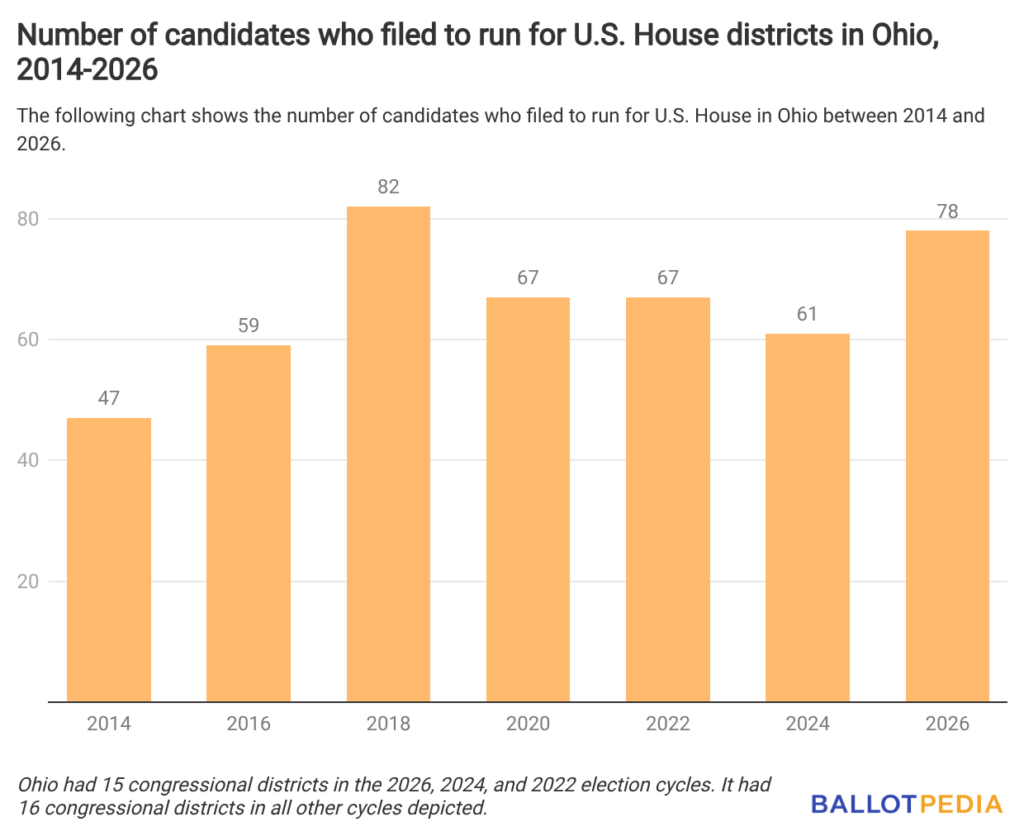
All incumbents — five Democrats and 10 Republicans — are running for re-election, meaning no districts are open this year. There were two open districts in 2024, one in 2022, none in 2020, two in 2018, one in 2016, and none in 2014.
These are the first elections since the Ohio Redistricting Commission voted unanimously to approve a new congressional map. The state was required to redraw its congressional district boundaries ahead of the 2026 elections due to a constitutional amendment that set shorter expiration dates for maps adopted without bipartisan support.
Here are some interesting details from this year’s filings:
- Twenty primaries — 12 Democratic and eight Republican — are contested this year.
- Rep. Max Miller (R) and eight Democrats are running for the 7th Congressional District, the most candidates running for a district this year.
- Seven incumbents — three Democrats and four Republicans — are facing primary challengers this year.
- Candidates filed to run in the Republican and Democratic primaries in all 15 districts, meaning no districts are guaranteed to either party.
In Ohio, primary elections are determined via plurality vote, meaning the candidate with the most votes wins, even if they did not win an outright majority.
Click here to read more about Ohio’s 2026 U.S. House elections.
Two new measures have been certified for this year’s statewide ballots
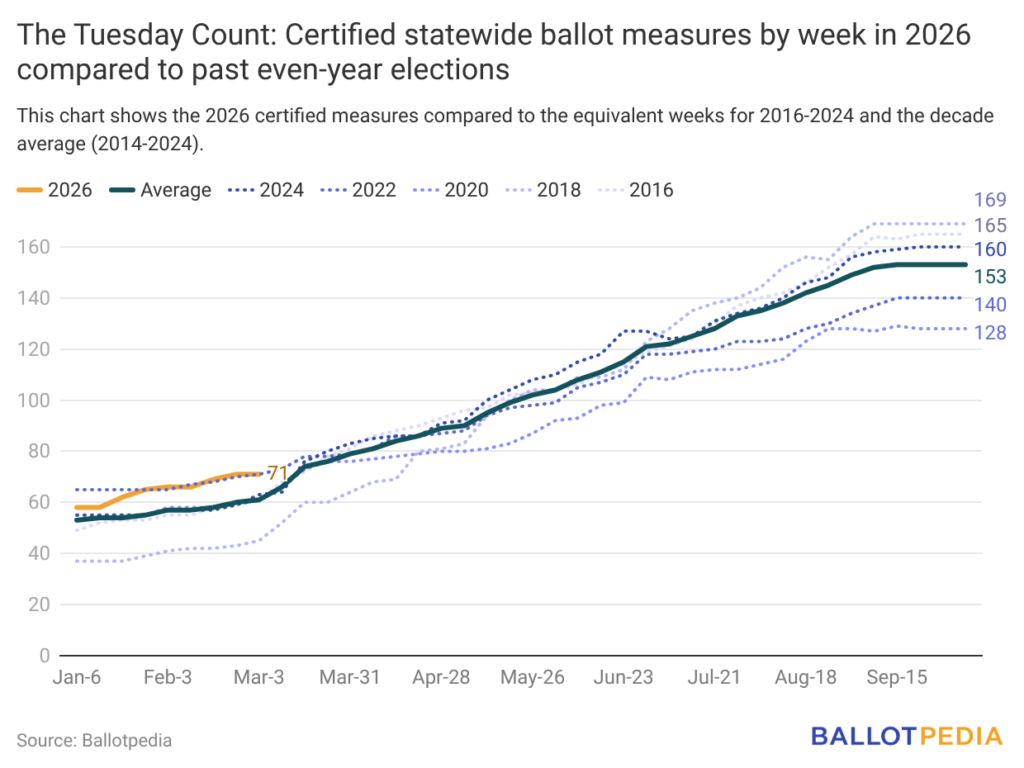
As of March 3, the 71 statewide measures certified for statewide ballots in 2026 are above the historical average for this point in the cycle across even-numbered years from 2014 through 2024.
By this time during even-numbered years from 2014 through 2024, an average of 61 statewide measures had been certified for the ballot. From 2014 to 2024, an average of 153 statewide measures were certified.
Over the past two weeks, two new measures were certified for the Nov. 3 ballot in their respective states:
- New Mexico Repeal Separate Election Requirement for School Election Dates Amendment
- Wisconsin Prohibit Partial Veto to Increase Tax or Fee Amendment
Signatures have been submitted and are pending verification for 10 initiatives:
- Alaska Citizenship Requirement for Voting Initiative
- California Two-Thirds Vote Requirement for Special Taxes Initiative
- California Voter Identification and Voter List Maintenance Requirements Initiative
- Colorado Biological Sex Requirement for School Sports Measure
- Colorado Prohibit Surgeries to Alter Biological Sex Characteristics of Minors Measure
- Colorado Require Life in Prison for Human Trafficking of Minors Measure
- Maine Birth Certificate Sex Requirement for Public School Sports Initiative
- Missouri Congressional Map Referendum
- Oklahoma State Question 836, Top-Two Primary Elections Initiative
- Utah Eliminate the Independent Redistricting Commission Initiative
Enough signatures were verified for 13 indirect initiatives to certify them to their respective state legislatures:
- Massachusetts Change State Tax Revenue Limit Initiative
- Massachusetts Decrease State Income Tax Rate to 4% Initiative
- Massachusetts Eliminate Recreational Marijuana Sales and Allow Limited Possession Initiative
- Massachusetts Establish the Nature for All Fund Initiative
- Massachusetts Legislative Stipend Calculation and Payment Rules Initiative
- Massachusetts Limit on Required Lot Size for Single-Family Homes Initiative
- Massachusetts Permit Collective Bargaining for Committee for Public Counsel Services Employees Initiative
- Massachusetts Permit Same-Day Voter Registration Initiative
- Massachusetts Public Records Requirements for Legislature and Governor’s Office Initiative
- Massachusetts Rent Control Initiative
- Massachusetts Top-Two Primary Elections Initiative
- Washington Limit Participation in Female Sports to Students Verified as Biologically Female Initiative
- Washington Parental Right to Review Education Materials, Receive Notifications, and Opt Out of Sexual-Health Education Initiative
The next signature deadline is April 1 in Idaho, where initiatives related to the sales tax, abortion, medical marijuana, and recreational marijuana have been approved for signature gathering.
Click here for more information about the ballot measures that could be on the ballot this year.