


Welcome to Ballot Bulletin: Ballotpedia's Weekly Election Policy Digest. Every Tuesday, we deliver the latest updates on election policy around the country, including nationwide trends and recent legislative activity.
In this week’s edition, we cover 460 bills state legislatures acted on in the last week and look at trends in foreign funding bans across the country.
The state of election legislation in the U.S.
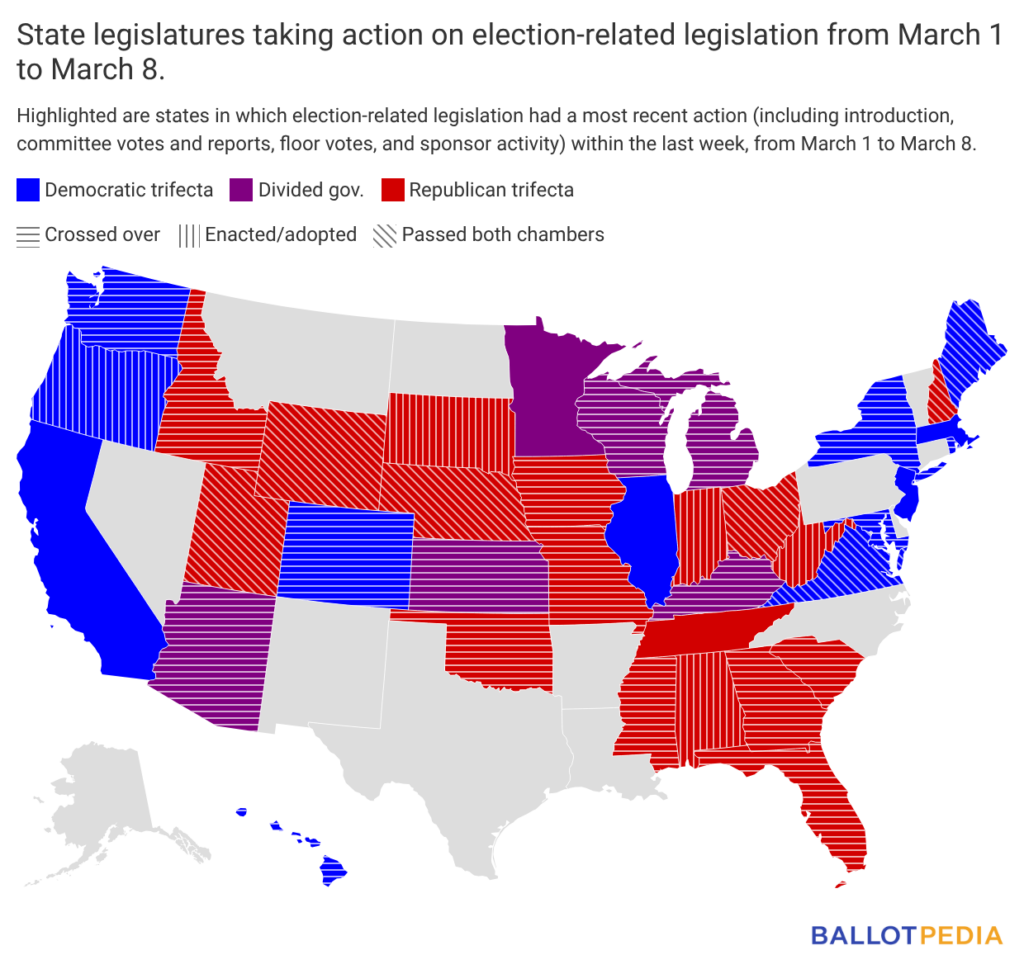
Lawmakers in 37 states acted on 460 election-related bills over the past week. Forty state legislatures are in regular or special sessions. In the last week, 16 bills were enacted, 37 bills passed both chambers of a state legislature, and no bills were vetoed.
Of the bills acted on this week, 141 (30.65%) are in states with Democratic trifectas, 259 (56.3%) are in states with Republican trifectas, and 60 (13.04%) are in states with divided government. The most active bill categories this week were campaign finance (141), election types and stages (99), and voter registration and list maintenance (87).
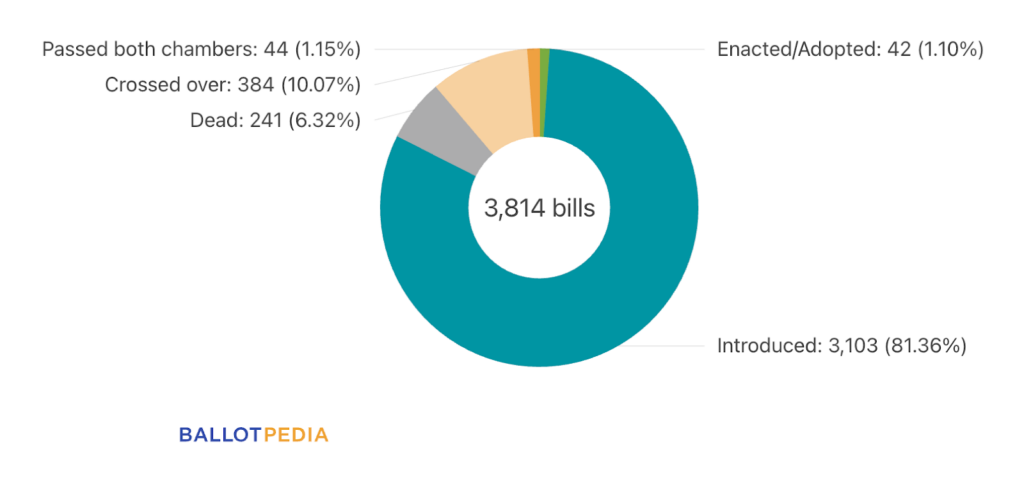
Ballotpedia is currently tracking 3,814 election-related bills across the country. We are actively processing bills filed since Feb. 24 as legislative activity increases for 2026.
The chart below breaks down the status of those 3,814 bills by where they stand in the legislative process:
Note: In some states, legislators can file hundreds of bills per day. We are actively reviewing those bills to determine their relevance to election administration. As a result, during this period of heightened legislative activity, the newsletter may not yet account for all relevant bills introduced in 2026.
Enacted bills
Sixteen bills were enacted this week. They are:
- Alabama (Republican trifecta)
- Indiana (Republican trifecta)
- Oregon (Democratic trifecta)
- South Dakota (Republican trifecta)
- West Virginia (Republican trifecta)
Bills passing both chambers
On March 4, the Ohio Senate concurred with the House amendments on SB 63, covered in last week’s Ballot Bulletin, sending the bill to Gov. Mike DeWine (R). The bill prohibits elections from being conducted in the state using ranked choice voting or instant runoff voting. It also requires the withholding of Local Government Fund distributions from municipalities that attempt to authorize the use of either of these voting methods.
On March 3 and March 4, respectively, the South Dakota House passed SB 17 and SB 175, sending both bills to Gov. Larry Rhoden (R). SB 17 prohibits candidates from accepting contributions from foreign nationals or loans from a state, state agency, political subdivision, foreign government, foreign national, federal agency, or the federal government. SB 175 requires individuals to provide proof of citizenship with an approved form of identification when registering to vote, such as a copy of a birth certificate, tribal ID, or passport. If SB 175 is signed, South Dakota would become the tenth state with a law requiring proof of citizenship when registering to vote in at least some cases.
Thirty-four other bills passed both chambers this week. They are:
- Maine (Democratic trifecta)
- Nebraska (Republican trifecta)
- Oregon (Democratic trifecta)
- South Dakota (Republican trifecta)
- Utah (Republican trifecta)
- Virginia (Democratic trifecta)
- Wyoming (Republican trifecta)
To see a full list of bills awaiting gubernatorial action, click here.
Vetoed bills
No election-related bills we are following were vetoed in the past week. For a list of all vetoed bills, click here.
All bills
The chart below shows all bills Ballotpedia is currently tracking, broken down by partisan sponsorship:
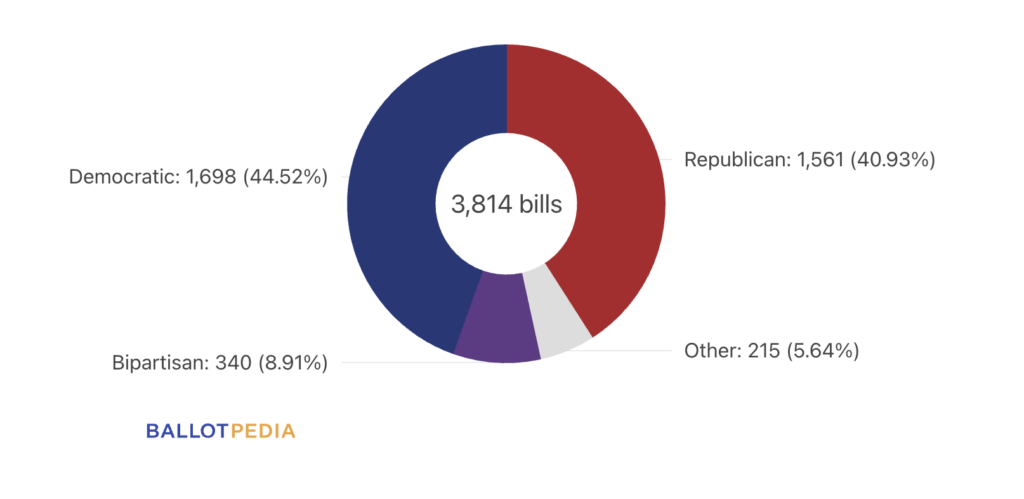
We are currently following 3,814 election-related bills, including bills carried over from the previous year.
- Trifecta status
- Democratic: 1,689 (44.28%)
- Republican: 1,374 (36.03%)
- Divided: 751 (19.69%)
- Partisan sponsorship
- Democratic: 1,698 (44.52%)
- Republican: 1,561 (40.93%)
- Bipartisan: 340 (8.91%)
- Other: 215 (5.64%)
In the news
On March 4 and March 5, respectively, the Utah Senate passed HB 209 and the Utah House concurred with the Senate version of the bill. If Gov. Spencer Cox (R) signs the bill, Utah voters would be required to provide documentary proof of U.S. citizenship in order to register to vote. HB 209 specifies that individuals who register to vote with a federal voter registration form may only cast a vote for federal elections, unless they provide documentary proof of U.S. citizenship.
Supporters of the legislation say that any number of noncitizens on the voting rolls merits legislative action. The bill’s sponsor, Rep. Cory Maloy (R), said, “This bill is about tightening safeguards and public confidence, not responding to widespread fraud. Even rare or inadvertent registrations undermine trust in elections.”
Critics of HB 209 say that it will create an administrative and financial burden for county election offices, and that there are not widespread patterns of non-citizen voters casting ballots. The ACLU stated, “When Kansas enacted a similar law, 31,000 eligible voters were prevented from voting, and the law was ultimately found to be an unconstitutional burden on voting rights.”
Here are other news stories from across the country:
- On March 6, Georgia SB 568 died in the state Senate on a 27-21-2 vote, with six senators absent. Among other provisions, the bill would have required the state to switch to exclusively using hand-marked paper ballots instead of electronic ballot markers. Proponents of the bill said that it would increase public confidence in election results, while critics said it would present logistical challenges around voting equipment that could not be resolved in time for the state’s November elections.
- On March 5, South Dakota Gov. Larry Rhoden (R) signed SB 30 into law. The bill adds citizenship status to the list of reasons a person may challenge another individual’s eligibility to vote. Challenges must be submitted no later than 90 days before a primary, runoff, special, or general election. Proponents say the bill is necessary to secure the integrity of the state’s elections, while critics have expressed concerns over allowing individuals to question the citizenship status of others.
- On March 5, HB 5533 was introduced in the Connecticut House. The bill would prohibit law enforcement presence, including ICE, from being within 250 feet of an elections site under all but exceptional circumstances. HB 5533 follows nationwide trends of states prohibiting federal law enforcement presence or activity on Election Day or requiring election official compliance with law enforcement personnel.
Policy spotlight: Thirty states weigh legislation on foreign funding in elections
The story below is adapted from a recent Ballotpedia News story by Andrew Bahl.
Lawmakers in 30 states are considering new state laws or constitutional amendments so far this year related to foreign funding in elections.
Federal law prohibits federal, state, and local candidates from soliciting, directing, or receiving contributions from individuals who are not citizens or permanent residents of the United States. The law also bans contributions from foreign governments, political parties, corporations, organizations, or groups whose principal place of business is in a foreign country.
Federal courts, however, have established that the ban does not apply to issue advocacy, such as lobbying or spending in ballot measure campaigns. The Federal Election Commission has affirmed that foreign individuals, corporations, and governments can contribute to ballot measure campaigns.
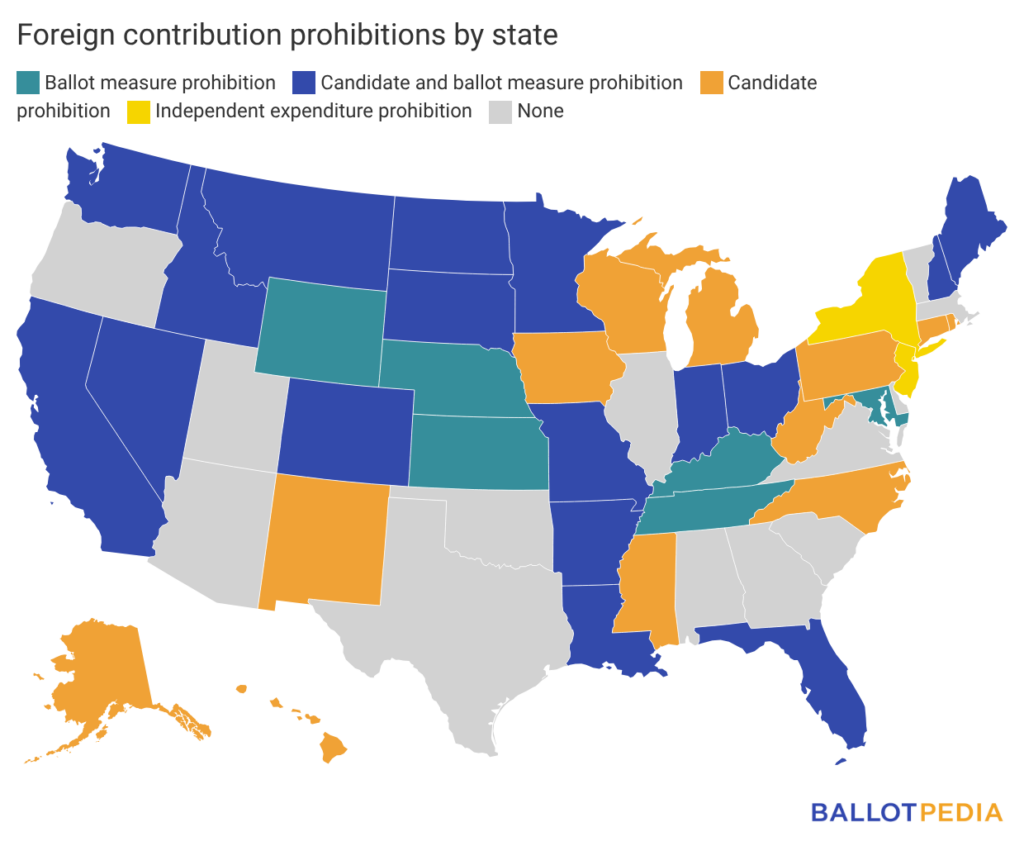
Beyond federal law, 37 states have enacted their own bans on foreign contributions in some types of elections:
- Twelve states have state-level prohibitions on foreign contributions to candidates.
- Six states prohibit contributions from foreign individuals and groups to ballot measure campaigns.
- Seventeen states prohibit foreign contributions to both candidate and ballot measure campaigns.
- Two states have prohibitions on foreign groups making independent expenditures.
So far this year, legislators in 30 states have introduced or carried over from the 2025 session 83 bills that create, modify, or repeal campaign finance regulations related to contributions from foreign individuals or entities.
Seventeen of those bills have passed at least one chamber of a state legislature. Lawmakers in Alabama, Florida, Georgia, Michigan, Mississippi (bill died in committee), and West Virginia have advanced legislation banning foreign contributions to ballot measure campaigns. In Arizona, Hawaii, New York, South Dakota, and Washington, lawmakers have advanced legislation banning at least some foreign entities from giving to both candidates and ballot measure campaigns.
In 2025, nine states enacted 12 bills related to foreign funding in elections. In 2024, Ohio enacted a law related to foreign funding in elections.
Read more about legislation addressing foreign funding in elections here.
Editor’s note: In last week’s Ballot Bulletin, we included an incorrect summary of TN SB 367 that reflected an earlier version of the bill. As enacted, the bill allows political parties to select nominees for the offices of judge, district attorney, or public defender to fill vacancies that occur after the nomination deadline and establishes certification requirements.