


Welcome to Hall Pass, a newsletter written to keep you plugged into the conversations driving school board governance, the politics surrounding it, and education policy.
In today’s edition, you’ll find:
- On the issues: The debate over technology in the classroom
- Your voice belongs in this research
- School board filing deadlines, election results, and recall certifications
- Here’s where K-12 public school teachers get paid parental leave—and where they don’t
- Extracurricular: education news from around the web
- Candidate Connection survey
Reply to this email to share reactions or story ideas!
On the issues: The debate over technology in the classroom
In this section, we curate reporting, analysis, and commentary on the issues school board members deliberate when they set out to offer the best education possible in their district. Missed an issue? Click here to see the previous education debates we’ve covered.
In 1983, the National Commission on Excellence in Education released A Nation At Risk: The Imperative for Educational Reform. The report, which spurred an interest in educational reform among lawmakers and academics, said that American students were falling behind their peers in other countries, and that the public education system was failing to prepare students for the workforce. Among the report’s many recommendations was a call for schools to teach students how to use and understand computers and other electronics for personal, academic, and professional purposes. The report touched off a debate about education technology — or edtech, as it is commonly abbreviated — that continues today.
State and federal education legislation since the release of A Nation At Risk has continued to emphasize the use of technology in the classroom. No Child Left Behind, which President George W. Bush (R) signed in 2001, called for students to be technologically literate by eighth grade and increased funding to districts to acquire new technology. President Barack Obama (D) signed the Every Student Succeeds Act (ESSA) in 2015, which similarly increased funding for educational technology and called for enhancing students’ digital literacy.
Since the 1980s, districts have invested billions in desktop computers, laptops, tablets, and other forms of technology aimed at enhancing teaching and learning. In 2024, K-12 public schools spent roughly $30 billion on edtech, an amount that is anticipated to double by 2033. Although the value of edtech for learning has long been debated, recent concerns about cellphones in classrooms has led to a renewed scrutiny of educational technology more broadly.
Today, we bring you two perspectives from teachers on whether edtech enhances or undermines students’ learning experience.
Kelli Cannon is a Digital Learning Specialist with the Jordan School District, in Utah, and a board member with the Utah Coalition for Educational Technology. She previously taught elementary school in the district. Cannon says that classrooms are a necessary space for students to learn how to use technology in a safe and responsible manner. Cannon argues that low-income students, in contrast to their peers from wealthier families, often lack access to technology at home, leaving classrooms as one of the few places they can learn how to use digital devices and navigate the internet. Cannon says technology also allows teachers in rural districts to personalize instruction for students in multiple grade levels, and gives refugee and immigrant students tools for bridging cultural and linguistic barriers.
Skyler Graham is a high school English and social studies teacher at a charter school in Brooklyn. Graham says that students have become overly reliant on technology, leading them to struggle with answering questions without reaching for a search engine. She says that constant access to technology keeps students from boredom, which hampers their imaginations, creativity, and problem-solving skills. She draws on her own experience as a member of Gen Z who, growing up, struggled with excess screen time, and says she works to draw a line in her classrooms between using technology for some assignments while leaving plenty of room for students to think and discuss without using digital devices.
As a parent and a teacher, I’ve seen how technology helps students. It’s time we stop villainizing it. | Kelli Cannon, Salt Lake Tribune
“Drawing on my experience as an elementary educator and a district Digital Learning Specialist, I believe this debate is about much more than screen time. It’s about equity. When we severely limit classroom technology, we don’t protect every child equally. We are intentionally widening the digital divide. Higher-income families can provide digital literacy at home. But for many Utah students, the classroom is often the only place they have access to a reliable device or high-speed internet.
“Serving as a board member of the Utah Coalition for Educational Technology has reinforced my belief that digital tools are essential for meeting the needs of a diverse student population. Even in 2026, Utah still relies on the one-room schoolhouse model in our most remote areas. For a single teacher managing students in grades K–6, technology is the only way to provide the personalized instruction these students deserve. Stripping these tools away tells lower-income and rural students that they don’t deserve the same head start as their peers.”
I’m a Gen Z teacher. Schools rely too much on Chromebooks. | Skyler Graham, Chalkbeat New York
“With a Chromebook by their side all day, they [students] will often Google answers to any and all questions, including those that ask for their thoughts and analyses. These days, it’s common to forgo memorizing your friends’ phone numbers and street addresses and, by the same logic, times tables and rudimentary spelling. Why memorize the product of 6 and 8, or the difference between “there” and “their,” or learn to read an analog clock when you can just look it up? And how can we expect our students to learn these foundational pieces of background knowledge without giving them an opportunity to struggle through the challenge of learning?
“When schoolwork and peers get boring or frustrating, they can fill their time (or avoid difficult conversations) by scrolling through Pinterest, Google Images, or surreptitiously perusing Snapchat. I don’t blame them — I’ve also developed the habit of filling unoccupied and stressful moments with aimless scrolling. But when we lose boredom, we lose space for creativity and reflection; when we escape our problems, we cannot learn to problem-solve.”
Your voice belongs in this research
Ballotpedia is conducting the first-ever national survey dedicated to the rural school board experience, and we want to hear from you. Whether you serve on a board, work alongside one, or follow local education closely, your perspective belongs in this research.
The survey takes about 10 minutes, and responses are confidential. Findings will be published here in Hall Pass.
School board update: filing deadlines, election results, and recall certifications
In 2026, Ballotpedia will cover elections for more than 30,000 school board seats. We’re expanding our coverage each year with our eye on covering the country’s more than 80,000 school board seats.

Click here to learn more about school board elections.
Here’s where K-12 public school teachers get paid parental leave—and where they don’t
According to the U.S. Department of Education’s National Center for Education Statistics (NCES), there were roughly four million full- and half-time K-12 public school teachers during the 2020-21 school year, the most recent year for which data are available. About 70% were under the age of 50. In other words, the vast majority are in the years of life when having and raising children is most common. Roughly 77% of public school teachers are women.
In a recent study, the National Council on Teacher Quality (NCTQ), a think tank that advocates for policies that improve teacher effectiveness, found that most teachers are not covered by paid family leave policies. Paid parental leave refers to state- or employer-provided policies that provide new parents with compensated time off from work.
Although the U.S. does not guarantee paid parental leave at the national level, several states have implemented their own policies for state workers, including teachers in some cases.
Here’s a look at where public school teachers do and do not have paid parental leave options.
According to the NCTQ, 15 states and D.C. require districts to provide teachers with paid parental leave. The length of time away from work and amount of compensation with which districts provide teachers when they have children varies between these states:
- In six states, teachers can receive partial pay for between 12 and 18 weeks.
- In nine states and D.C., teachers can receive full pay for between six and 12 weeks.
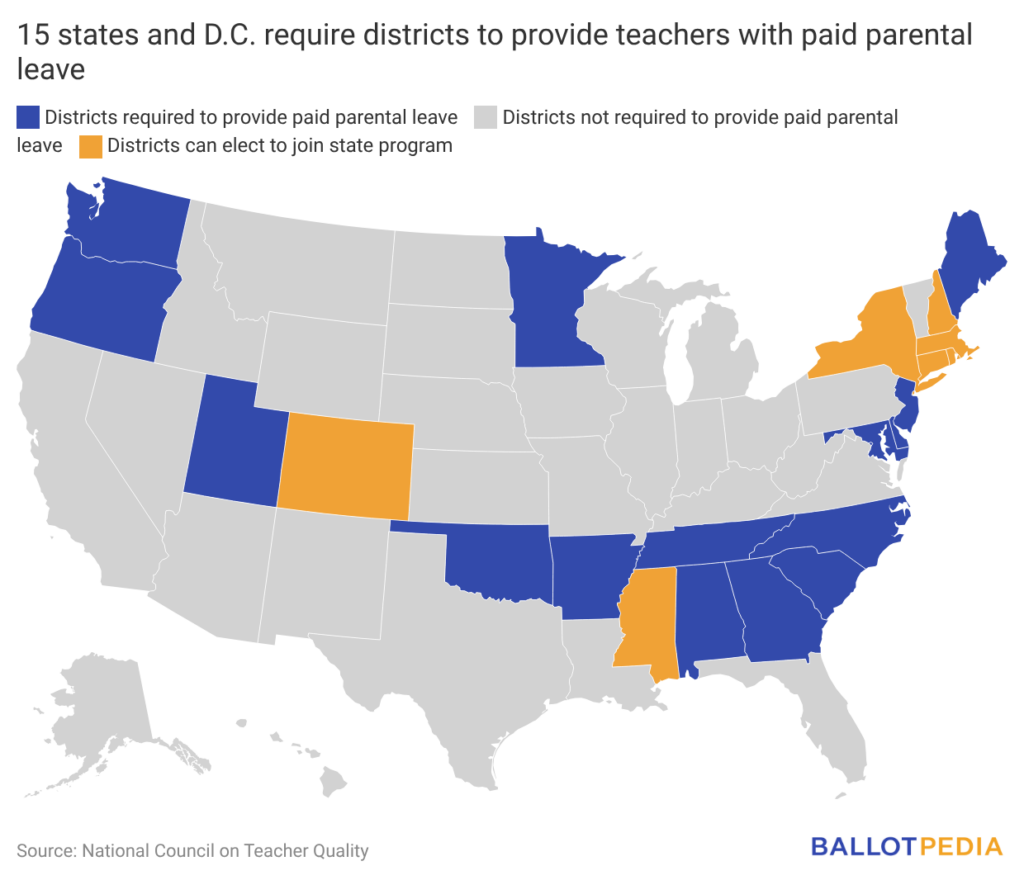
In addition to the 15 states and D.C. that require districts to provide paid parental leave, seven other states give districts the option of participating in an existing state leave program. The remaining 28 states don’t require that districts provide any sort of parental leave. Some districts choose to provide paid leave to teachers, even in states that don’t require it, though data suggest most don’t. A 2022 NCTQ survey of 148 of the largest districts in the country found that 18% reported providing teachers with paid parental leave.
According to NCTQ, states use several different methods for supporting parental leave for teachers, including fully reimbursing districts for substitute costs, fully reimbursing districts for salary costs, reimbursing teachers through a social insurance program, or requiring districts to shoulder the full costs.
The 15 states that require paid parental leave for teachers are split between Republican- and Democratic-led states. Overall, seven states have Republican trifectas, six have Democratic trifectas, and two have divided governments (both with Democratic governors and Republican-controlled legislatures).
However, of the nine states that provide teachers with full pay for the duration of the leave plan, seven have Republican trifectas, one has a Democratic trifecta, and one has a divided government.

Of the seven states in which districts have the option of participating in a statewide social insurance program, five have Democratic trifectas and two have Republican trifectas.
Delaware, with a Democratic trifecta, and Arkansas, with a Republican one, have the most expansive parental leave policies for teachers — 12 fully paid weeks off. In 2018, Delaware Gov. John Carney (D) signed HB 3, providing state employees, including teachers, with up to 12 weeks of paid parental leave. At the time Carney signed the bill, Delaware had a Democratic trifecta. The bill passed the Delaware House 27-13, mostly along partisan lines (while 13 Republicans opposed it, three Republicans joined with all Democrats in voting to advance the bill). HB 3 passed the Senate 16-4 with five Republicans joining all Democrats in supporting it.
Republicans in the Delaware Legislature said the bill was costly and would make it challenging for state agencies and school districts to find temporary replacements for employees on leave. State Rep. Ruth Briggs King (R) said, “We have many people in the state who would love to have 12 weeks. It’s hard to stand here and say we’re going to elevate state workers to this level, but the people footing the bill don’t have [the] same consideration.”
The bill’s sponsor, state Rep. Debra Heffernan (D), said: “The decision to return to work after welcoming a new child shouldn’t be rooted in fear of lost wages or failing to make ends meet. With this legislation state workers would not have to choose between a career and their families.”
Arkansas enacted its 12-week, fully-paid parental leave policy in 2025, when Gov. Sarah Huckabee Sanders (R) signed HB 1017. HB 1017 modified the LEARNS Act, an education omnibus bill enacted in 2023 that, among other things, established a voluntary, 12-week parental leave policy. Under that policy, the state would split the costs 50/50 with districts that elected to opt in — though few ultimately chose to do so. HB 1017 made it mandatory for districts to offer paid parental leave and made the state fully responsible for reimbursing districts for the costs of hiring substitutes to fill in for teachers on leave.
The bill passed the Arkansas State House 68-19 with the support of 49 Republicans and all 19 Democrats. Nineteen Republicans voted no. The bill passed the Senate 27-4 with the support of 21 Republicans and all Democrats. Four Republicans voted no.
Sanders said, “Our teachers shouldn't have to choose between their families and their classrooms, and in Arkansas, we're making sure they don't have to.” In its legislative report, the Conduit News, which says it is “Your #1 Source for Conservative Arkansas News and Politics,” said it opposed HB 1017, writing, “This bill would increase government spending by expanding paid maternity leave to 12-weeks off for women who have a child, adopt a child under one, or became a foster parent of a child under one. This would be for ANY school employee, not just education personnel, as is currently the standard.”
In both Delaware and Arkansas, the state fully reimburses districts for the costs of hiring substitutes to fill in for teachers on leave.
A 2024 RAND survey of teachers found that 32% reported having access to paid parental leave, a lower share than similar working adults. Rand defined “similar working adults” as “employed adults who are between the ages of 18 and 64, have at least a bachelor’s degree, and report working at least 35 hours per week.” About 46% of workers in that category reported having access to paid parental leave.
RAND is a nonpartisan think tank and research institute in Santa Monica, California.
For teachers in districts that don’t offer paid leave, options for taking time off after pregnancy or adoption include planning birth times over the summer, using accumulated sick time, or taking unpaid time off through the Family and Medical Leave Act (FMLA). FMLA, which President Bill Clinton (D) signed into law in 1993, provides eligible employees with up to 12 unpaid weeks for caring for a new child, health emergencies, and caring for family members with health conditions. However, the law only applies to workers who’ve been at their jobs for a year.
Arguments against mandated paid parental leave policies for teachers have often centered on the financial costs to districts, states, or both. California, with the second highest number of K-12 public school teachers in the country and no requirement that districts offer paid parental leave, provides a prominent example. In the last 10 years, several bills that would have given teachers at least six weeks of paid parental leave have either been vetoed or died in the California State Legislature:
- In 2017, then-Gov. Jerry Brown (D) vetoed AB 568, which would have required districts to pay for the six-week parental leave policies out of their own budgets. Brown said “I believe further decisions regarding leave policies for school employees are best resolved through the collective bargaining process at the local level.”
- In 2019, Gov. Gavin Newsom (D) vetoed similar bills that also placed the full cost of the leave policies on districts. Newsom said, “Providing every California worker with paid family leave is a noble goal and a priority for my administration. However, this bill will likely result in annual costs of tens of millions of dollars and should be considered as part of the annual budget process and as part of local collective bargaining.”
- In 2025, the California State Assembly voted 62-0 to advance AB 65 (with 17 absences), which would have required districts to provide up to 14 weeks of paid leave to teachers. Ten Republicans joined with 52 Democrats to approve the bill. However, the Senate never took up the bill before the legislative session ended.
Extracurricular: education news from around the web
This section contains links to recent education-related articles from around the internet. If you know of a story we should be reading, reply to this email to share it with us!
- Sherrill budget will propose record K–12 school funding as N.J. stares down $3B deficit | NJ.com
- Should Chicago school board members be paid? Legislators weigh compensation ahead of historic election | Chicago Tribune
- Listening to the Teachers Who Quit | American Enterprise Institute
- 'Dopamine Kids' explains why children crave screens and helps them enjoy life instead | NPR
- The Water Polo Scandal That Rocked LA’s Most Elite Private School | Vanity Fair
- Red states are taking control of school districts as Republicans decry poor test scores, student protests | Chalkbeat
- School Board Members’ Bill of Rights heads back to the House | WLRN
- Trump administration investigating New Richmond School District’s gender policy | Wisconsin Public Radio
Take our Candidate Connection survey to reach voters in your district

Today, we’re looking at survey responses from the two candidates in the June 23 primary to represent Precinct V on the Granite School District school board, in Utah. Four of the seven seats are up for election this year, and general elections are scheduled for Nov. 3.
Granite School District is Utah’s third largest district, with roughly 60,200 students. It is located in central Salt Lake County.
Brianda De Leon earned her Ph.D in education from the University of Texas at San Antonio, and her career experiences includes working in education and workforce development. Here’s how De Leon answered the question, “What areas of public policy are you personally passionate about?”

“I am personally passionate about public policies that strengthen public education, expand educational opportunity, and support student success from early learning through postsecondary and workforce pathways.
I am also interested in policies that promote transparent governance, community engagement in decision-making, and effective collaboration between schools, families, and local partners. My professional background has shaped a strong interest in the connection between education, workforce development, and long-term economic stability for students and families.”
Click here to read the rest of De Leon’s responses.

Aimee Warren earned a bachelor’s degree from Brigham Young University, Idaho, and her career experience includes working as a nonprofit professional. Here’s an excerpt from Warren’s answer to the question, “What are the main points you want voters to remember about your goals for your time in office?”
- “Building Community. I believe schools work best when families are welcomed and heard. I will encourage open communication, responsive leadership, and accessible opportunities for parents and guardians to participate. Every family should feel they have a seat at the table and a voice in their child’s education.
- Building Trust. I am committed to open communication, responsible decision-making, and listening carefully before voting. Families and community members deserve clear, honest information about school board decisions. I will always ask thoughtful questions and work to build trust between the district, schools, and families.
- Building Better Futures. Every child deserves the chance to learn, grow, and succeed. I believe strong academics start with supporting kids at every level — from early literacy, to helping students who need extra support, to providing real challenges for advanced learners. I will work to ensure classrooms have the tools, resources, and updated materials they need so every student can thrive. Every child — no matter where they live or what their background is — deserves the opportunity to succeed. I will support programs that expand access, remove barriers, and help students discover their strengths. From academics to extracurriculars, our district must ensure opportunity reaches every corner of our community.”
Click here to read the rest of Warren’s responses.
As a reminder, if you're a school board candidate or incumbent planning to run this year, click here to take the survey. If you complete the survey, your answers will appear in your Ballotpedia profile. Your responses will also appear in our sample ballot. If there is an election in your community, share the link with your candidates and urge them to take the survey!