


Welcome to the Monday, March 16, Brew.
By: Briana Ryan
Here’s what’s in store for you as you start your day:
- New Mexico enacts law prohibiting the deployment of troops to polling places
- South Dakota Legislature passes REINS-style bill
- Eight candidates are running in the Republican primary for lieutenant governor of Georgia on May 19
New Mexico enacts law prohibiting the deployment of troops to polling places
On March 9, New Mexico Gov. Michelle Lujan Grisham (D) signed legislation prohibiting a person from bringing or ordering military troops or armed federal agents to a polling place or ballot drop box location.
Federal law prohibits the deployment of troops or United States servicemembers to a polling place "unless such force be necessary to repel armed enemies of the United States."
New Mexico SB 264 creates state-level penalties for those who deploy troops or armed federal agents to a polling place or drop box site. It also prohibits a person from interfering with the conduct of an election or from interfering with an election official, voter, challenger, or watcher while they are discharging their duties.
In addition, the bill prohibits a person from attempting to impose a law, rule, or change to voter qualifications that goes against New Mexico law. And it allows the attorney general, secretary of state, a county clerk, or a voter who experienced intimidation or was not able to vote due to a disruption at a polling place to bring a civil action to enforce the law's provisions.
On Feb. 15, the state Senate passed SB 264 26-16, with all Democrats voting in favor and all Republicans against. On Feb. 17, the state House passed it 41-26, with 41 Democrats voting in favor, 26 Republicans voting against, and three members not voting.
New Mexico is one of eight states where lawmakers have introduced legislation on law enforcement presence at polling places.
Legislators in California, Kansas, Virginia, and Washington have introduced bills prohibiting the enforcement of immigration laws near polling places, vote-counting locations, or other election sites. Illinois lawmakers introduced a resolution urging federal agencies not to conduct immigration enforcement near polling places. California, Illinois, Virginia, and Washington have Democratic trifectas, while Kansas has a divided government.
Legislators in Connecticut, a Democratic trifecta, have introduced a bill prohibiting federal agents from being within 250 feet of an election site unless there are exigent circumstances, the officers give notice to the state and have a judicial order, or their presence is requested.
Democratic lawmakers in Georgia, a Republican trifecta, have introduced a bill that would prohibit the governor from deploying the National Guard with the intent of interfering with the right to vote.
Conversely, the Arizona Mirror reported in February that Arizona lawmakers were considering an amendment to SB 1570 that would have required counties to sign agreements to have federal immigration officers present at polling places or ballot drop-off locations. The amendment was not taken up.
Check out our Election Administration Legislation Tracker to track bills related to law enforcement at polling places, as well as other election-related topics.
South Dakota Legislature passes REINS-style bill
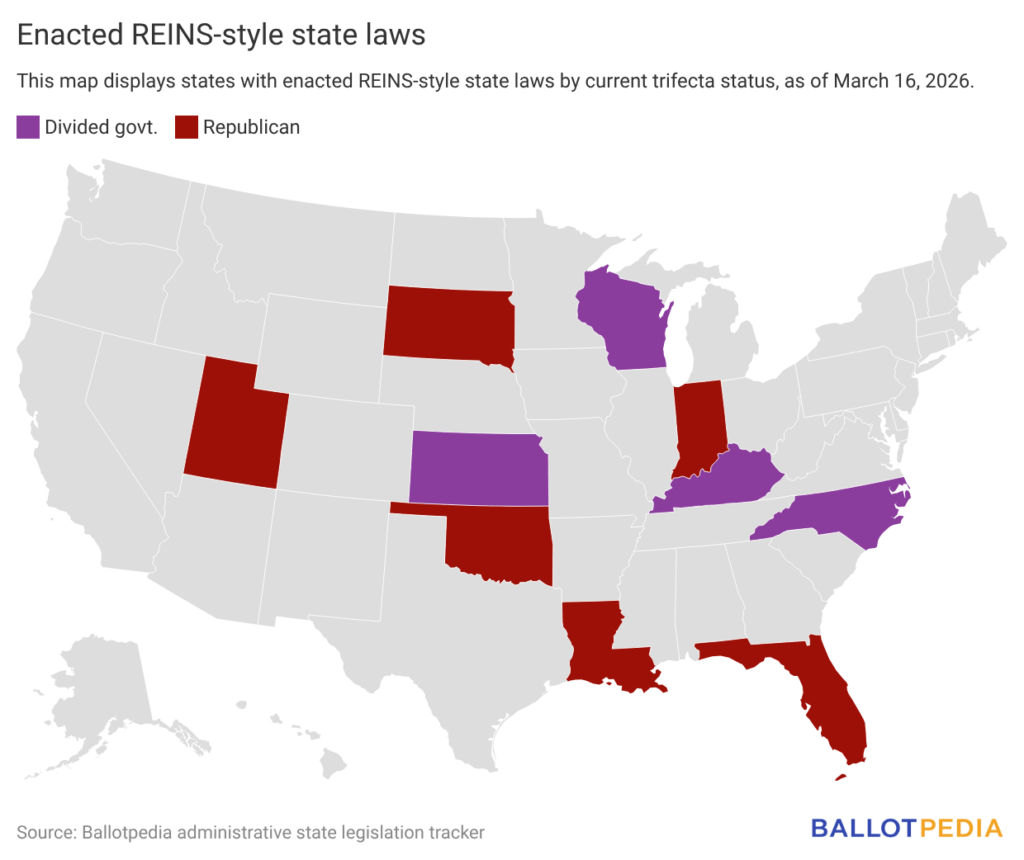
On March 12, South Dakota Gov. Larry Rhoden signed Senate Bill (SB) 133, legislation that adopts a REINS-style law and prohibits judicial deference to an agency's determination of whether a rule would be subject to the REINS-style law. South Dakota is now the 10th state with a REINS-style law, and at least the seventh state where the legislature has restricted judicial deference to agencies since the U.S. Supreme Court decided Loper Bright Enterprises v. Raimondo — holding that federal courts may not defer to an agency’s interpretation of an ambiguous statute — in 2024.
On Feb. 24, the South Dakota Senate passed the bill 33-0 with members absent. On March 3, the South Dakota House of Representatives passed it 66-1, with three absences. South Dakota has a Republican trifecta.
REINS-style laws
REINS-style state laws require legislative approval or review of proposed agency regulations with certain financial or economic impacts before they become effective. These laws differ in each state by the legislative entity required to review and approve regulations and by the economic threshold that triggers legislative involvement.
Six states with Republican trifectas have a REINS–style law, and four states with divided governments do.
Judicial deference
Judicial deference to an agency is the practice of a court deferring to an agency’s interpretation of a statute, regulations, or other determination. Perhaps the most well-known deference standard, Chevron deference compelled federal courts to defer to an agency's interpretation of an ambiguous statute before the U.S. Supreme Court struck down it at the federal level in June 2024. The South Dakota Senate passed a 2026 bill on Feb. 23 to broadly limit judicial deference, but it did not pass the House Judiciary Committee. SB 133 prohibits a narrower form of deference: it restricts courts from deferring to an agency's determination of whether a rule meets the definition of a "major rule," and is therefore subject to new REINS provisions. Agencies must make this determination during the rulemaking process as part of the regulatory impact analysis.
South Dakota’s REINS provisions
South Dakota Senate Bill 133 changes how the state handles major rules — defined as any regulation expected to cost businesses, individuals, local governments, or other non-government groups more than $3 million over two years. When an agency proposes a major rule, it must prepare a cost analysis for a legislative oversight committee (the IRRC). The IRRC then has three options: send the rule back to the agency to be revised so it no longer qualifies as major, confirm the agency has legal authority to issue the major rule, or recommend an up-or-down vote in the full legislature.
If anyone challenges whether a rule qualifies as major, courts must review that question without deferring to the agency's judgment.
Zooming out
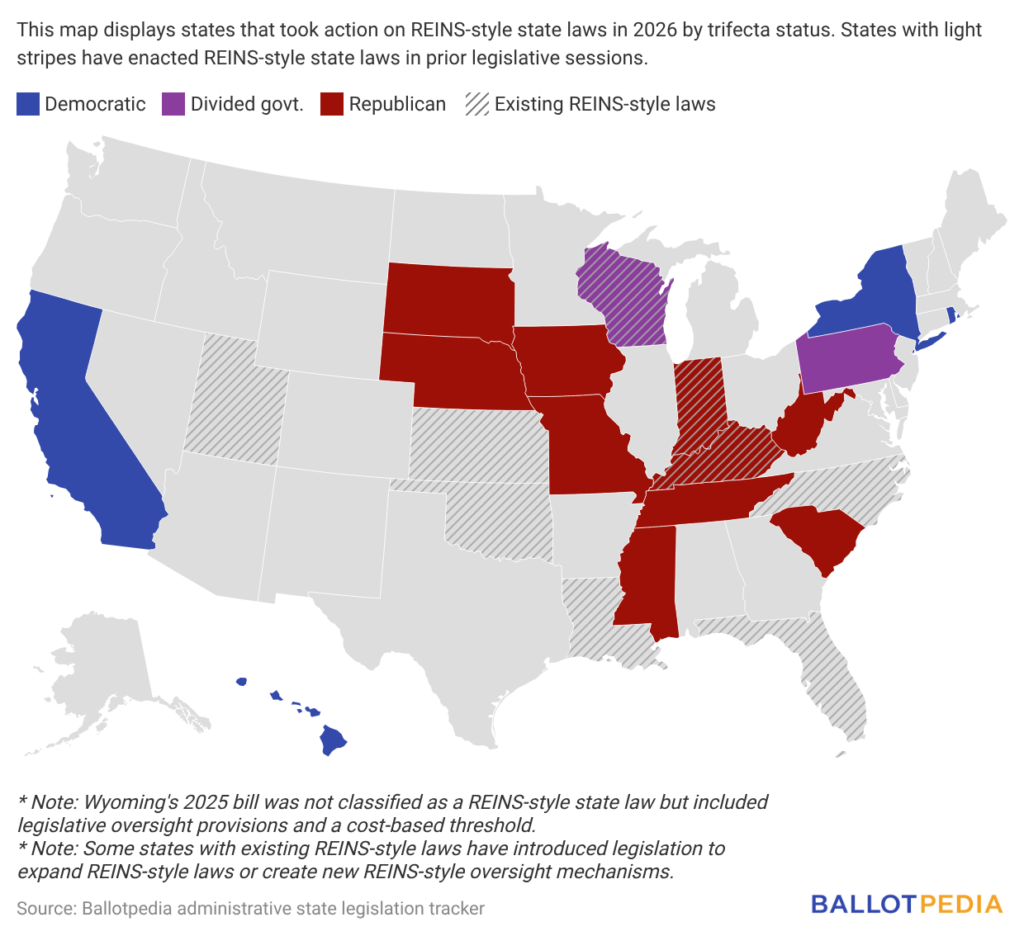
Fifteen states have taken action on 21 REINS-style bills in 2026. Two bills have become law, South Dakota’s SB 133, and Indiana’s Senate Bill 4. SB 4 changed Indiana’s existing REINS-style law, originally enacted in 2024, by decreasing the threshold that triggers legislative review from $1 million over a two-year period to $500,000 over the same time period.
Two bills — in Missouri and South Carolina — have passed one chamber. Of the 15 states that have taken action on REINS-style bill this year:
Click here to learn more about REINS-style state laws.
Eight candidates are running in the Republican primary for lieutenant governor of Georgia on May 19
Eight candidates are running in the Republican primary for lieutenant governor of Georgia on May 19. Greg Dolezal (R), Steve Gooch (R), John Kennedy (R), and Blake Tillery (R) lead in polling and media attention. Incumbent Lt. Gov. Burt Jones (R) is running for governor of Georgia rather than for another term as lieutenant governor.
While all four leading candidates are members of the Georgia Senate, they have taken different approaches with their campaigns.
Dolezal has represented Georgia Senate District 27 since 2019. He has also served as chief deputy majority whip since 2019. His campaign website states that he "stood with President [Donald] Trump when it mattered most" and "has authored some of the most conservative laws to pass the Georgia legislature." Dolezal was one of four state senators in 2020 who called for a special session to select a separate slate of presidential electors. At the time, Georgia Gov. Brian Kemp (R) said he would not call a special session.
Gooch has represented Georgia Senate District 51 since 2011. He was also majority leader from 2023 to 2025. Gooch's campaign website states that he "has been a consistent and vocal supporter of President Donald Trump ever since he came down the escalator in Trump Tower in 2015. It also states that if elected lieutenant governor he will "not only deliver real relief for our families by eliminating the state income tax, he will overhaul our property tax system to ensure our seniors and veterans are no longer taxed out of their homes by runaway local governments."
Kennedy represented Georgia Senate District 18 from 2015 to 2025. He was also president pro tempore from 2023 to 2025. The Georgia Recorder's Maya Homan wrote that "While other candidates for the seat emphasized their loyalty to President Donald Trump and MAGA policies, Kennedy took a different approach, focusing on his conservative values and work in the state legislature." According to Kennedy's campaign website his priorities include improving education, addressing public safety, and "continuing [Georgia’s] historic run of job creation and investment."
Tillery has represented Georgia Senate District 19 since 2017. He has also served as chair of the Appropriations Committee, which develops the state's budget, since 2020. Tillery said he is focusing his campaign on messages on issues "that seem to appeal to everyone": "We're talking about eliminating the state income tax. We're talking about making sure that Georgia immigration laws are followed, and that sanctuary cities don't exist. We're talking about making sure that state taxpayer dollars are not used to pay for transgender surgery."
David Clark (R), Brenda Nelson-Porter (R), Takosha Swan (R), and Jerry Timbs (R) are also running in the Republican primary.
In Georgia, a primary candidate must earn a majority of the vote to win. If no candidate wins a majority, there will be a runoff election between the top two vote-getters on June 16.
Click here for more information about this primary election.